
By Ron Anderson, Chief Innovation & Technology Officer, Edmonton Police Service
Canada’s transit systems are the lifelines of our major cities—moving millions of people every day through complex urban spaces. But across the country, a troubling trend has been unfolding: violence and disorder on transit have been climbing for years. Statistics Canada data shows that assaults on transit doubled in most of Canada’s largest metropolitan areas between 2016 and 2024, and Edmonton continues to experience high incident rates despite recent improvements.
Addressing these challenges requires more than traditional approaches to policing. It requires rethinking how we understand, navigate and respond within the built environment—especially in the parts of our transit systems where conventional tools simply don’t work.
That’s why the Edmonton Police Service (EPS), in partnership with Esri Canada, initiated a pilot project to develop the Edmonton Transit Enhanced Community Safety System (ETECS), a next‑generation solution powered by geographic information system (GIS) technology. Backed by a $1.3‑million federal grant through the Canadian Safety and Security Program, ETECS represents a transformative shift in how law enforcement can operate in complicated indoor and underground spaces.
Seeing what was once invisible
Transit hubs, particularly underground stations, present a unique operational blind spot. Traditional GPS technology weakens or fails completely below ground, leaving officers without precise location awareness at the very moments when fast, coordinated action is essential.
GIS changes that.
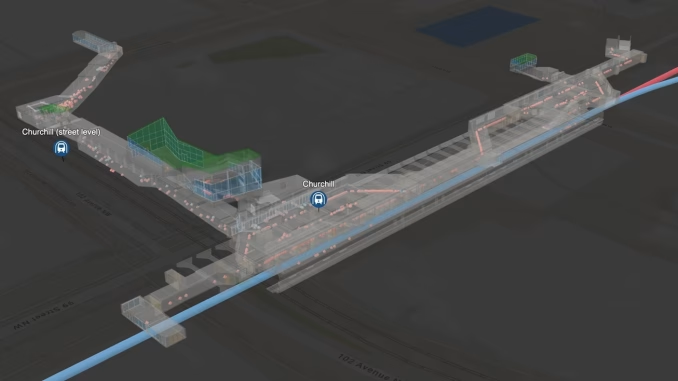
At the core of ETECS is a digital twin of Churchill LRT Station—a detailed virtual 3D model that allows officers to virtually walk through tunnels, pedways and platforms before ever stepping inside the station. Using the indoor mapping and positioning capabilities in Esri’s ArcGIS platform, officers can track their own movements and those of their colleagues in real time, even where GPS signal is unavailable. Dynamic dashboards integrate live video feeds, indoor positioning and sensor data to give command teams an immediate operational picture: who is where, what is happening and how the situation is evolving second by second.
For a police service, this level of situational awareness is revolutionary.
From reactive to proactive policing
The power of GIS is not limited to real‑time response. It allows us to analyze patterns and hotspots over time, helping to shape more effective and equitable strategies for keeping transit spaces safe. Indoor mapping reveals not just where incidents occur, but how people move through environments. These insights can guide everything from officer deployment to future station design.
As Joann Fox, director of public safety at Esri Canada, has noted: “knowing precisely what’s happening and where officers are located at any given point in time—above ground and underground—makes a huge difference in public safety.” GIS gives police services the ability to visualize and interpret complex data streams in real time with a clarity that was not possible a decade ago, enabling evidence‑based decisions that directly improve community outcomes.
A national blueprint for safer transit
While ETECS began as a made‑in‑Edmonton innovation, its implications reach far beyond one city. The system is scalable, adaptable and designed to serve as a national model for safe, modern transit systems. Communities across Canada face similar challenges: aging infrastructure, increased ridership and growing expectations for safety and transparency. As CBC reporting underscored, transit safety has become a pressing national concern; and cities everywhere are searching for solutions that balance efficiency, equity and public trust.
With ETECS, we now have a blueprint.
This pilot project demonstrates how advanced spatial tools, such as mapping, indoor positioning, real‑time analytics and digital twins, can work together to overcome operational gaps that have long hindered transit policing. From better incident response to smarter resource allocation, GIS enables a shift from reactive enforcement to proactive community safety. As municipalities look to modernize, ETECS serves as a proven model that can be replicated in underground stations, pedways, malls, stadiums and other complex public environments across Canada.
Every day, our officers work to keep the public safe in environments that are becoming more connected, more data‑rich and more intricate. ETECS shows what becomes possible when we integrate geography—the one constant in every incident—into our decision making.


Be the first to comment