
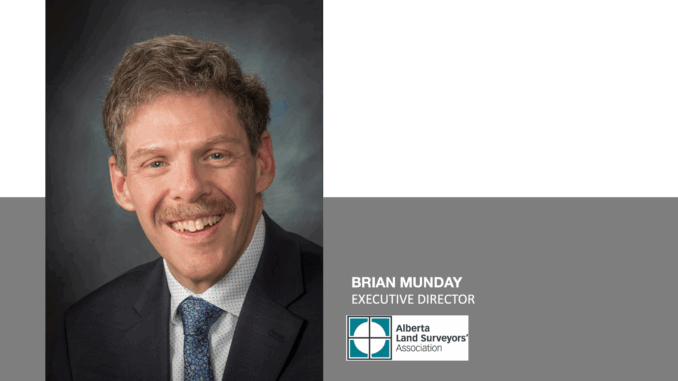
Alberta is undergoing one of the most significant reforms to professional regulation in decades — and land surveying is right at the center of it. With the introduction of Bill 40: The Professional Governance Act, the province is replacing nine pieces of legislation, including the Land Surveyors Act, with a unified framework that will reshape how more than 20 non-health professions are governed. For the Alberta Land Surveyors’ Association (ALSA), this is both a moment of modernization and a major cultural shift — one that affects everything from ethics and registration to the way future land surveyors will enter the profession.
In this exclusive interview, Brian Munday, Executive Director of ALSA, shares his insights on what Bill 40 means for the profession, why Alberta is phasing out articling after more than a century, and how a new competency-based model could shape the next generation of surveyors. He also weighs in on the federal Bill C-5 labour mobility legislation, national harmonization efforts, education funding challenges, and the strategic role land surveyors play in Canada’s infrastructure ambitions.
Brian will be joining us this fall at GoGeomatics Expo 2025 in Calgary, where he will speak as part of our national conversations on professional standards, workforce renewal, and regulatory reform.
What prompted the move to Bill 40, and how is ALSA preparing for implementation?
The Government of Alberta originally introduced the Professional Governance Act (as Bill 23) back in 2022, but it got caught up in the provincial politics that were taking place at the time and never got to third reading.
It was reintroduced this spring. The government says that the purpose of the Professional Governance Act is to modernize and streamline the governance of professional regulatory organizations (such as the Alberta Land Surveyors’ Association).
It consolidates nine separate acts into a single unified framework to simplify and standardize governance across twenty non-health professional organizations.
The Alberta Land Surveyors’ Association has been preparing for this new legislation, which will replace our Land Surveyors Act since the original Bill 23 was introduced. This has meant updating bylaws, governance procedures, re-tooling the entire ALSA website and looking into every document and process that we currently have.
How will Bill 40 change ALSA’s governance or relationship with the provincial government?
We always knew the role of the Alberta Land Surveyors’ Association has been to protect the public interest but it was never in legislation. Now it will be.
More specifically, the Alberta Land Surveyors’ Association must:
- Establish competence and other requirements for the registration of registrants,
- Make, maintain and enforce a code of ethics and conduct and practice standards and guidelines for registrants,
- Safeguard against the unlawful use of any restricted title, the unlawful practice of any restricted activity or the unlawful provision of services within an exclusive scope of practice,
- Exercise its powers, discharge its duties and carry out its functions in a manner that protects the public interest.
What do you see as the biggest opportunity — and the biggest risk — in this new regulatory framework?
The Land Surveyors Act, in its current form, has been around since 1982. It is great that we are finally able to get our governing legislation modernized and reflect today’s standards and expectations for being a professional regulatory organization.
Having said that, when you’ve been doing something for forty years or more, it will take a little time getting used to new terminology and new processes.
Why phase out articling now, after more than a century?
Articling in the land surveying profession was created more than 100 years ago at a time when the mentoring land surveyor would be in the field all day and every day for the entire season with their pupil. That hasn’t happened for a long time now.
Today, we have situations where the mentoring land surveyor is usually in the office and the pupil is in the field. The pupil might send in their notes and records digitally but they are not having the same sort of conversations and discussions and learning opportunities as if they were together in the field all the time.
Many land surveyors are so busy trying to review plans, deal with clients and run a business that the mentorship side of things falls lower down on the priority list.
What new model is ALSA developing for registration — and how will it be more responsive to today’s workforce needs?
The new model, which still has details to be worked out, is based on a competency model. We have identified six key competencies that land surveyors will be expected to have on Day One.
The student will be required to take structured courses over a maximum of four years that cover each of these competencies.
One of the key things to understand about these competencies is the emphasis we are placing on ethics and professional communication. In the past, a great deal of effort has been put into making sure the student knows the art and science of land surveying – but when we look at the discipline complaints we receive, it is almost always about ethics and professional communication rather than how the boundary was established or re-established.
The students will still be required to gain some experience working for a land surveyor. The final step is going to be a professional practice exam where we will examine their overall understanding of what it means to be a professional land surveyor.

Do you worry about consistency or quality in the absence of the traditional articling process?
This new process will create more consistency and quality. Rather than relying on the traditional articling approach, where we hope the student sees a variety of situations and we hope that the mentor teaches them something about ethics and communication, these new competency courses will reinforce what we, as the professional regulator, are expecting today’s students to know and understand.
Do you see alignment or friction between Alberta’s Bill 40 and the federal push for labour mobility under Bill C-5?
The important thing to understand is that Bill 40 (The Professional Governance Act) has a different purpose from Bill C-5. The Professional Governance Act is intended to bring together twenty non-health professional regulatory organizations under one common regulatory model.
Alberta already has a Labour Mobility Act and the government is trying to make sure that the Professional Governance Act and Alberta’s Labour Mobility Act and Alberta’s Fair Registration Practices Act all work together and not at cross-purposes from each other.
Could ALSA’s model become a blueprint for national harmonization — or does it introduce more complexity?
I have been involved in discussions on labour mobility for land surveyors for the last 25 years. The fundamental basis for having a labour mobility agreement for land surveyors is the level of trust that all of us have in protecting the public interest.
While Newfoundland might have a different registry system and Ontario might have a different registration process and exams, each of us have a high degree of trust in the other that we are trying to achieve the same goal.
Other jurisdictions may very well look at our new model for registration of new land surveyors and decide to adopt all or part of it. If they do, they will make their tweaks to it to make it work for them – and then we will look at what they are doing and see if we can incorporate that into our system and improve upon it. It gives everyone the opportunity for constant improvement and growth.
What would it take to modernize and align surveying standards across provinces while respecting regional autonomy?
If we are talking about survey standards, such as how to subdivide land or what needs to be shown on a real property report, I don’t think we will ever get to a point where those standards are consistent from coast to coast to coast. The history of the survey systems is just too different across the country, and you would need buy-in from governments (in multiple ministries across each government, as well as, in many cases, municipal governments) to make that happen.
However, if we were to discuss surveying standards in relation to being a professional regulatory organization, I believe there are some positive signs on the horizon. The regulatory land surveying associations across Canada have just started discussions on harmonizing mandatory continuing professional development requirements across Canada. That is, if one province requires a land surveyor to have 30 hours of continuing professional development over three years, the next province over shouldn’t mandate 60 hours over the same period.
As I say, we have just started these discussions, and depending on how they go, it may lead us to look at other areas where we can harmonize requirements.
What are the deeper causes behind Canada’s declining surveying graduate numbers?
If you look at the demographics across Canada, every industry in every sector is struggling with declining numbers. Land surveying is not alone in that concern.
I believe that our new competency courses will provide a clear and direct path for students who graduate from geomatics programs about how they can become professional land surveyors.
RELATED READ: Canada’s Surveying Workforce Crisis: SAIT’s Carina Butterworth on Fixing the Pipeline
There’s growing concern across the sector that government funding models for education don’t reflect the actual demand for surveyors. Do you see this disconnect in Alberta as well — and how is it affecting program sustainability and workforce readiness?
We have to recognize that it is much easier for post-secondary educational institutions to teach students in programs where they don’t require a great deal of infrastructure or there is a high level of enrolment. Surveying or geomatics suffers from being a small program and requiring a high degree of infrastructure (such as labs and specialized equipment and software).
That is a systemic challenge all across Canada. The professional regulatory land surveying organizations across Canada can’t fund programs directly because our mandate is to protect the public interest and our role is very specific.
We are hopeful that our new competency courses for people who are interested in land surveying will create a closer tie-in with educational institutions and that will help offset some of these concerns that relate to government funding.
Are there enough viable entry points for early-career professionals today? What barriers are you most concerned about?
In reviewing the history of the Alberta Land Surveyors’ Association, there were many knowledgeable, capable, and eminent land surveyors who spent more than twenty years throughout the 1960s and 1970s trying to find a way to establish a university program for land surveying. It was felt that a university degree being a prerequisite for entry into the profession would put land surveying on the same plane as engineering, medicine, and other professions that required a university degree. I’m not sure that is the same today.
Many land surveyors had traditionally grown up in rural communities across Canada, and I wonder how many of them are willing to move to the city, or could afford to move to the city to go to school.
When we talk about entry points, I believe we need to take a closer look at both of these issues.
How can we raise awareness of surveying as a modern, essential infrastructure career?
As a professional regulatory organization, it is not necessarily the Alberta Land Surveyors’ Association’s role to raise awareness of land surveying as a career. It is our role, however, to make sure the public is served by having the right number of land surveyors (including support staff) when the demand is there.
All of us have traditionally focused on activities like career presentations in high schools or career fairs or student scholarships, but if we want to be effective with the limited resources all of us have, we need to move beyond the traditions and do a serious examination of where our finite tools can have an almost infinite impact.
Is the government recognizing the strategic importance of land surveying — especially amid major infrastructure investments — and could workforce shortages threaten Alberta’s ability to deliver?
The land survey system in Canada (and particularly in Alberta) is so good and so sound that it is often taken for granted. We are a victim of our own success.
It could become a bottleneck, but when the Alberta economy has boomed (as it did in the 1950s, 1970s and early 2000s) there has always been an influx of young people wanting to become land surveyors and other land surveyors wanting to move to Alberta. Of course, the reverse has also been true during the bust times.
Jobs and opportunities will always have a far bigger impact than any career presentation.
What message would you share with federal or provincial policymakers about the future of surveying in Canada?
For more than 115 years, the Alberta Land Surveyors’ Association has been regulating the profession and giving the public and industry certainty in their property rights.
Land surveyors and the Alberta Land Surveyors’ Association’s guidance and oversight of the profession underpins economic activity and growth in so many sectors, like construction, in the energy industry, and within municipalities. Our impact reaches every corner of Alberta.



Be the first to comment