
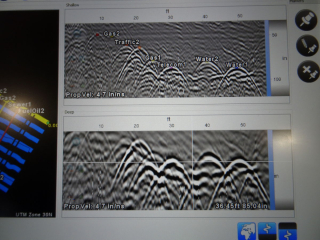
The major inhibitor to broader use of ground penetrating radar for detecting the location of underground utilities is the difficulty in interpreting radar scans. The Technology Report Technology Advancements and Gaps in Underground Safety published by the Common Ground Alliance in 2018 identified “User-friendly GPR system to deploy for helping construction crews avoid utilities” as an important gap. In September 2019 at Intergeo Leica Geosystems released the DSX ground penetrating radar system that is the first to address this gap in a compact, portable system. The DSX system includes analytic software DXplore enabling GPR to be used productively without a trained geotechnics specialist by utility repair and maintenance, civil engineering and surveying companies.
Before the DSX, non-geotechnical professionals including surveyors found it a challenge to interpret GPR scans consisting of images with hyperbolas showing the reflections of RF waves from underground objects. GPR remained the preserve of highly trained geotechnical and other underground engineering professionals.
As I discovered at a recent talk I gave to the Alberta Land Surveyors Association, there is a lot interest among the surveying community to expand their professional offerings beyond the traditional above ground survey to include below ground surveys. Two years ago the one-button BLK360 opened up engineering grade laser scanning to a much broader professional audience. Leica Geosystems is betting that with a similar focus on simplicity the DSX device and DXplore software is going to open GPR scanning to a much broader professional community, including civil engineering and surveying companies.
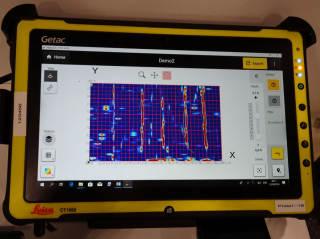
The key feature of the DSX GPR device and DXplore software is analytics to interpret the GPR scans and visualize underground infrastructure in the form of tomographic images, rather than radar hyperbolas.
For accurate locating the DSX supports seamless integration of positioning sensors (GNSS antennas) and is the first device to be integrated into machine control workflow through avoidance zones based on an underground utility map generated by the DSX.
The DSX workflow is very simple: import available as-builts in the area as DXF or other CAD format files into DXplore. If possible, walk the site to perform a visual inspection using an electromagnetic locator (EML) to search for power cables and conductive utilities and mark them on the ground. Define a grid for the area to be surveyed. Walk the grid with the DSX device linked with Leica GPS/GNSS antennas with real-time feedback on the DSX’s display. Create a georeferenced 3D map using the tomographic display (no hyperbolas !) of what was detected to manually identify suspected utilities on the display. The software then processes the captured GPR images to confirm the utility pipe or cable. You can then export a 2D or 3D vector file in a CAD compatible file format. Very simple.
But too simple for experienced GPR practitioners. I have talked to very experienced GPR people who don’t find the DSX interesting for them. As GPR experts they are trained to work with B-scan/radargram data representation and interpretation, thus expert systems such as Leica DS2000 or IDS GeoRadar Stream are more suitable.
But for people who don’t have GPR experience, believe that underground surveying represents a significant business opportunity, and already use or know Leica Geosystems total stations or other survey equipment this is being seen as a way to get their toes in the water. Furthermore I fully expect that Leica will not stop here but will continue to develop easy to use GPR software for detecting and mapping underground infrastructure including support for the multi-channel Leica IDS Georadar arrays that are being applied to very sophisticated mapping of underground infrastructure.

Be the first to comment