
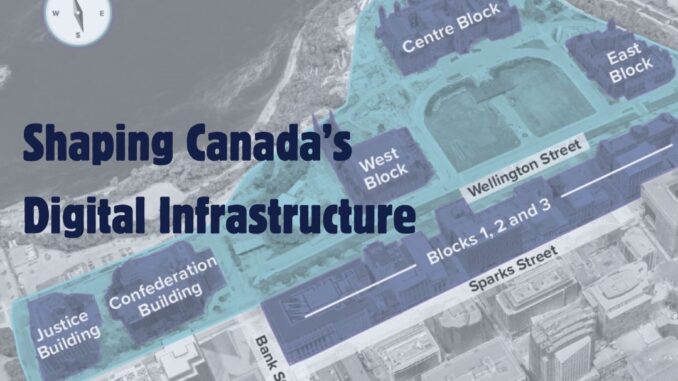
In an interview at GeoIgnite 2025, two of Canada’s most influential voices in digital infrastructure innovation — Dr. Stephen Fai, Director of the Centre for Advanced Studies in Architecture (CIMS) at Carleton University, and Laura Chow, Associate Director and co-lead of the Centre’s Digital Twin project — shared their perspectives on the future of data-driven infrastructure. Their work on the Parliament Hill rehabilitation has become a national model for how Building Information Modeling (BIM), Geographic Information Systems (GIS), and Digital Twins can come together to modernize public infrastructure.
Our conversation explored the challenges and promises of BIM-GIS integration, the evolving role of digital standards, and Canada’s readiness for a data-driven transformation of infrastructure. Below is a curated version of our exchange, with contextual reflections leading into each key question.
Understanding the BIM-GIS Divide
In my own experience working at the intersection of GIS and construction technology, one persistent challenge has been achieving seamless integration between spatial and engineering data. With many federal infrastructure projects relying on both, it felt natural to open the conversation with a question about this ongoing tension.
What are the current challenges in aligning BIM and GIS models, especially in large-scale federal projects?
Dr. Stephen Fai: The real challenge now is not visualization — that’s largely resolved. It’s the schema and information standards. How do BIM and GIS speak to each other? That’s still an ongoing issue. I don’t think we’ll ever reach perfect harmony. There will always be a need for some kind of translation between standards.

Canada’s Readiness for National Standards
Given the increasing momentum around OpenBIM and ISO compliance, I was curious to know how Canada stacks up in aligning provincial and federal practices. The goal was to understand whether our public infrastructure is benefiting from a cohesive digital vision or if fragmentation still reigns.
Do you believe Canada is well-positioned to adopt and implement these standards across the federal and provincial levels?
Dr. Fai: I’m more optimistic than ever. There are active conversations among government departments, and industry is also pushing forward. Every major company seems to be offering a digital twin platform, so the ecosystem is vibrant and collaborative.
The Role of ISO 19650 and IFC
As someone who’s worked with data governance and digital asset management, I know how essential consistent data standards are. I wanted to drill into how standards like ISO 19650 and IFC are shaping workflows between engineers, GIS professionals, and project owners.
How critical are standards like IFC and ISO 19650 in achieving long-term interoperability between engineering and geospatial disciplines?
Laura Chow: ISO 19650 is critical. It helps establish clear information requirements so that teams are aligned from the beginning. You can work backward from your digital twin goals to identify the information you need at every stage. Setting this up early ensures the project isn’t missing key data later on.
Digital Twins in Operational Infrastructure
The concept of digital twins often gets hyped as a futuristic ideal, but I was interested in how it applies to real-world asset management especially in historic or operational environments. I specifically asked about Parliament Hill to ground the discussion in a known project.
How do you see the role of Digital Twins in managing historical and operational infrastructure, like the Parliament Hill rehabilitation project?
Laura Chow: Right now, data is fragmented across different groups. Digital Twins help federate that data, not just for design and construction, but also for asset management and operations. They allow decision-makers to manage assets at a global or campus scale, which is especially useful for large owners like the federal government.
From Pilot to Policy: BIM’s Broader Impact
CIMS’ work on Parliament Hill is often cited in Canadian digital infrastructure circles. I wanted to better understand its downstream impact whether it led to changes in departmental thinking, policy evolution, or broader adoption of BIM practices in the public sector.
What impact has the Parliament Hill Digital Twin project had on policy, maintenance, and public engagement?
Dr. Fai: It’s had a large impact. Before this, Public Works wasn’t actively using BIM. Our work on the West Block served as a successful demo, which encouraged early adoption for the Centre Block and later the East Block and Library of Parliament. Now there’s a broader interdepartmental conversation about standardizing BIM and integrating it into digital twin frameworks.
Is Innovation Welcome in Government?
Innovation in the public sector can be a double-edged sword. While the appetite exists, legacy systems and procurement rules often slow progress. I wanted their insider view on whether federal partners are truly enabling experimentation.
What opportunities and limitations have you observed when collaborating with federal departments? Is innovation being embraced?
Dr. Fai: Absolutely. The federal government has been very receptive. From VR and digitally assisted fabrication to public outreach using 3D modeling and robotic carving, there’s been a genuine appetite for innovation. They’ve encouraged pushing boundaries.
Community and Collaboration at GeoIgnite
Finally, I wanted to step back from the technical and reflect on the community we’re part of. GeoIgnite brings together public, private, and academic leaders and I was curious how the panelists were experiencing the energy and focus of this year’s event.
How did you find the sessions and overall experience at GeoIgnite this year?
Laura Chow: Very inspiring. Especially this morning’s talk — it emphasized how collaboration is one of our strengths in Canada. It’s been great to see everyone coming together.
Final Thoughts
Throughout our conversation, one message was clear: while interoperability remains a challenge, collaboration is gaining ground. With projects like Parliament Hill setting the precedent and academic-government partnerships expanding, Canada’s digital infrastructure future looks promising, especially when built on shared standards, shared goals, and shared data.




Be the first to comment