
More than six decades ago, a small grapefruit-sized satellite silently soared into space — never to return. Launched in 1958, Vanguard 1 became the fourth artificial satellite in history and the oldest man-made object still orbiting Earth. Now, in an ambitious and symbolic mission, engineers are planning to bring this vintage spacecraft home.
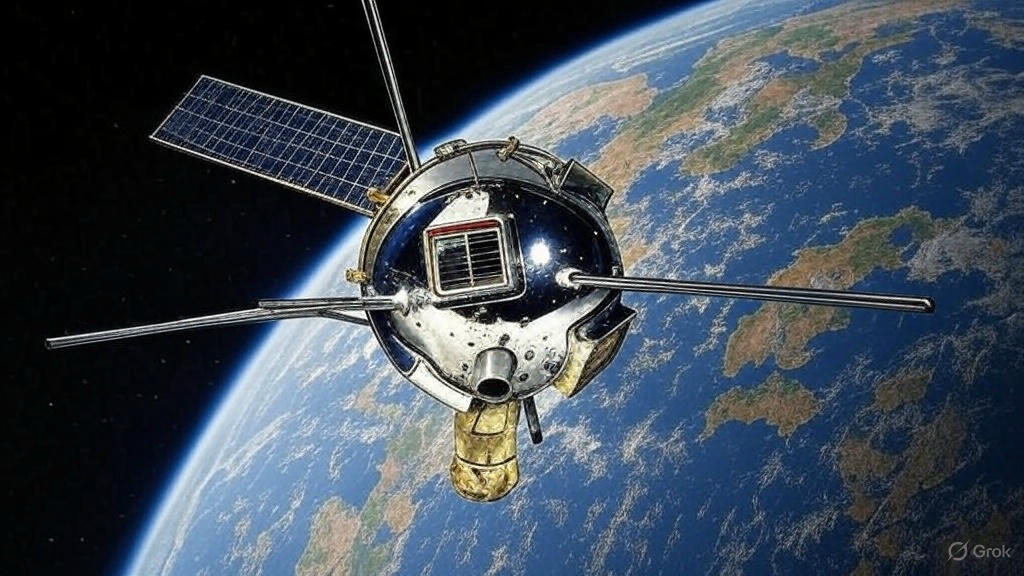
A time capsule from the Dawn of space exploration
Originally designed by the U.S. Naval Research Laboratory, Vanguard 1 was a scientific trailblazer. It tested launch systems and explored the behavior of spacecraft in Earth’s upper atmosphere. Unlike its early peers that quickly succumbed to atmospheric drag and burnt up, Vanguard 1 remained in orbit due to its highly elliptical trajectory. Though it stopped transmitting data in 1964, the satellite has silently circled Earth for 67 years — a testament to early space engineering.
With no power left and no means of communication, Vanguard 1 has become a time capsule — preserving the scars and secrets of its long journey through space.
The plan: precision recovery
Engineers at Booz Allen Hamilton, a technology consulting firm, have put forward a proposal to recover this historic artifact. The mission would involve sending a specialized spacecraft to rendezvous with Vanguard 1, inspect its condition, and then gently nudge it into a lower orbit where it can be captured and safely returned to Earth.
Several technologies are being considered, including the use of SpaceX platforms or even the International Space Station as part of the recovery process. However, due to the satellite’s fragile structure and the precision required to intercept such a small, passive object, the operation is being likened to a “jewelry” mission – one requiring meticulous care and surgical accuracy.

Why bring it back?
If successful, this mission could unlock a treasure trove of scientific and historical insights. Here’s what researchers hope to learn:
- Material resilience: How did the spacecraft’s surface withstand decades of exposure to micrometeorites, radiation, and extreme temperature swings?
- Electronics durability: Can any internal components, such as wiring or shielding, still be analyzed after nearly 70 years in space?
- Technology validation: The recovery effort could test and refine future space cleanup, repair, and satellite servicing missions.
Beyond science, Vanguard 1’s return would be deeply symbolic – a relic of the early space age that could find a new home in the Smithsonian Institution, reminding generations of the bold steps humanity took toward the stars.
A path for future missions
Despite the scientific enthusiasm, the proposal faces hurdles. Chief among them are funding and risk management. Private investors with a passion for space history may play a role, and government support is being explored. Still, proponents argue that the mission could set a precedent for low-cost satellite recovery and orbital debris removal – technologies critical for the sustainability of near-Earth space.
As the space industry looks forward to colonizing the Moon and Mars, it’s also looking back – to honor its roots and learn from them. The return of Vanguard 1 won’t just be a technical achievement. It will be a moment of reflection, celebrating a quiet satellite that opened the door to the universe.

Be the first to comment