
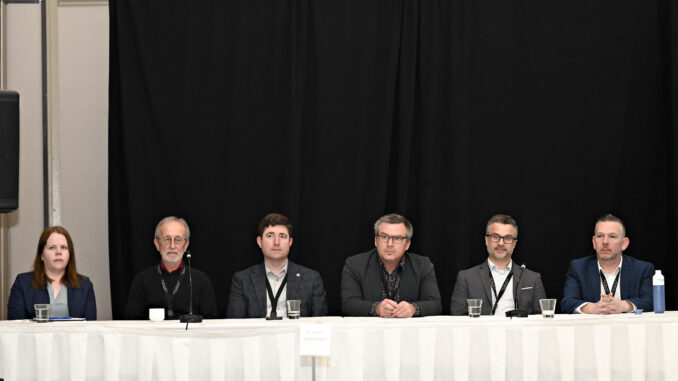
Hains introduced the concept of Hydrospatial = Hydrography++, setting the tone for a conversation that would explore not only tools and workflows but also deeper issues of education, collaboration, and real-world integration of this data.
Andy Hoggarth: Cloud-Based Transformation and Responsible Automation
Andy Hoggarth began by walking through the legacy of CARIS, a pioneering hydrographic software company born in New Brunswick over 45 years ago. Now operating as part of Teledyne Geospatial, CARIS has systems deployed in over 120 countries, with Canada being the very first.
Andy outlined a fundamental shift currently underway in the hydrospatial industry:
-
From desktop to cloud: Moving away from monolithic desktop applications toward cloud-first solutions.
-
From expert-only tools to broader access: Simplifying interfaces and enabling workflows that can be automated but still reviewed and modified by professionals.
-
From static charts to dynamic data products: Including AI-powered analytics, not just nautical charts.
“We’re two years into a five-year journey to pivot our software to cloud platforms. But we must ensure that automation doesn’t take away the fun of the job, or we’ll lose the next generation of hydrographers.”
Andy also shared a compelling anecdote about how AI could support high-profile search missions like MH370, using pattern recognition to distinguish man-made objects from natural seafloor features. For him, AI’s power lies in aiding discovery, not replacing expert judgment.
Kyle Goodrich: Satellite-Derived Bathymetry and the Human Factor
Next, Kyle Goodrich discussed the explosive rise of satellite-derived bathymetry (SDB) as a disruptive force in hydrospatial mapping. Although SDB offers immense potential in cost-effectiveness and historical time-series analysis, Goodrich warned against treating it as a push-button solution.
“There’s a risk of watering down the technology. It’s too easy now to generate a product, but interpreting its reliability still takes human expertise.”
He emphasized that SDB is now widely known and accessible, with new startups emerging almost weekly. However, the barrier to entry is low, and that makes quality assurance and data interpretation even more critical. The key, he noted, is blending automation with human interpretation, making workflows engaging and even therapeutic through elements like gamification and AR interfaces.
He also spoke passionately about youth engagement:
-
When exposed to the field, students overwhelmingly want to pursue ocean mapping, even if they previously hadn’t heard of it.
-
There is incredible untapped enthusiasm, the challenge is awareness and access, not interest.
Derrick Peyton: Collaboration the Future of Ocean Monitoring
Derrick Peyton brought a pragmatic view from the field. Drawing on his experience leading remote hydrography missions, including in the Canadian Arctic and Thunder Bay, he stressed the need for collaborative ecosystems that integrate academia, government, and industry.
“Technology alone isn’t the challenge, it’s people. The hardest job is getting someone to go to work in the morning. The real power lies in bringing good people together across sectors.”
He believes the future lies in hybrid surveying approaches, combining traditional vessels with remote and autonomous vehicles. But these must be guided by multidisciplinary goals and coordinated planning.
Some key points from his intervention:
-
Remote sensing must support multiple objectives. If you’re already surveying, it’s inefficient to do it without including biodiversity sensors, water quality tools, or infrastructure mapping.
-
Institutional silos are a problem. Often, a department or agency only collects what it needs, ignoring broader uses that could benefit the entire hydrospatial community.
-
Academic-industry alignment is critical. Success depends on creating pipelines from student training to applied workforce development.
Dr. Ian Church: Rethinking Education and Certification
Dr. Ian Church spoke on behalf of academia, noting the growing discrepancy between workforce needs and educational infrastructure:
-
Canada lacks enough formal programs in ocean mapping to meet demand.
-
Industry is increasingly hiring from adjacent disciplines (e.g., geography or biology), often without core training in acoustics or multibeam systems.
“Ocean mapping isn’t hard, until something goes wrong. Then, only those with foundational knowledge can solve the problem.”
Dr. Church advocated for:
-
Flexible certification paths that allow individuals from diverse academic backgrounds to become certified hydrographers.
-
More modular, industry-led training programs (e.g., short courses on sonar or digital workflows).
-
Embedding geomatics and ocean mapping concepts in high school curriculums to increase awareness early on.
He also praised in-person school visits and career talks as one of the most effective tools for recruitment, emphasizing the importance of outreach in classrooms across Canada.
Research Gaps: From Digital Twins to Mangrove Mapping
When asked about critical research gaps, the panelists delivered a powerful list of forward-looking topics:
1) Live Science and Digital Twins
Louis Maltais called for a new way of delivering science, beyond static PDFs:
-
Findings should feed into dynamic, real-time digital twins of the ocean environment.
-
These twins can power predictive tools (e.g., forecasting algal blooms or fish strandings).
-
Canada needs to shift toward “science that works for Canadians”, integrated, responsive, and application-focused.
2) Mangrove Mapper Challenge
Andy Hoggarth proposed a research initiative focused on creating an optimal methodology to map mangroves, including:
-
Canopy structures (optical or LiDAR)
-
Water dynamics (tidal conditions)
-
Sub-seafloor bathymetry
“Mangroves are critical carbon sinks. If we solve how to map them properly, we can create powerful sustainability metrics for restoration and carbon finance.”
3) AI for Inland Water Networks
Colleen Fuss highlighted major operational needs:
-
Automated correction of water polygons and stream lines
-
Culvert detection, especially in flat areas like Manitoba, where flow paths are hard to detect
-
Improved uncertainty models for watershed boundaries, especially where international water negotiations are sensitive.
Closing Reflections: Timing, Trust, and Transformation
The panel concluded with thoughtful reflections on where hydrospatial science is headed:
-
With increasing access to centimeter-level positioning on smartphones, crowdsourced data will surge. But its quality, validation, and integration remain unanswered challenges.
-
Government workflows must evolve to better share data, reduce silos, and align with emerging user needs.
-
Funding shifts and political cycles can complicate long-term hydrospatial strategies, but collaboration and continuity are key.
Denis Hains closed by reminding participants that context and timing matter, just as they did in the past with vertical datum innovations in Canada. With geopolitics, climate change, and open data accelerating change, now is the right moment to act.
Hydrospatial science is no longer just about mapping the seafloor, it’s about building digital ecosystems that combine automation, human insight, community participation, and scientific rigor. GeoIgnite 2025’s panel on hydrospatial challenges made one thing clear: the next era of marine data innovation will be collaborative, dynamic, and people-driven.
Be the first to comment