
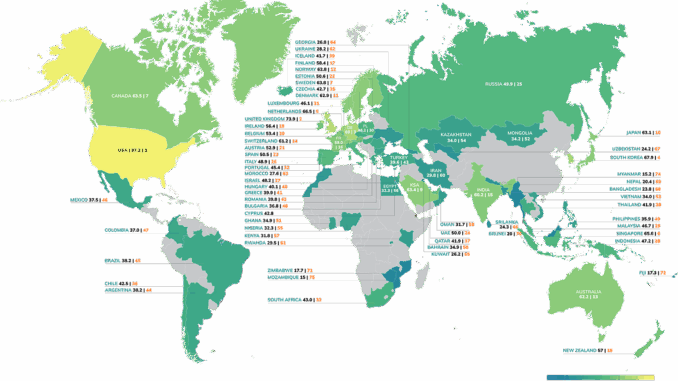
Canada’s ranking in the Geospatial Knowledge Infrastructure (GKI) Readiness Index 2025 has slipped slightly, dropping from 7th to 8th out of 75 countries. This change comes as South Korea made a dramatic leap, advancing from Rank 25 in 2022 to Rank 4 in 2025, driven by substantial investments in spatial data infrastructure, AI integration, and smart city technologies. Additionally, Sweden surpassed Canada, moving from Rank 13 to Rank 7. South Korea’s rapid rise, in particular, underscores the intensifying global competition in the geospatial sector. While Canada remains a top player, this drop highlights the need for the country to maintain its momentum and continue innovating.
The GKI Readiness Index 2025, released recently by Geospatial World, provides a detailed assessment of the global geospatial capabilities of 75 countries, evaluating their geospatial knowledge infrastructure across five key pillars: Infrastructure, Policy Landscape, Institutional Capacity, Industry Ecosystem, and User Adoption.
Performance Breakdown: Strengths and Challenges
Canada’s performance across these five pillars reveals a mix of strengths and areas for improvement.
Industry Ecosystem (Rank 6)
Canada’s geospatial industry remains strong, ranking 6th globally. This high placement reflects a dynamic private sector, thriving academic communities, and a network of geospatial companies and startups that continue to push the boundaries of innovation. Canada is recognized for its ability to produce world-class geospatial solutions, which positions it as a leader in the industry.
Institutional Capacity (Rank 7)
With a ranking of 7th in Institutional Capacity, Canada benefits from solid institutional frameworks. The country’s government agencies and educational institutions provide the necessary support for geospatial programs, and there is a well-established pipeline of skilled professionals. This strength in institutional capacity continues to play a key role in maintaining Canada’s position in the global geospatial space.
Policy Landscape (Rank 9)
Canada ranks 9th for Policy Landscape, indicating a strong policy environment for geospatial data use. Policies such as open data initiatives and national spatial data infrastructure (NSDI) plans are in place to support innovation. However, the report suggests that while the policies are robust, their execution must improve to ensure that the benefits of these frameworks are fully realized. This gap between policy creation and implementation is a challenge that needs to be addressed.
Infrastructure (Rank 12)
Geospatial infrastructure remains Canada’s weakest area, with a ranking of 12th. While the country has strong Earth Observation programs and mapping systems, there is room for improvement in modernizing and expanding infrastructure. The report emphasizes the need for more comprehensive and accessible geospatial systems, particularly given Canada’s vast geography. Investments in updated satellite systems, GPS networks, and data platforms will be essential to bolster this pillar.
User Adoption (Rank 14)
The biggest area of concern for Canada is User Adoption, where it ranks 14th. Geospatial technologies and data are not yet as widely integrated into decision-making across industries and government services as in other leading nations. To close this gap, Canada needs to focus on raising awareness, expanding access to geospatial data, and making these tools more user-friendly for businesses, local governments, and the public.
Notable Changes in Global Geospatial Rankings
While Canada’s ranking has dropped, other countries have seen substantial improvements in their geospatial readiness, signaling increasing global competition. Notably:
-
South Korea made an impressive leap from 25th in 2022 to 4th in 2025, driven by its significant investments in spatial data infrastructure, AI integration, and smart city technologies.
-
Saudi Arabia rose from 17th to 9th, thanks to its Vision 2030 initiative, which places a strong emphasis on digital transformation and geospatial development.
-
Sweden jumped from 13th to Rank 7th, reflecting its strategic focus on sustainability and interoperability in geospatial data systems.
-
India improved from Rank 18th to 5th, fueled by policies such as the National Geospatial Policy 2022 and ongoing integration of Earth observation technologies.
These countries’ significant improvements in infrastructure, policy, and adoption highlight the dynamic nature of the geospatial industry, with nations increasingly recognizing the importance of these technologies to their economic and governance systems.
Bridging Gaps for Future Geospatial Leadership
Canada’s ranking in the GKI Readiness Index 2025 reflects its strengths in industry and institutional capacity, but the country must address weaknesses in user adoption and infrastructure. While the drop from 7th to 8th place is minor, it highlights the need for continuous improvement in the rapidly evolving global geospatial landscape.
To maintain its leadership, Canada must invest in modernizing geospatial infrastructure, enhancing policy implementation, and expanding the use of geospatial technologies across all sectors of society. By addressing these challenges, Canada can sustain its position as a global geospatial leader and ensure that it remains competitive in the face of growing international competition.



Be the first to comment