
- EarthDaily Strengthens Wildfire Monitoring with SkyForest Acquisition
- New Seismic Mapping Project Aims to Safeguard Metro Vancouver
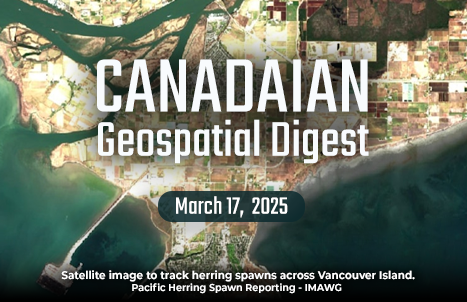
- Tracking Herring Spawns from Space to Support Coastal Conservation
- Legacy of Water Diversions Still Felt in Great Lakes Communities
- B.C. Ferries Explores Homegrown Alternatives for Satellite Connectivity
- Scholarship Alert: GIS Opportunities for UM Students
EarthDaily Strengthens Wildfire Monitoring with SkyForest Acquisition
EarthDaily Analytics has acquired SkyForest, a cloud-based platform specializing in wildfire risk assessment and forestry analytics. This strategic move bolsters EarthDaily’s geospatial capabilities as it prepares to launch its Earth Observation satellite constellation in 2025. The integration of SkyForest’s advanced analytics will enable more accurate, real-time wildfire monitoring and forest health insights, supporting industries such as insurance, utilities, and forestry. The acquisition marks EarthDaily’s continued commitment to leveraging AI and big data for enhanced environmental risk management.
Read more: here
New Seismic Mapping Project Aims to Safeguard Metro Vancouver
A groundbreaking 10-year seismic mapping initiative led by Western University is shedding light on how earthquake risks vary across Metro Vancouver. The project focuses on how local geology influences earthquake wave behavior, with softer sediments shown to amplify shaking and increase risks like landslides and liquefaction. With 29 regional maps already released, the team plans to finalize a 3D seismic velocity model by 2026. These insights aim to assist planners, architects, and residents in making informed safety decisions and preparing for potential seismic hazards.

Read more: here
Tracking Herring Spawns from Space to Support Coastal Conservation
Loic Dallaire, a UVic master’s student, is pioneering the use of satellite imagery to monitor herring spawning along Vancouver Island. Collaborating with the Pacific Salmon Foundation and Indigenous partners, his research seeks to enhance traditional monitoring by offering a broader and more consistent view of spawning events. The project aims to develop an interactive tool by 2027, empowering communities and organizations to better understand and manage spawning patterns for conservation and fisheries management.

Legacy of Water Diversions Still Felt in Great Lakes Communities
Mid-20th-century water diversions, like the Ogoki and Long Lake projects, significantly altered ecosystems and reshaped communities along the Great Lakes. Originally designed to boost hydroelectric power by increasing water flow over Niagara Falls, the projects disrupted natural habitats and forced the relocation of the Whitesand First Nation due to flooding. Additionally, these diversions contributed to higher levels of methylmercury in fish, affecting food security for local communities. The lasting ecological and cultural impacts of these interventions highlight the need to consider long-term environmental consequences in infrastructure development.

Read more: here
B.C. Ferries Explores Homegrown Alternatives for Satellite Connectivity
B.C. Ferries is reevaluating its satellite internet providers amid rising tensions over U.S. tariffs affecting Canadian imports. The company, which has been testing SpaceX’s Starlink for crew communications, is now launching a public procurement process to consider Canadian alternatives. While options like Telesat Lightspeed and Xplore Inc. are on the radar, none currently match Starlink’s speed and global reach. Reliable communication remains critical, especially for crews in remote areas like Bella Coola and Haida Gwaii, as B.C. Ferries seeks solutions aligned with Canada’s broader trade strategy.

Scholarship Alert: GIS Opportunities for UM Students
Esri Canada is offering two scholarships for University of Manitoba students utilizing Esri technology. The UM Student GIS Scholarship awards $1,500 along with training and conference opportunities for students working on GIS-focused capstone or thesis projects. Applications are due by April 18, 2025. The Esri Young Scholar for Canada highlights exemplary GIS work from students nationwide, with winners receiving conference travel and additional bursaries. Applications for this award are due by March 19, 2025.
Read more: here


Be the first to comment