
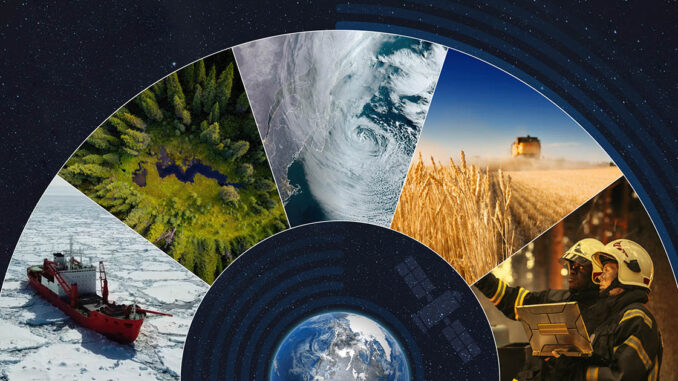
The Canadian Space Agency (CSA) has chosen 20 projects for funding totaling $5 million as part of its Satellite Mobilization for Biodiversity Action initiative. The program, which was first announced at the beginning of 2025, aims to fund innovative, satellite-driven approaches to biodiversity monitoring and conservation across Canada. Research teams will utilize technologies like Earth Observation data, artificial intelligence, and machine learning to solve some of the biggest biodiversity challenges like habitat degradation, species decline, and climate change.
The announcement was made by Lisa Campbell, President of the Canadian Space Agency (CSA) at the 76th International Astronautical Congress on September 29.
Through this initiative, the 20 Canadian companies — including eight collaborating with Indigenous organizations — will advance solutions to pressing challenges such as declining wildlife populations, habitat degradation, deteriorating water quality, and forest disturbance. Several projects will apply artificial intelligence to satellite imagery to detect invasive species, assess forest and agricultural landscapes, and monitor migratory bird patterns, generating actionable insights to help protect nature and restore biodiversity.
“Canada has been a leader in space for decades, and this leadership gives us a unique advantage here on Earth. Space technologies provide the critical information we need to protect our planet. Through this investment, we are safeguarding our lands and waters, strengthening our economy, and ensuring a better, more resilient future for Canadians,” said Campbell.
The following three provide a snapshot of the innovative ways satellite data is being applied to biodiversity challenges.
- Arctus Inc.’s EeyouSat project intends to improve satellite-based mapping and monitoring of coastal ecosystems in Eeyou Istchee, where the Cree Nation, located in northern Quebec, has observed habitat degradation. The project will carry out research and development on how to improve the detection of submerged aquatic vegetation and coastal ice so that ecological change can be monitored more effectively in this area.
- The Satellite Analytic project is being implemented by Complex System Inc. The goal will be to develop AI-powered software that uses a single 2D satellite image to predict and generate 3D models of terrestrial landscapes. By developing 3D maps with higher resolution, and assessing land change, this tool will significantly improve assessments of agriculture, land use, and resilience of the terrestrial landscape.
- The EO & Indigenous Knowledge project is being implemented by Wildlands League and will map climate strongholds for migratory birds in the Hudson Bay Lowlands and beyond. Through combining satellite Earth observations and Indigenous knowledge, the project will assess habitat conditions critical not only for bird conservation and community climate resilience, but to inform future decision-making.
The CSA’s funding is also promoting new partnerships to pair leading-edge space-based technologies with local expertise to address knowledge gaps that can aid biodiversity conservation efforts across Canada and welcomes applications from for-profit or not-for-profit organizations located in Canada. Funding includes up to $250,000 dollars per project, program or initiative. The CSA issued the call for proposals in January 2025 and selected 20 projects in September, giving a window of up to two years to complete the project.
This initiative demonstrates the growing importance of satellite Earth observation in environmental stewardship and aligns with Canada’s efforts to support innovation and partnership by working towards Canada’s 2030 biodiversity targets.


Be the first to comment