
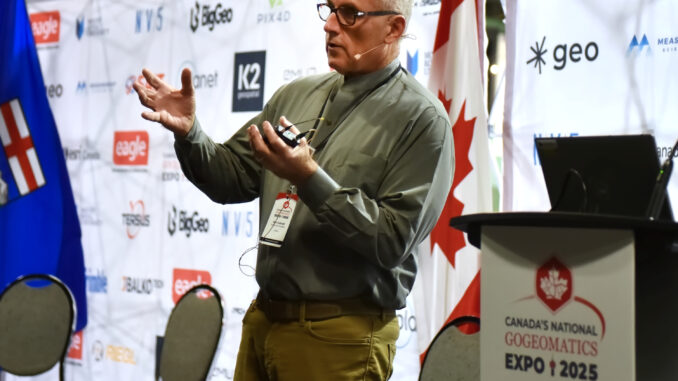
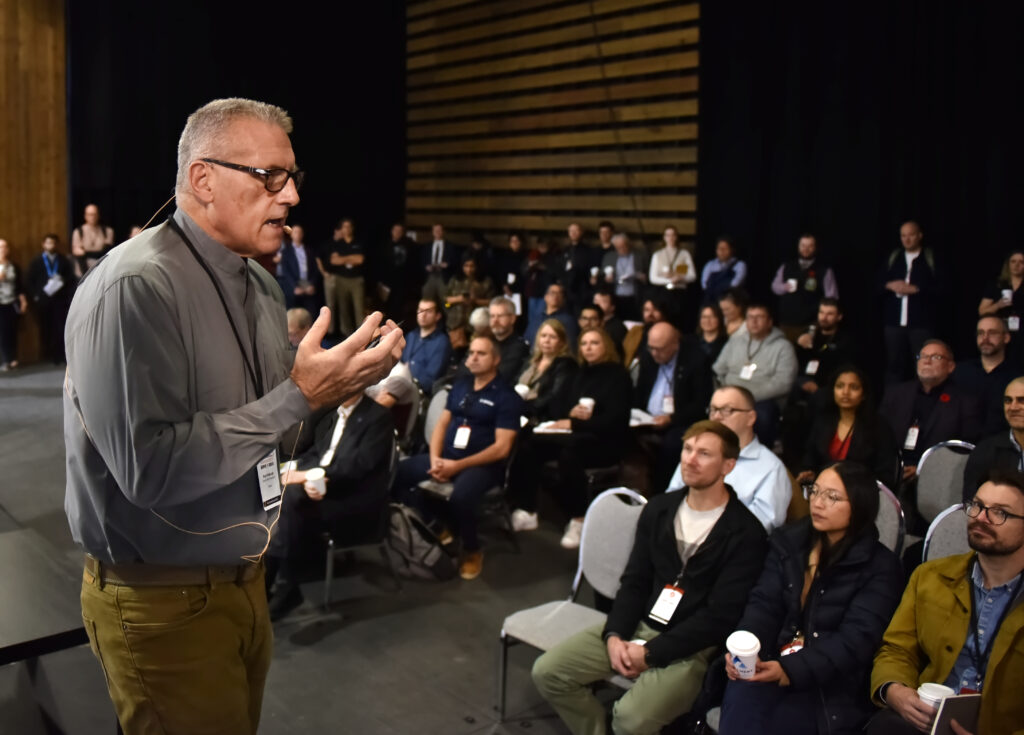
At CalgaryExpo 2025 after the “Geomatics Through the Generations” by Charlie Trimble, I sat down for a deeper conversation with Bryn Fosburgh, Senior Vice President, Trimble, and a thought leader in the geospatial industry. Bryn’s perspective bridges history and future: from the early constraints of GPS to today’s sensor-rich, AI-enabled workflows. His insights reveal not only where the industry is heading, but how organizations (large and small) can prepare for a new era of automation, accuracy, and client sophistication.
During your keynote, you called AI ‘the next utility’. What makes AI a utility rather than a tool?
Utilities are available everywhere: light switches, water, and electricity. AI is already there. Most people use it daily without realizing it. Its availability and ubiquity make it a utility.
(He noted the cost must remain reasonable, but he believes pricing is currently fair.)
Across surveying, construction, and asset management, where is the fastest ROI for AI?
In large datasets and repetitive tasks. Today AI is more horizontal than vertical. As vertical specialization grows, ROI will explode.
(He explained that point clouds, SLAM, design-to-field workflows, and utility mapping will see major gains.)
How will AI reshape QA/QC in point clouds, SLAM, and mobile mapping?
Accuracy depends entirely on the knowledge base. More data = better models. But human oversight will always be necessary. Humans must have the authority to veto AI.
How can we build trust for AI among public sector and construction clients?
Construction is slow to adopt new tech. You build trust by proving accuracy repeatedly. Don’t boil the ocean. Solve small problems first : drop, drop, drop, and the ocean forms.
If GPS were designed today from scratch, how would it differ?
The architecture wouldn’t change much. But we’d reach things like RTK faster because of battery, processors, and integration capacity. We would have integrated sensors e.g. INS, LiDAR, cameras, much earlier.
What advice would you give companies modernizing field-to-office workflows?
Don’t be trapped by legacy systems. But don’t adopt technology just because it’s new either. Instead ask: Does this improve the outcome? Balance is everything.
What’s the biggest difference between clients now and 30 years ago?
Clients today are vastly more informed. They’ve moved companies, used many tools, have colleagues everywhere, and have the internet. A young client may know more than the vendor. Preparation is more important than ever.
(Don’t listen only to what the customer asks for. Listen to the problem they’re trying to solve.
Industry Standing at an Inflection Point
My conversation with Bryn Fosburgh highlighted a simple truth: the geospatial industry is standing at an inflection point. AI is no longer a futuristic concept but an everyday utility, quietly shaping datasets, field practices, and decision-making. Yet Bryn reminded us that technology alone is not the answer. Trust, human oversight, clear problem-definition, and balanced adoption remain core pillars of meaningful innovation.
Whether it’s the future of QA/QC, the next generation of field-to-office workflows, or the evolving expectations of today’s clients, Bryn’s message is consistent: Start small, stay curious, and let the problem, not the trend, guide the solution.
This extended conversation adds another layer to the multigenerational story of geospatial technology, one where experience meets rapidly accelerating change, and where leaders like Bryn help us navigate the path forward.
Be the first to comment