
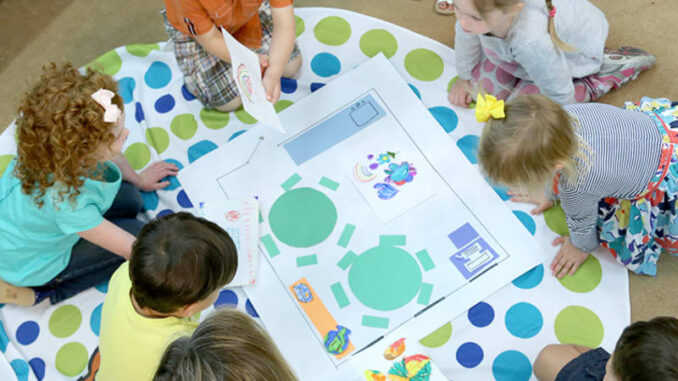
At this year’s SaGES conference, one of the most quietly powerful moments came from a session that had nothing to do with remote sensing algorithms or cartographic frameworks. Instead, it focused on people, specifically, learners with dyslexia, and how STEM education often leaves them behind, even when they’re wired for spatial brilliance.
Keynote speaker Erin Kline from Fraser Academy opened her session by naming the elephant in the room: roughly 1 in 5 people has dyslexia, but only about 20% go on to post-secondary education. In fields like geospatial science, where spatial reasoning and big-picture thinking are essential, this gap doesn’t just affect students, it affects the field as a whole.
Kline, who has spent over two decades working with learners who have dyslexia and ADHD, explained that dyslexia is not a learning deficiency but a learning difference. While traditional classrooms are built around heavy reading and writing demands, many students with dyslexia are visionaries and systems thinkers who just don’t thrive in that setup.
Learning to Read vs. Reading to Learn
Kline shared how the education system often misses the mark. From kindergarten to about grade 3, students learn to read. By grade 4, the shift happens, students are expected to read to learn. That’s when many learners with dyslexia begin to fall through the cracks. And by the time they reach university, things get even harder: taking lecture notes while trying to process spoken content, writing lab reports, and reading long research papers without accessibility tools.
Yet, these are the same learners who can build engines without manuals, conceptualize spatial layouts in seconds, and connect ideas across disciplines in ways others might miss.
The session featured a powerful video from Maggie Aderin-Pocock, a British space scientist who described her early struggles in school. She had dreams of working in space but often felt defeated when trying to put her ideas onto paper. It wasn’t until a teacher asked a science question, and she was the only one with the right answer, that her confidence started to grow.
Her story served as a reminder that when the right supports are in place, students who think differently can achieve extraordinary things.
Changing How We Teach, Not Who We Teach
Kline didn’t stop at theory. She offered specific, practical changes that educators can make, many of which don’t take much time but have a huge impact:
- Offer audio versions of textbooks and articles
- Share lecture slides in advance
- Use visual instructions and examples
- Break large assignments into clear, manageable steps
- Choose clean, legible fonts and spacious formatting
And for geospatial educators specifically, she added that using maps, models, and visuals isn’t just good practice, it’s good accessibility. Many learners with dyslexia process information better through images and structures than through text.

This Isn’t Just About Dyslexia
Kline emphasized that these changes don’t only help students with learning differences. They help everyone. When instructions are clearer and content is available in multiple formats, all learners benefit, especially in fast-paced, technically demanding fields like Geomatics.
For institutions, this means going beyond checking the box for accommodations. It means actively building environments where more learners can succeed, not just survive.
What the Geospatial Community Can Do
The takeaway from this session was clear: The geospatial field is full of potential for learners with dyslexia, but the door needs to be wider.
Educators can start by rethinking assessment and delivery methods. Employers can revisit hiring practices that focus too heavily on written communication. And curriculum designers can build pathways that value diverse cognitive styles.
Because if we’re serious about innovation, we need the minds that think differently.
Erin Kline reminded everyone in the room that brilliance doesn’t always look the way we expect. As geospatial educators and professionals, we often pride ourselves on seeing the bigger picture. It’s time our systems reflected that.

Be the first to comment