
Globally the International Energy Agency (IEA) estimates that buildings account for one-third of the globe’s energy consumption. In the U.S. buildings account for 72 percent of electricity use. In the world’s warming climate the growing demand for electric power is increasingly being met by alternative fuels. Many jurisdictions are finding that energy efficiency provides the least expensive “alternative fuel.” For example, Burlington, Vermont has been able to meet the energy needs of a growing local economy over the last 19 years through efficiency – the City’s annual electricity consumption in 2009 was only about 2 percent greater than in 1989.
Pike Research has projected that as a result of the recast EU EPBD directive and similar legislation in other parts of the world worldwide revenue from net zero energy building construction will grow at an annual rate of 43% over the next two decades, reaching $690 billion by 2020 and $1.3 trillion by 2035.
IDC Energy Insights identified smart buildings as one of the top 10 priorities for electric power utilities in 2012. Energy efficient buildings not only reduce overall power consumption but, even more importantly, reduce peak load. For example, California uses 5% of its electric power generation capacity less than 50 hours a year. The US Green Building Council (USGBC) and partners supported by Southern California Edison, have started the Demand Response Partnership Program (DRRP) to encourage commercial building owners to contribute to peak load reduction by partnering with electric power utilities. The Ontario Energy Board’s (OEB) mandated reduction of peak demand of 5.6% and overall consumption by 4.9% translates into financial incentive programs such as the Ontario Power Authority’s High Performance New Construction (HPNC) program which will fund up to 100% of the cost of energy modeling for a building, and will pay $400 to $800 for every kilowatt saved over code.
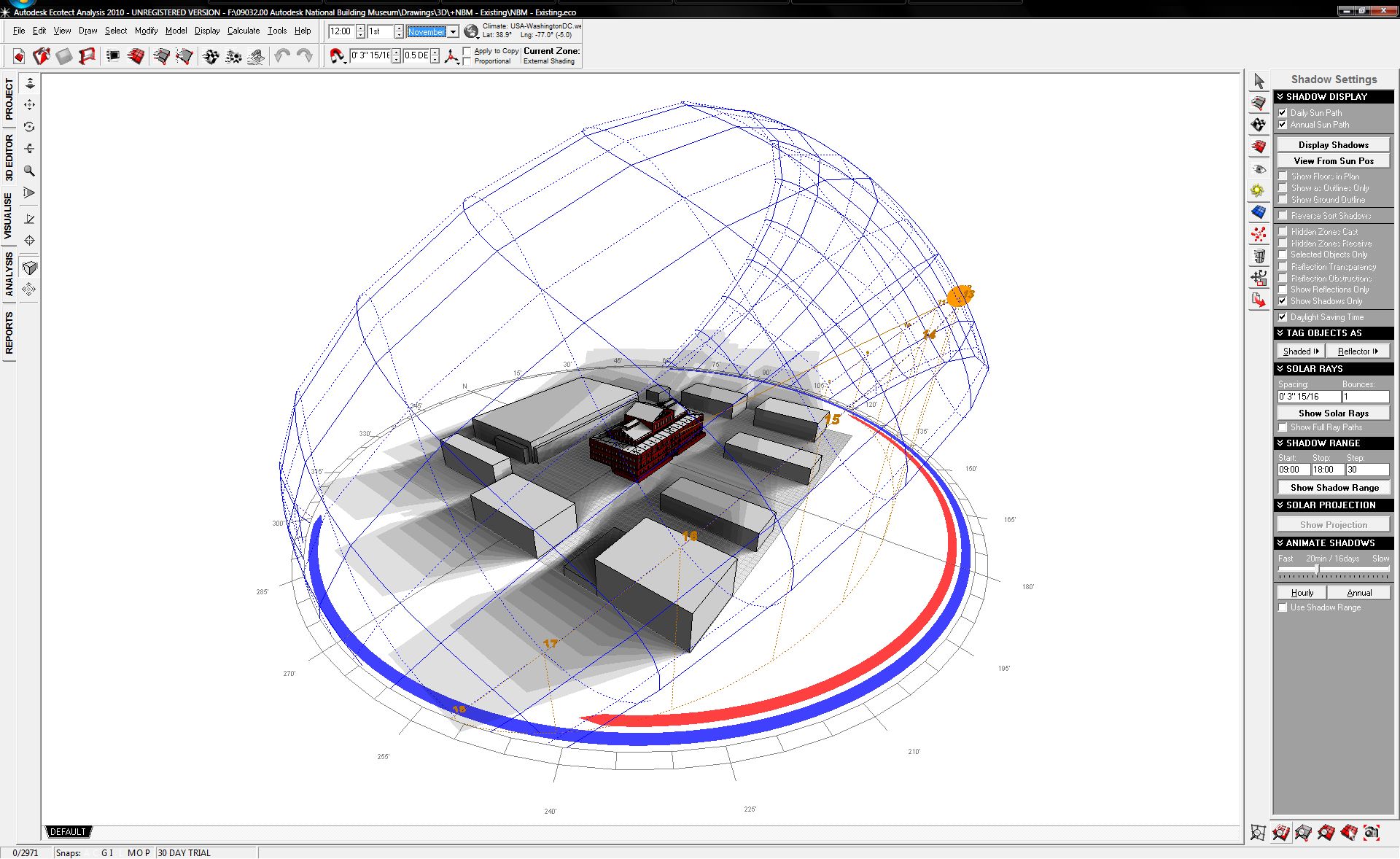 The convergence of building information modeling (BIM), geospatial data and energy modeling enables designers to reduce the energy footprint of existing structures as well as design new, highly energy efficient structures. For an existing structure, laser scanning can be used to derive a dimensionally accurate building model (BIM). Using the geographic location of the building and local historical insolation and weather information. a building energy performance analysis of an historic, 140 year-old government building shows that zoning, natural ventilation, daylighting, decoupling interior spaces, and solar photovoltaic panels can reduce the building’s annual energy consumption of 5.5 million kWh by 60%.
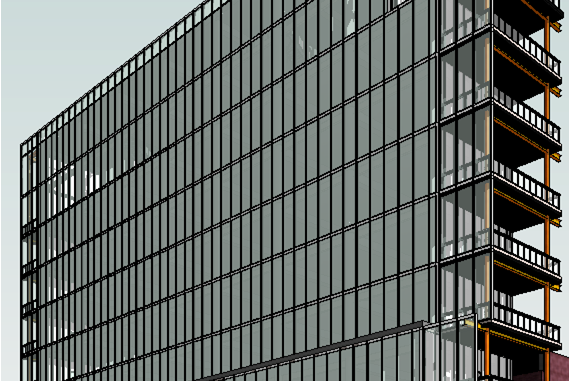
 For a new building an architect’s BIM model provides the key elements that are required for the energy analysis such as simplified walls and floors, room bounding elements, complete volumes, and window frames and curtain walls. Together with the geographical location of the building and the local environmental conditions, an energy performance analysis can reduce annual energy consumption and power bills by 40%. As an added benefit, reducing the electric power usage of a new building over code generates an immediate payback of $400 to $800 per kW saved from the Ontario Power Authority’s HPNC program.
The complete article can be found in Geospatial World August 2012.

Be the first to comment