

I have a background in history, not engineering or science, and for many years I didn’t think there was a space for me in the industry. But I was curious. I spent close to a decade attending space conferences on my own. Eventually, people started assuming I already worked in the field, which made me realize I actually could contribute. That led to our pivot into EO and climate-related software solutions.
As climate-related disasters become more frequent, how does Deploy’s work fit into the broader need for resilience and preparedness?
I believe Climate resilience isn’t just about big-picture science — it’s about enabling better decisions at the local level. At Deploy, we are focused on helping communities and organizations make sense of their risk environment, whether that’s through assessing flood vulnerability, wildfire exposure, or infrastructure resilience.
We need tools that are grounded in data but built for action — things people can actually use. It’s also about working across silos: civil defence, climate adaptation, emergency planning—they’re all part of the same system. If we can help connect those dots with data and insight, that’s where we can make a meaningful contribution.
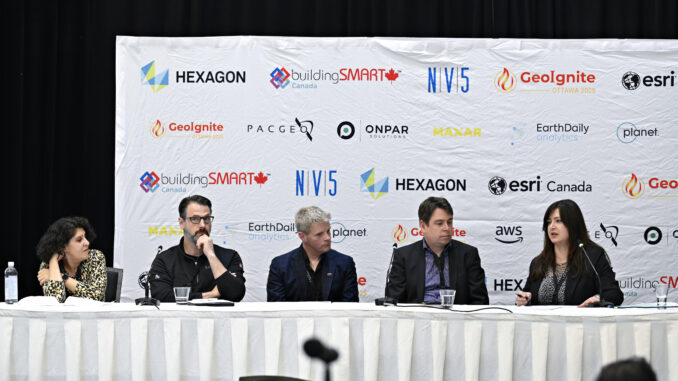
During the panel discussion at GeoIgnite, you spoke about some of Deploy’s recent solutions in flood monitoring and emergency response. Could you share more about that work and what made it effective?
That was a great example of how complex challenges—like flood response—require collaboration across disciplines and geographies. One of our recent projects was part of the CSA smartEarth program, where we developed a citizen science-based tool to monitor floods along the Ottawa River. The idea was to let residents submit geolocated flood observations, which we could then fuse with satellite data to give emergency response teams a clearer picture of what was happening on the ground.
To make it work, we partnered with a disaster response expert from South Africa and with PCI Geomatics to handle the satellite data processing and algorithm development. That kind of collaboration was essential — not just for the technical pieces, but for maintaining scientific rigor. When you’re dealing with community-contributed data, you need to ensure it’s validated and used appropriately. Our expert partners helped set the thresholds and quality standards to make that happen.
We also pulled in a variety of EO sources — Sentinel, Landsat, Planet, Airbus, and RCM — and used AI for object classification. It reached TRL 5, which meant it was technically sound and had strong potential for operational use. More importantly, it showed what’s possible when you blend open data, AI, and community input in the right way.
There’s been a lot of discussion about the role of AI in EO. What’s your view on that?
AI is a powerful tool that can help scientists be more productive and can assist in converting and interpreting large datasets. But it’s not a replacement for human oversight. AI can hallucinate, especially in high-stakes applications like flood risk assessment. You need human expertise to validate and contextualize results. It’s about using AI to augment, not replace, what people do best.
Can you speak about Deploy’s involvement in the Linux Foundation’s Open Source Climate initiative?
We are technical contributors to the OS-C initiative, which is developing open-source data and AI algorithms for physical risk assessment. Although that particular work doesn’t rely heavily on EO imagery, it helps us better understand how to use diverse data sources to assess risks to assets like buildings or infrastructure. EO data still plays a key role in understanding environmental vulnerabilities such as flooding or wildfires.
What makes collaboration effective in the EO and space community?
Time and communication are essential. You need to build relationships, learn the language of the industry, and engage with others at events like this one. Sometimes conversations don’t lead anywhere immediately, but years later they result in meaningful partnerships. Bringing empathy to these collaborations, understanding what people need and why we’re doing this work, is just as important as technical skills.
What advice would you give to young professionals interested in entering the EO or AI space?
It’s never been easier to try things and share your work publicly. Start a small project, post your code and reflections, even your mistakes, on GitHub or similar platforms. That shows initiative, willingness to learn, and technical capability. It also helps you build a network and stand out to future employers. Everyone is still learning in this space. Being open about that can actually work in your favor.



Be the first to comment