
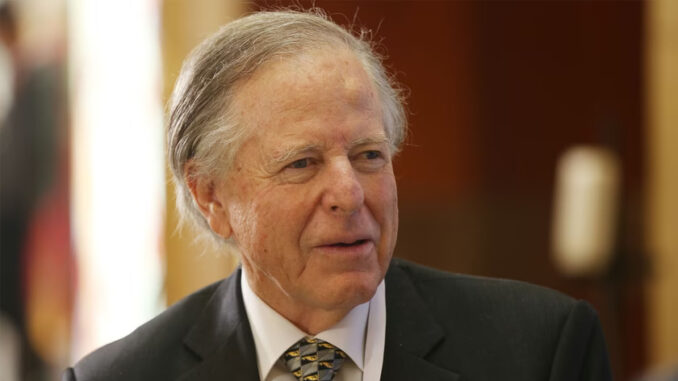
This November, Charlie Trimble — the pioneering technologist who helped turn GPS into a global utility — will speak at the GoGeomatics Expo 2025 in Calgary. It’s a rare public appearance from someone long retired but still widely regarded as one of the most influential figures in the history of modern surveying, geospatial positioning, and location-based technologies.
Charlie’s name is, of course, synonymous with the company he founded — Trimble Inc. — but his contributions go far beyond the brand. He helped redefine how we understand and interact with physical space, laying the groundwork for a revolution that would ripple across surveying, agriculture, construction, infrastructure, and everyday life. The GPS we now take for granted owes much to the risks, insights, and convictions formed in the early years of Trimble’s journey — when nothing about this future was guaranteed.
When asked what prompted him to accept the speaking invitation, Charlie didn’t miss a beat: “You know the answer — it’s Bryn.” The reference was to Bryn Fosburgh, now a Senior Vice President at Trimble, who joined the company as a young engineer and was mentored by Charlie in those early days. Their relationship has since grown into a lasting bond, grounded in trust, shared purpose, and mutual respect.
Bryn will also be speaking at the GoGeomatics Expo 2025, delivering a keynote on AI’s impact in BIM and geospatial — making their reunion on stage all the more special.
But there was another reason, too. With a wry nod to geopolitical tensions, Charlie hinted that the decision was also a quiet gesture of respect and support for Canada at a time when global relationships feel more fragile than ever.
In this rare and wide-ranging conversation, Charlie reflects on GPS, entrepreneurship, the evolution of surveying, and his current passions — from system resilience to Silk Road archaeology. What follows is a candid look into the mind of one of our field’s most enduring pioneers — still sharp, still curious, and still deeply engaged with the future.
Did you ever imagine that GPS would become this disruptive and ubiquitous, shaping not just industries, but everyday life around the world?
There was no way. I was seeking a second navigation product that offered superior technology compared to the one we were using. And the pot of gold at the end of the rainbow was a billion-dollar car navigation market.
Actually, we hypothesized that there was a much bigger market when we came out with the little marketing booklet, The Ninth Utility, where we framed GPS as an emerging information utility akin to water or electricity. We were doing that for ourselves — trying to figure out what markets would really need GPS.
Later, we realized that the early markets were related to time-tagging events and geotagging positions. This really came out of the oil exploration industry. GPS was first used simply to recalibrate offshore positioning. And later, when it became continuous, it was used for time-tagging hydrophone events and positions. That’s when we started to realize we were onto something really big.
Does it surprise you today — the scale of what it has become?
In some ways, yes. In other ways, no. We recognized that to safeguard the GPS spectrum, which occupies a portion of the radio frequency spectrum, we needed to ensure its ubiquity. There are tremendous demands on the RF spectrum, especially from people who believe this portion is unused. So, to secure GPS for the long term, we had to drive the cost of GPS to zero.
By the year 2000, the Hong Kong price for GPS functionality — in million-a-month quantities — was a dollar. So, we had effectively done it. [“Hong Kong price” refers to the mass manufacturing cost in high-volume electronics production — about $1 per GPS chip in that era.]
And now, with the exception of specialized survey or construction receivers using signals from all the constellations, GPS has basically disappeared into silicon. It’s a small cell on an IC, or can now even be done entirely in software.
When you started Trimble, many foundational technologies didn’t yet exist. What were some of the critical ones you wish had been available back then?
In some ways, you can say we were lucky that they weren’t there, because virtually no one else would have had the audacity to try to do it. We were extremely small and underfunded, which made it take longer to accomplish things. So, in a way, we were lucky.
What I wished had happened sooner was the cell phone revolution, especially the ability to use a digital back channel on the cell phone, which meant we could get away from private radio. You basically had to get a license in a particular area to have a radio that would actually do the communications. That was the technology that slowed the growth. But it happened.
Fortunately, computational power steadily increased. It went forward the same way we did — on the backs of so-called Moore’s Law. Then, too, we had to come to a realization back in the late ’80s that what was important about GPS was the information. It connected the real and theoretical worlds.
Today, with the complete advent of digital twins, it is what ties cyberspace to reality — cyberspace to real space. And that clearly is what caused a tremendous blossoming in the first couple of decades of this century. And now, with the advent of AI, we’ve got another push.
What would be your advice to young entrepreneurs today, who are building on top of GPS/GNSS rather than from scratch?
First of all, you have to build on top of something. Building from scratch has always been really tough. My advice is: look at trends that are visible but not yet being used by people who fundamentally use GPS. See how they can be brought together to solve real needs.
We think the world is changing very rapidly, but it still takes five to ten years for a technology to go from a curiosity to something that truly is mainstream. These things are visible now, even though they’re not yet being used.
If you were starting Trimble today, with today’s VC culture, global politics, and regulatory complexity, do you think the same story could unfold? Or would it be harder now?
It was really hard. And I’m not sure we would have survived if it had been any harder. Today, it would be different. Every story happens in a different place, at a different time, with different problems. But don’t expect this to be an easy road or a high-probability one. If you look at the chances of a startup actually becoming an S&P 500 company, the percentage has an awful lot of zeros to the right of the decimal point. The odds are not in your favor.
When I was starting out, the common wisdom in Silicon Valley was that you had to survive for five years to have a 50% chance of continuing.
Jensen Huang, in a Caltech commencement address, said something like: we had to go after markets that had zero value today, because if they didn’t, and we started opening them up, somebody would take it away from us. And that’s the world we’re in now.
You have to believe in what you’re building. People say market pull is better than technology push, and that’s true for incremental improvements. But you’re not going to build something big with just incremental improvements.
Looking at how location technology is being used today — from surveillance to real-time tracking — what ethical or societal questions do you think the geospatial industry still hasn’t fully grappled with?
The societal questions are still there. We’re really in some challenging territory. A lot of these applications are like the classic two-edged sword — you’ve got the capacity to do tremendous good, and the potential to do tremendous damage.
You have to take a systems approach. We’ve always talked about “privacy, security, and integrity,” and it’s not just an application-level issue — it’s a system-level responsibility.
Actually, the much bigger problem we’re facing today has to do with AI, not surveillance. Every new technology can be very useful and beneficial to mankind, but it can also be useful to the bad guys.
People often look at successful companies like Trimble from the outside and assume it was all about a big idea or a moment of genius. But what actually made it work — especially behind the scenes, in terms of leadership and culture?
We had a good culture. I think they still do. Honestly, I borrowed a lot of it from where I learned to be an engineer — Hewlett-Packard. It was based on management by objectives. There’s no one right culture. Steve Jobs had one kind. Larry Ellison had another. Jensen Huang has his own.
What matters is the driving force and the people it attracts. Maybe I was seen as the visionary, but I had people who solved problems I couldn’t. People who made things happen. That’s how the company grew.
Starting a company is also just a lot of work. If you’re not ready to give it everything, the odds of success are low. And if you don’t enjoy it, at least some part of it, you won’t have the energy to keep going. For me, it was about two things: learning and building things that didn’t exist before. I’ve always enjoyed both.
And then there’s luck. When you’re small, it matters. David Packard told me that, in my first year at HP, I was sitting next to him at a Christmas party. He just said it plainly: “When you’re small, luck plays an important part.” And he was right!
You also have to be really good at something — even if it’s small. That’s how you start to grow. As an engineer, you always face trade-offs in price and performance. We decided the best way to manage that was simple: build the best.
What keeps you busy these days?
I started the transition by joining a number of boards. I’m simplifying my life now, and it’s really down to two things I’m passionate about.
One is the acquisition of knowledge. I’m very involved with high-risk research at Caltech, helping to seed projects across multiple disciplines. This isn’t about financial return, but more about accelerating the advancement of knowledge. I get to be the fly on the wall and watch that unfold, which I really enjoy.
The other is an interest in the rise and fall of civilizations, and how trade has shaped them. I’ve been traveling to archaeological sites, which ties together two of my passions — travel and antiquity. Exploring that history and visiting those places makes the experience even more rewarding.
You mentioned an interest in archaeology and ancient trade routes. What drew you to that, and how does it connect to your background in positioning and navigation?
It really started with a broader curiosity about the rise and fall of civilizations, and the role trade played in shaping them. I’ve been particularly focused on regions connected to the Silk Road.
When I was in school, Western civilization was taught as beginning with the Greeks. But that’s clearly not the full story. Yes, the Greeks were part of it, but they weren’t the beginning. It’s been fascinating to go back and explore what came before.
This past spring, I traveled through Uzbekistan and visited three of the key cities along the Silk Road. But the journey actually began the year before, when I visited the Buddhist caves in Dunhuang, China. That’s when I really saw the connection. I already knew how figures like Genghis Khan helped bring East and West together through trade, and how that flow of ideas may have even accelerated the Renaissance in Europe.
But this goes even deeper. I came to realize that as far back as Han dynasty times, the Chinese had pushed far west. In fact, it was the defeat of the Tang army on the edge of what is now Uzbekistan that determined that Muslims, not the Chinese, would ultimately govern that part of the world.
So, it’s fun. Yeah, absolutely.
What do you hope this new generation of surveyors, engineers, and geospatial professionals take away from your story?
I hope they understand that we didn’t start out trying to build something grand. We started out trying to solve specific problems — with rigor, with curiosity, and with respect for the people who would use the tools.
The tools may have changed. The pace has certainly accelerated. But the fundamentals haven’t. Listen to the user. Build systems that work in the real world. Don’t chase perfection — chase value.
And stay curious. If you lose that, none of the rest really matters.



Be the first to comment