
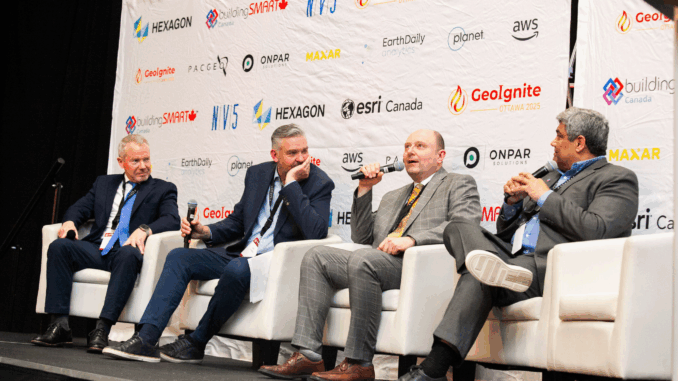
As the national conversation around artificial intelligence, Earth observation, and national security continues to evolve, a high-profile panel at GeoIgnite 2025 brought together three of Canada’s leading voices in the geospatial domain to debate how the country can adapt its geospatial intelligence (GEOINT) strategies in a rapidly changing world.
Moderated by Prashant Shukle, former Director General at Natural Resources Canada and a leading advisor on geospatial matters, the panel featured Brigadier General Eric Vandenberg (Director General of the Intelligence Enterprise, Department of National Defence), Eric Loubier (Director General, Canada Centre for Mapping and Earth Observation), and Wade Larson (business development lead at EarthDaily Analytics and a veteran of Canada’s EO sector).
Moving Beyond Silos: The Need for Integration
The discussion opened with a frank acknowledgment of Canada’s fragmented approach to geospatial data. Brig. Gen. Vandenberg emphasized that before chasing new technologies, government agencies must first get a clearer view of the data they already have — and ensure visibility across departments. “Every government department creates data now,” he said. “But is there visibility in that data across the Government of Canada? And is that data available to Canadian citizens?”
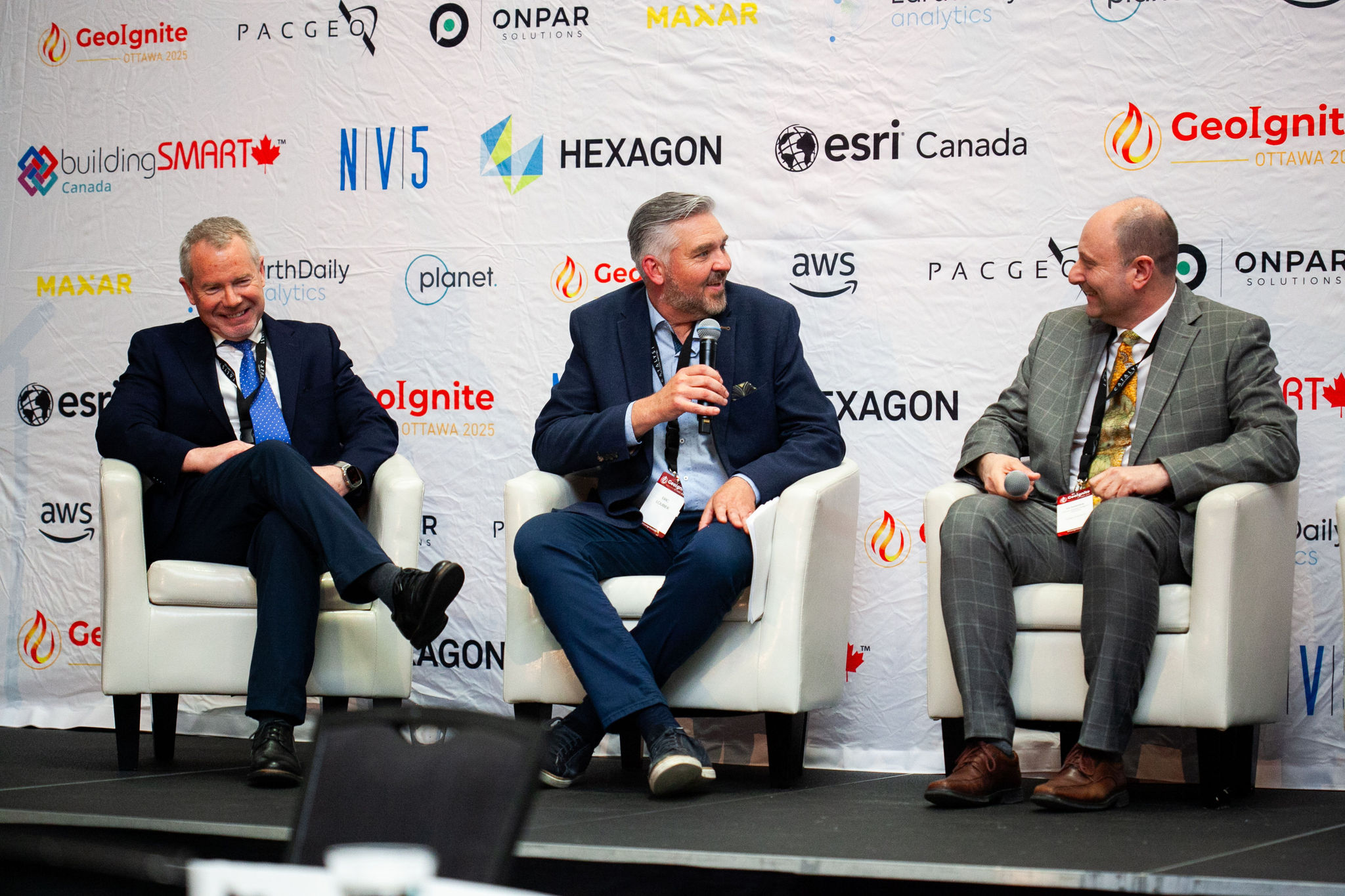
Loubier echoed this sentiment, pointing out the increasing dual-use potential of technologies originally developed for civilian purposes. “If I do change detection for map updating,” he said, “that same process through AI could be reused for surveillance in the Arctic or for border monitoring.” He called for a mechanism to identify where geo-intelligence solutions are emerging across government and break down the silos that isolate them.
AI, Industry, and the Business Model Dilemma
The conversation quickly turned toward AI adoption and public-private collaboration. Larson, whose company EarthDaily is launching a constellation of Earth Observation satellites next month, argued that Canada’s GEOINT model must move away from slow, procurement-heavy approaches toward long-term, service-based models. “We’re transitioning from traditional RFIs and RFPs to subscription-driven services,” he said, drawing a parallel to how Netflix transformed the video rental market by embracing the cloud.
He emphasized that cloud computing, miniaturization, and falling launch costs are making this shift inevitable — and Canada must adapt its business model to stay competitive. “We need a factory model,” Larson added. “Government identifies the needs. Industry designs, builds, operates, and maintains the solutions — with long-term financing and scalability built in.”
Vandenberg acknowledged historical trust issues between defense and industry but pointed to recent steps toward change, including a new defense industrial strategy under development. “There are a lot of things industry does better than government,” he said. “We have long since come past the idea that the government should build everything.”
Still, both he and Loubier stressed that the real challenge is aligning innovation with long-term sustainability — particularly when government departments are under increasing budget pressure.
Open Data: Still Foundational, But Under Threat
Shukle steered the conversation to the role of open data as a public good. While Canada’s open data policies have delivered undeniable benefits, Loubier warned that they can only succeed if the infrastructure behind them is sustainably funded. “When technology is taken for granted, it risks disappearing,” he said. “We need to make sure that open mapping and EO infrastructure doesn’t become invisible — and therefore ignored.”
Larson agreed, suggesting that Earth Observation must evolve into an “invisible embedded utility,” akin to GPS in smartphones. “100 terabytes of data a day — that’s too much for human eyes,” he said. “It has to be processed by machines, by AI.”
What’s Holding Canada Back? Culture, Capacity, and Political Will
A consistent theme throughout the session was Canada’s slow pace of structural change. “We’re not going to see change just because we want it,” said Vandenberg. “It will come when elected officials make it a political priority.” He cited the example of U.S. defense agencies routinely working with cleared private contractors in secure environments — a cultural norm that Canada has yet to fully adopt.
Audience members raised concerns about government “leanness” — that agencies are now too understaffed to even evaluate or absorb innovative EO offerings. One participant noted that “lack of demand is not necessarily lack of intent — it’s lack of bandwidth.”
In response, the panel agreed that a clearer demand signal from government, including sustained procurement of Canadian EO data and services, could radically alter the industry’s trajectory. Larson pointed to the success of U.S. and Japanese programs where governments played anchor customer roles, enabling commercial growth and global competitiveness.
Final Thoughts: From Potential to Action
As the session closed, panelists stressed the need for a cultural shift, not just a technological one. Canada has the tech knowhow but still lacks the policy frameworks and business models to fully capitalize on them.
The challenge, as framed by Shukle, is to stop chasing “shiny pennies” and start building long-term, integrated systems that serve both public needs and private innovation.



Be the first to comment