
Transmission constraints
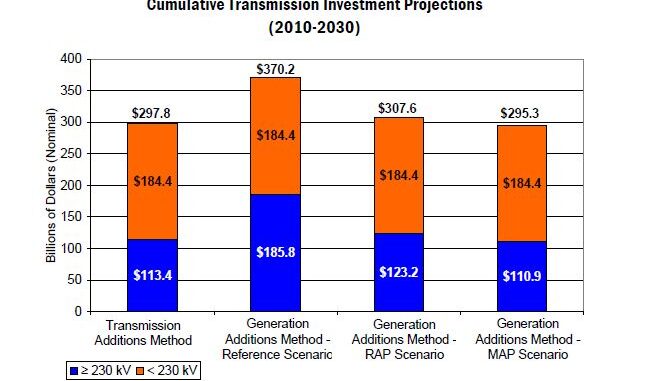
Estimates of the transmission buildout required in the US to reduce congestion and to bring renewable electric power to market have ranged from 19,000 to 50,000 miles of new transmission lines. The Brattle Group has estimated the total investment in transmission required between 2010 and 2030 to be on the order of $300 billion. One of the most important provisions of the Energy Policy Act of 2005 was to encourage expansion of the transmission grid in the U.S.
In the United States it has been estimated that it requires 12-20 years to plan and build a new transmission line. In October, 2009, nine Federal entities signed a Memorandum of Understanding increasing their coordination to expedite and simplify building of transmission lines on Federal lands. The Obama administration has announced pilot projects to streamline the permitting of transmission lines, to speed up integration of renewables.
It was reported from the recent NARUC Summer Committee Meetings that some U.S. states may not be able to meet their renewable portfolio standards (RPS) goals because of a lack of transmission to carry the power to market. “Transmission constraints are impeding RPS implementation in large portions of New England, transmission congestion is inhibiting renewable energy use in New York.”
In California a state Commissioner said that Pacific Gas & Electric (PG&E), Southern California Edison (SCE), and San Diego Gas & Electric (SDG&E) are currently each obtaining approximately 21% of their energy from renewable resources and he expects that California will be able to meet its mandated target of 33% renewable.
Costs
 Another important factor is the continued low cost of natural gas generation and what some forecast will be the increasing cost of renewable energy generation. For example, Texas has already met its 2020 RPS objective of 10 GW of renewable energy capacity, mostly through wind generation. It is projected that because of competition from low cost natural gas generation, the transmission lines built as part of the the competitive renewable energy zone (CREZ) with a capacity of 18 GW from West Texas, may not be used to their full capacity. One prediction is that only 11 GW of the transmission capacity will ultimately be used. One regulator said that the cost of renewable generation including the necessary transmission and the cost of the dispatchable backstop generation could get too expensive and cause consumer backlash. A FERC commissioner expressed the opinion that ultimately coal and natural gas generation will become more expensive than renewable. The imponderable is when the price of natural gas will rise to what some forecast will be about $8/Mcf from the current economically unsustainable $2.00/Mcf.

Be the first to comment