
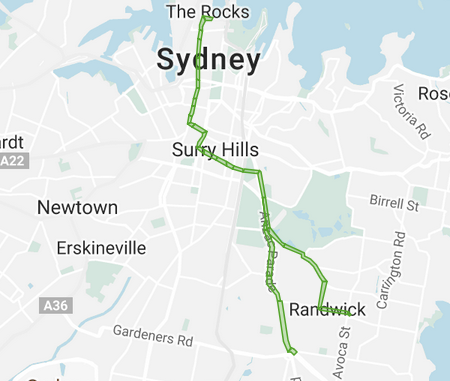
The Sydney Light Rail Project is a $2.1 billion PPP project for 12 km of light rail to be completed by 2019. Prior to awarding the contract for construction the Department of Transport for New South Wales undertook 12 months of night work to map 5,000 subsurface utilities along the route. 500 existing subsurface utilities were identified for relocation to make way for the new light rail infrastructure.
The first problem that was encountered was that as-built information from utility providers was frequently unreliable – incorrect location, incorrect materials, and so on – which caused disruption and delays with construction. The second problem was that during construction an additional 400 unknown services, not on the DoT maps, were found. Each of the unknown utility services that was encountered had to be treated as potentially live and all utilities in the area had to be contacted to try to identify the service, a process that typically required a month. Of the 400 unknown services that were found, a few were claimed by one of the utilities, but most of the unmapped services were found to be no longer in service. Unnecessary costs to the construction program were incurred as a result of these unforeseen delays. In addition completing the relocation of utilities was delayed by 5 months.
ACIL Allen (3D QLD Road Map – preliminary findings. Brisbane: #D QLD Task Force 2017 reported in Economic Value of Spatial Information in NSW 2017) has estimated that if a complete and reliable 3D map of underground infrastructure had been available at the project planning stage, the project could have been completed at least one and a half years sooner, at less cost with a much lower level of risk. While the project apparently remains ‘on time and on budget’, ACIL Allen says that this is only because the risk of delays and additional costs resulting from unidentified underground utilities were included in the contract pricing and schedule.
Construction folks will not be surprised by this. It once again points out advantage of 3D models replacing unreliable as-builts because it enables a process that speeds up project development because it leverages existing engineering data rather that requiring a “complete resurvey” (usually incomplete with respect to underground utilities) at the beginning of every project..
Be the first to comment