
The Ceres Benchmarking Air Emissions report compares the air pollutant emissions (SO2, NOx, mercury, and CO2) of the 100 largest U.S. power producers for 2010. These utilities include both public and private companies that own about 2,500 power plants and are responsible for 86 % of electric power generation and 88 % of the electric power industry’s emissions.
The U.S. electric power industry includes 5,800 power plants, which in 2010 generated 4.1 billion MWh of electricity. 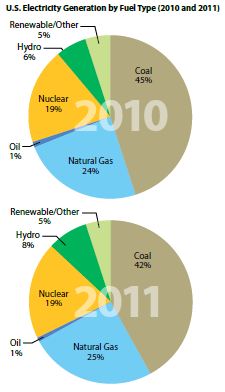 About 69 percent of this power was produced by burning fossil fuels (coal, natural gas, and oil) resulting in the release of SO2, NOx, mercury, and CO2.
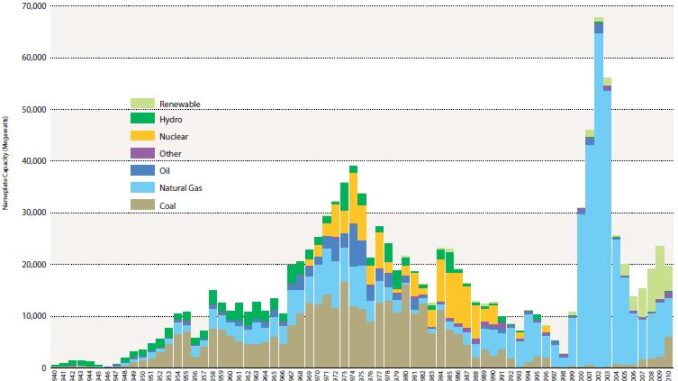
The U.S. electric power industry is changing rapidly. Since January 2010, about 40 gigawatts (GW) of coal plant retirements have been announced. According to the EIA, in April 2012 electricity generation from gas-fired plants was virtually equal to the generation from coal-fired plants. Renewable energy production more than doubled from 83 million MWh in 2004 to 195 million MWh in 2011. Utility energy efficiency budgets have increased 26 percent from $5.4 billion in 2010 to $6.8 billion in 2011.
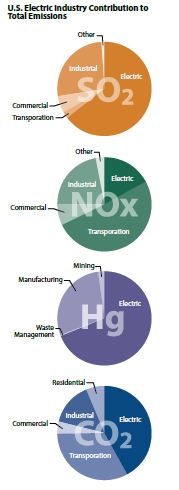
In 2010, the electric power industry was responsible for
- 64 % of SO2 emissions
- 16 % of NOx emissions,
- 68 % of mercury air emissions
- 40 % of CO2 emissions (more than transportation and industry )
Electric power industry emission trends
 In 2010 electric power emissions
- of CO2 were 24 % higher than they were in 1990 and 5 % higher then 2009 (total U.S. greenhouse gas emissions increased by over 3 %)
- of both SO2 and NOx were 68 % lower than they were in 1990 and continued to decline in 2011 and 2012.
- of mercury has only just begun to be resported by utilities
The increase in emissions is ascribed to increased energy consumption resulting from economic growth.
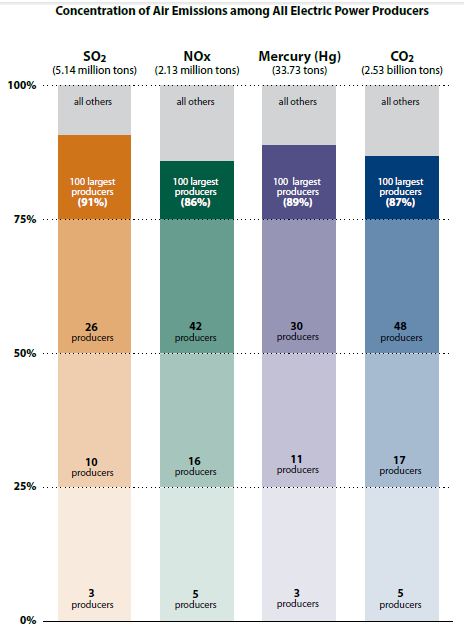 Air pollution emissions from power plants are highly concentrated among a small number of producers. About a quarter of the electric power industry’s CO2 emissions are emitted by five of the top 100 producers. Just three of the top producers are responsible for about 25% of SO2 emissions.
Energy efficiency
Efficiency programs were estimated to have generated 112.5 million MWh of electric energy savings in 2010. Ratepayer-funded energy efficiency program budgets in the United States increased 26 percent from $5.4 billion in 2010 to $6.8 billion in 2011. California, New York, Massachusetts, and Florida accounted for 50 % of the total electric energy efficiency budgets in the United States.
As of 2011, 24 states have established energy efficiency resource standards (EERS) which require utility companies to reduce their customer’s energy use through energy efficiency measures. For example, Vermont and Massachusetts require 2.5 % savings annually.
Regulations
Power plants are covered by federal regulations related to air quality, water quality and solid waste.
Mandatory reporting of green house gas (GHG) emissions – all major stationary sources of greenhouse gas emissions, including power plants, must report their greenhouse gas emissions beginning January 1, 2010. The program is expected ultimately to include 10,000 facilities and cover 85 % of the nation’s greenhouse gas emissions.
Regulation of GHG emissions
- EPA finalized emissions standards for new light-duty motor vehicles in 2010, and standards for medium- and heavy-duty vehicles in 2011.
- In 2010 EPA issued its final “Tailoring Rule” setting air permitting requirements for large stationary sources of greenhouse gas emissions under the so-called Prevention of Significant Deterioration (PSD) and Title V permitting requirements of the Clean Air Act.
- In 2012 EPA released a proposed New Source Performance Standard (NSPS) requiring new plants to have a GHG rate equal to or lower than that of a new combined-cycle natural gas plant.
- In 2011 EPA published the Cross-State Air Pollution Rule (CSAPR) which limits SO2 and/or NOx emissions from power plants in 28 states. Late in 2011 a circuit court stayed the rule pending litigation from states and utilities.
Mercury and hazardous air pollutants – In 2011 EPA released the federal limits on hazardous air pollutants from coal-fired power plants, known as the Mercury and Air Toxics Standards (MATS).
Coal ash waste – In 2010 EPA proposed two options to regulate coal ash disposal under the Resource Conservation and Recovery Act to regulate coal ash as either hazardous or non-hazardous waste.
Cooling water intake structures – In April 2011, EPA proposed new regulations governing cooling water intake structures at existing power plants. The final regulation is expected in 2012.

Be the first to comment