
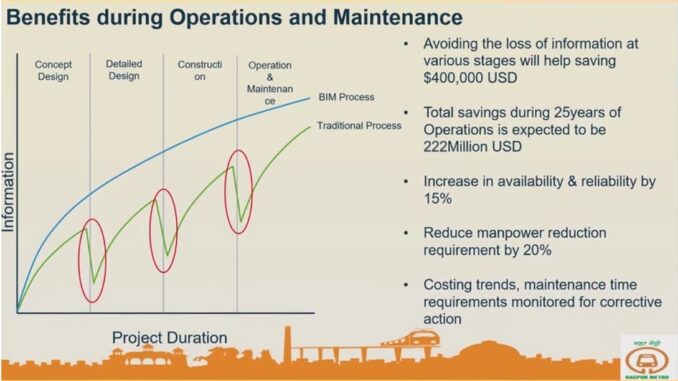
This year’s winner of a special recognition award at Year in Infrastructure was Maharashtra Metro Rail Corporation Ltd for its Nagpur Metro Asset Information Management System which implemented a digital twin and a tagging scheme right from design with the goal of eliminating information loss over the life-cycle of the project. It is estimated that this will save US$ 222 million over the 25 years of operation of the metro rail system.
The UK Government as part of its building information modeling (BIM) initiative has said repeatedly that it expects the big payoff of a digital twin, estimated at more than 40% savings, will be during operations and maintenance, typically representing 80% of the total cost of a facility. Companies such as BAM who do Design, Build, Finance and Maintain (DBFM) projects report significant benefits from full lifecycle BIM + geospatial. But there is little if any quantitative evidence supporting this conjecture. I have asked people from Finland familiar with the very early BIM developments in that country if there were studies of the benefits of BIM for operations and maintenance, but apparently the BIM focus there has been entirely on design and build. Crossrail with a budget of £14.8 billion is the biggest engineering project in Europe. The most interesting aspect of the Crossrail project is a 3D digital twin that has not only been used during design and construction, but is intended to be used for operations and maintenance. Crossrail appears to be one of the first major projects that may be able to provide support for the conjecture that the biggest benefits of BIM + geospatial are for operations and maintenance.
One of the first quantitative estimates of the benefits of a 3D BIM+geospatial full lifecycle project strategy I have seen was offered by this year’s a winner of a special recognition award at Bentley’s Year in Infrastructure in London. Maharashtra Metro Rail Corporation Ltd’s Nagpur Metro Asset Information Management System has implemented a digital twin and a tagging scheme right from design with the goal of eliminating information loss over the life-cycle of the project.
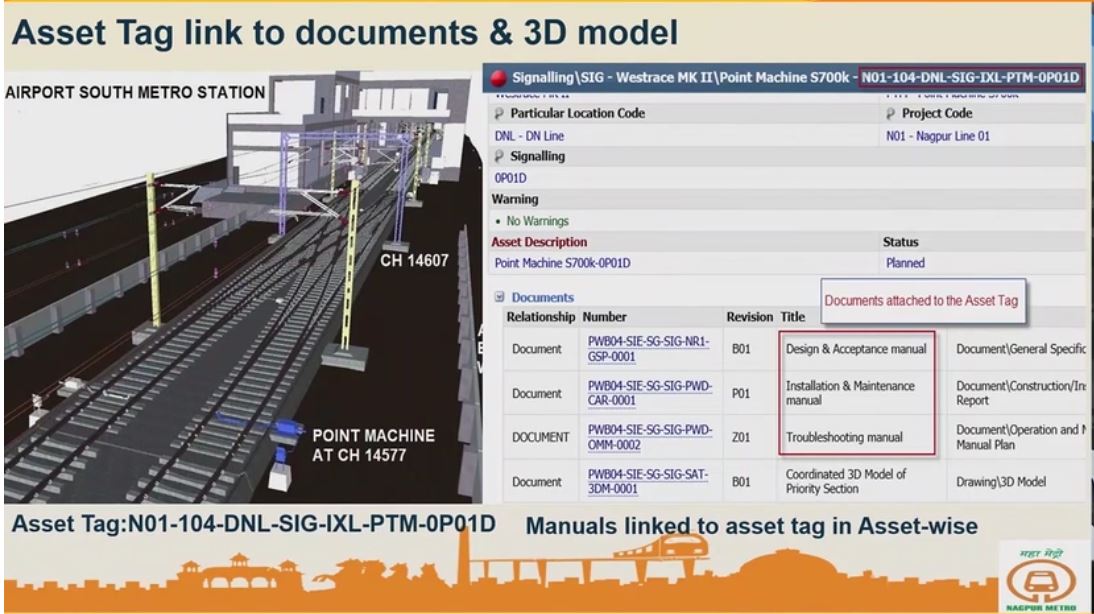 The Napgur Metro is a US$1.3 billion project underway in Nagpur, a city of 3.5 million in the Indian state of Maharashtra. This is the first project in Asia to integrate a digital twin with an asset management system to eliminate information loss about assets during design and construction. A 23 digit asset code was used to link 3D models developed using Bentley BIM tools with SAP financial management making it possible to track assets right from design through to operation and maintenance. BIM best practices followed the British PAS 1192 guidelines. Since the Nagpur system implements a full-lifecycle approach to project management, the location of each of the 500,000 assets comprising the systems is recorded making it possible to click on an asset in SAP and be shown the location of the asset in a 3D map. QR codes are used to track different versions of drawings. Final deliverables are digital models (Bentley iModels) rather than paper drawings providing a basis for digitalizing operations and maintenance.
The benefits of a 3D BIM+geospatial approach have been projected based on a 25 year lifetime for the project. It is expected that this will result in US$400,000 savings during plan, design and build, a reduction in operating manpower requirements by 20%, and increased availability and reliability. The really big payoff is an estimated savings of US$222 million over the lifetime of the project.
Geolocation plays a key role in integrating GIS and engineering data and applications for optimizing asset management workflows. One of the foundations for an integrated system of this type is Bentley’s decision many years ago to geospatially-enable all of their products Bentley calls this capability geocoordination. It provides a location-aware foundation for workflows that require integrated engineering and geospatial data and applications.

Be the first to comment