
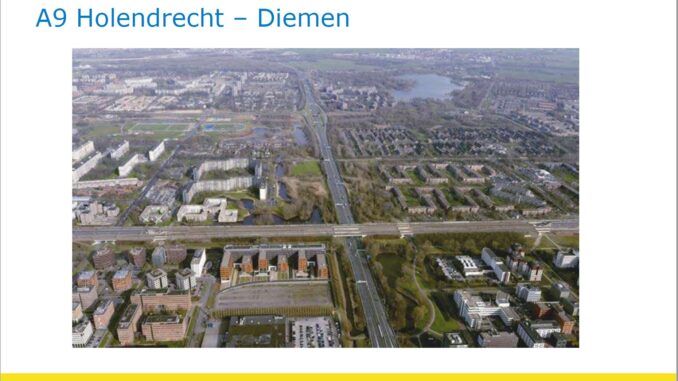
At the GeoBIM Building and Infrastructure Conference in Amsterdam, Ingeborg Ligtenberg, Senior Project manager for Mega Projects, described how the Dutch highway authority Rijkswaterstaat (RWS) is piloting a very different approach to highway construction. Rijkswaterstaat is responsible for the design, construction, management and maintenance of the main infrastructure facilities in the Netherlands including the national road network, waterway network and sluices.
Background
By way of background, the highway plan-design-build process that has been used over at least the past 25 years, starts off with a complete (re)survey of the project terrain to create a basemap on which the design is based. Existing as-builts in the area are rarely if ever consulted. The deliverables from the design process are paper drawings which are used by construction contractors to build the project. After construction is complete construction as-builts are submitted to the owner, but these are not “sealed”, meaning nobody signs off on them putting their professional reputation behind their accuracy and reliability. Practically what this means is that in the transportation industry, as-builts are treated as unreliable information and are rarely consulted.
At SPAR 3D 2013 Ron Singh, Engineering Automation Manager/Chief of Surveys, Oregon Department of Transportation (DoT) made a startling proposal that would stand the traditional highway construction process on its head. He proposed that the DoT should specify the data it needs and this data including BIM models and LIDAR scans would be collected by the DoT from the contractors during and after a highway construction project. The data would be saved in a geospatially-enabled database maintained by the DoT. One of the implications of this approach is that when a new project is initiated in the same area over 80 % of the necessary survey-grade information would already be available in the DoT’s database, which would make the traditional complete resurvey unnecessary – saving time and money.
As an example of how data reuse can save time and money, the Oregon DoT’s first automated machine guidance (AMG) project was in 1997. At that time in Oregon a few forward-looking contractors had invested in AMG technology foreseeing that it would save them money. These forward-looking contractors were winning bids by lowering their estimates just enough to beat other contractors. They found that AMG technology did save a lot of money. But the savings were going to the contractors, not to the DoT. To redress this, starting in early 2015, the DoT began specifying on its bid web site that projects were “AMG ready” meaning that the DoT was making available provide all the data it had which could be download to see design BIM models, mobile LiDAR, overflight data, and so on. The effect has been to drive bids down, because there is less risk for the contractor. As a result the DoT is now sharing in the savings.
Rijkswaterstaat pilots
At the first GeoBIM conference in Amsterdam, Jothijs van Gaalen gave some real world examples of highway construction transformation based on GIS+BIM integration including using laser scanning/LiDAR for reality capture at the beginning of a design/construction project.
The Rijkswaterstaat (RWS) board is convinced of the benefits of BIM and BIM/geospatial integration and decided initially to roll out BIM on four design-build-finance-maintain (DBFM) projects with the intention to require BIM on all DBFM-contracts in the future.
One of these projects is a highway expansion project for the highway connecting Schiphol-Amsterdam-Almere or SAA. The objective of the SAA project was to improve the accessibility and quality of life within the SAA corridor. 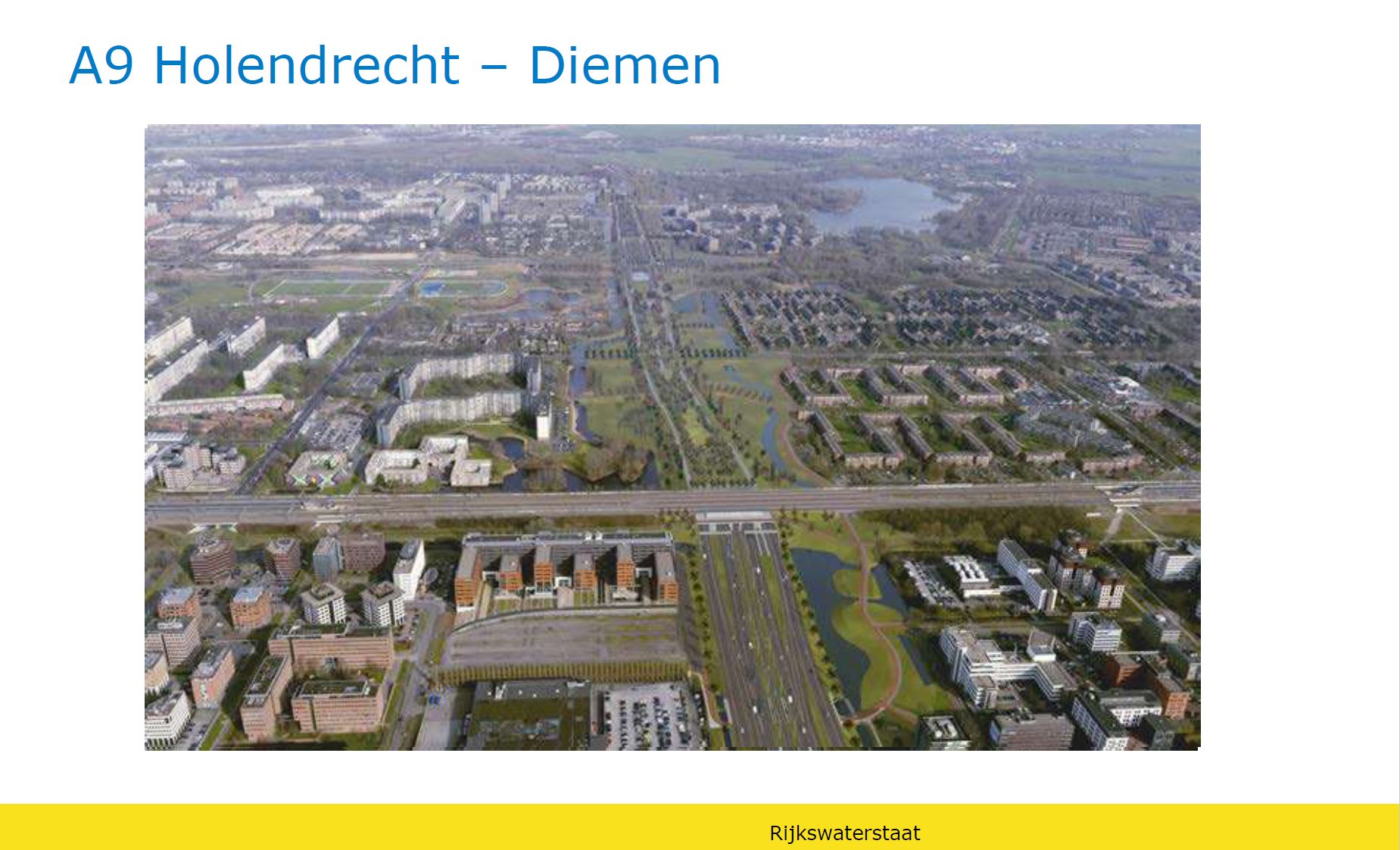 This includes the improvement of the natural and social environment and economic development and employment opportunities in the northern Randstad region. A stretch of the highway is shown before and after the highway widening.
On many highway projects RWS had experienced information flow problems due to different formats and data models. This not only necessitated major data conversion efforts, but also inhibited collaboration. One of the goals of the SAA project was to improve information flow which was expected to also improve the flow of asset information for reuse during the maintenance phase of the highway.
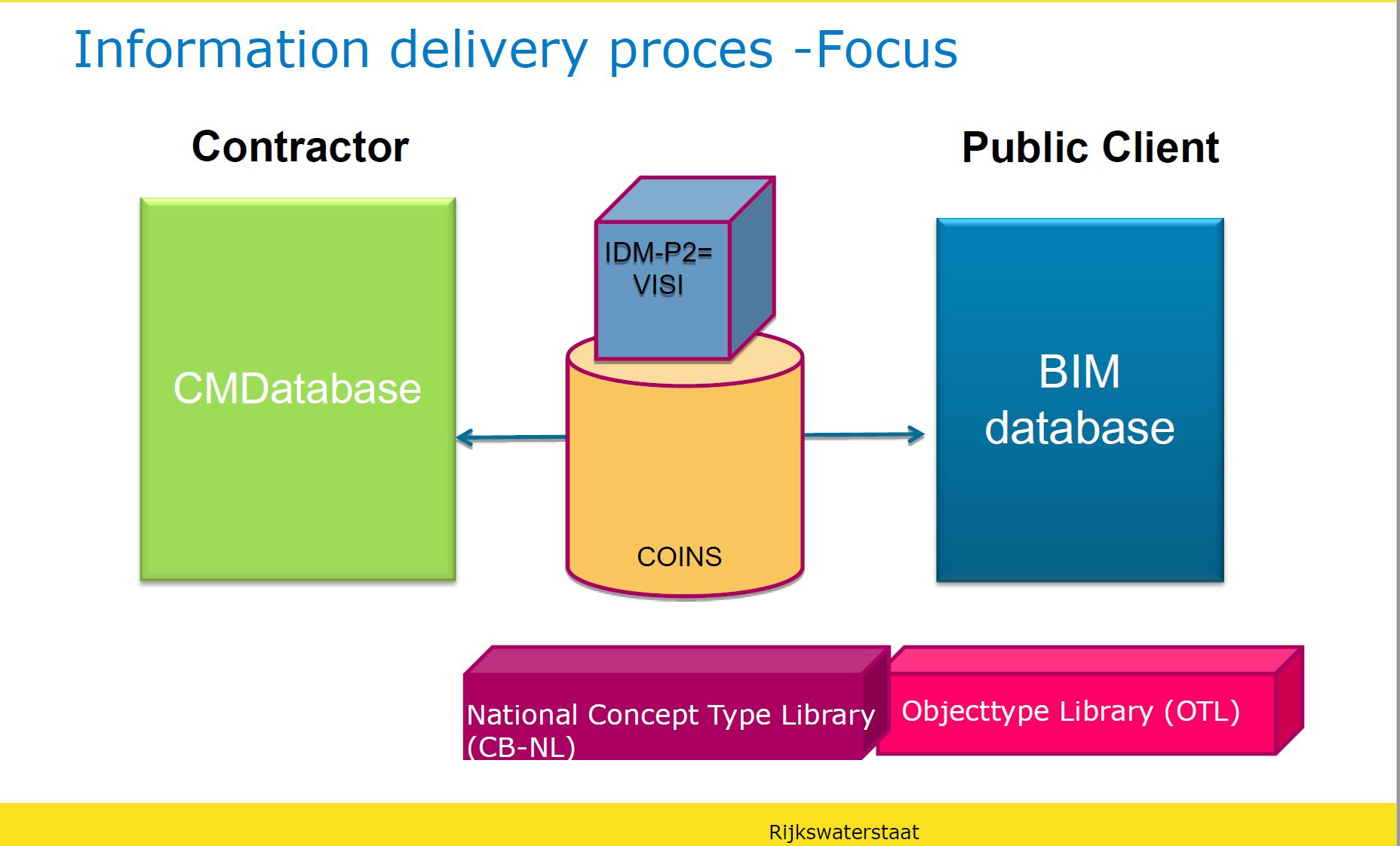 A critical part of the RWS’ new approach was the Information Delivery Specification (ILS). The ILS specified the general aspects of the required information including formats, standards, structure, and expected quality (timeliness and reliability) of the information. The ILS was a contractual obligation that also required the contractor to accept new versions of standards on a yearly basis. The standards that were adopted to ensure a uniform flow of structured information include VISI (an open communication standard for the construction industry based on XML), National Concept Type Library (CB-NL), Object Type Library (OTL), and COINS.
Today RWS is receiving a quarterly delivery of data from the contractor compliant with the ILS. This is a remarkable achievement that required a lot of hard work during this first project. But now that contractors are familiar with the standards and the ILS concept, it is expected that ensuring a uniform flow of information will be easier in future projects. The next challenge is enabling this data to be used for asset management during the maintenance phase of the project.
Reusing data on future projects
In response to a question, Ingeborg Ligtenberg said that this new approach was still in its initial phases but that the data would likely be made available to designers and contractors for future projects. It would be made available on an “as is” basis, which sounds similar to how the Oregon DoT makes its data available on its bid site.
As Ron Singh has pointed out, there is tremendous value in this data, but the value is only there if in the future engineers feel confident in using the data. If very accurate and rich data were collected during and after construction including, critically, its lineage in the form of metadata about how and when it was captured, so that a future engineering user would have no reason not to trust its provenance and reliability, then there should be nothing to prevent the data from being reused in future projects – saving time and money.
Autonomous vehicles
One of the consumers of this digital highway information may be autonomous vehicles. In-vehicle sensing is limited in its ability to enable safe and reliable driving under all conditions. For example, on snowy roads, lane markings may not be visible. Such driving conditions will require the autonomous vehicle to be equipped with ultra-accurate maps to augment in-vehicle sensing systems. Pre-loaded high-precision maps would enable autonomous vehicles to overcome many of these challenges – staying within lanes when wintry conditions obscure the lane markers. This will require sophisticated mapping systems and ultra-accurate and reliable DoT data to enable vehicles to navigate under challenging conditions.

Be the first to comment