
The Texas Water Development Board publishes a State Water Plan for the state every five years and has just approved the 2012 plan.
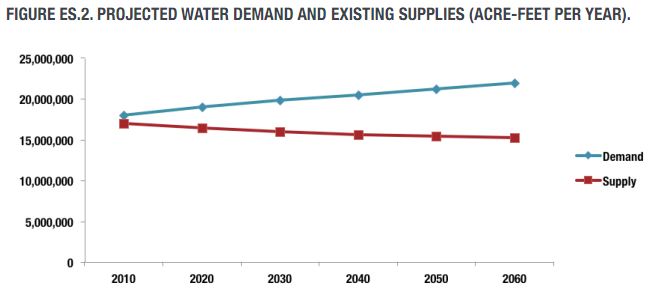
The state population, which is now 25 million, is projected to increase to 46 million by 2060, but demand for water is projected to rise by only 22 % partly because of reduced agricultural demand. Irrigation now accounts for 60 % of water demand in Texas, but this share is projected to drop to 45 % by 2060.
Over the same period water supplies will fall 10 percent as the Ogallala and other aquifers are depleted. The report says “In serious drought conditions, Texas does not and will not have enough water to meet the needs of its people, and its businesses, and its agricultural enterprises.”
 In the context of climate change, it says that temperatures are likely to rise, but that future precipitation trends are difficult to project. Climate models suggest that temperatures will rise and precipitation will decrease. In this scenario, Texas would begin experiencing droughts in the middle of the 21st century that are as “bad or worse as those in the beginning or middle of the 20th century.”
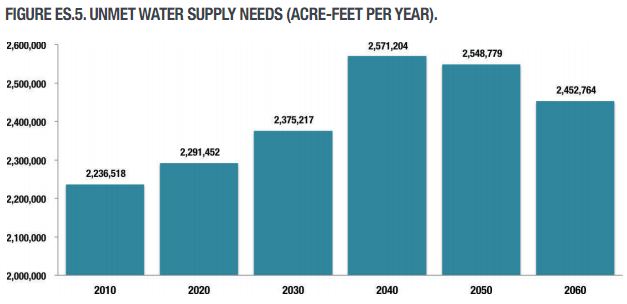 To ensure that the state has enough water, it is estimated that the state needs to invest $53 billion in building new reservoirs and wastewater treatment plants and other water infrastructure.
The report makes several recommendations
- develop three reservoir sites that are already planned
- make it easier to site other reservoirs, and to transfer surface water between different areas
- require public water utilities to audit their water losses annually rather than every five years

Be the first to comment