
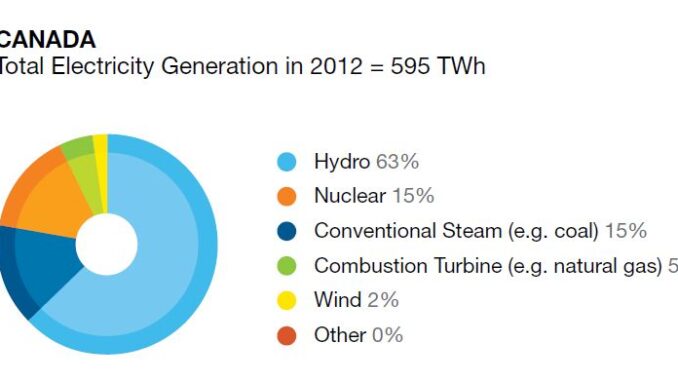
80 % of Canada’s electricity generation comes from non-emitting sources, primarily hydro and nuclear. Globally Canada is third in the total hydroelectric power generation, behind China and Brazil. 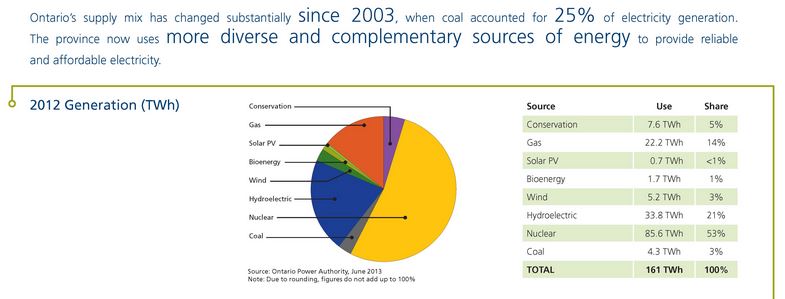 Ontario is on schedule to eliminate coal generation by next year. In spite of having some of the greenest power in the world, global statistics show that Canadians pay average electricity prices that are lower (and in many cases substantially lower) among OECD countries.
Some provinces still burn coal, but they are moving toward reducing emissions. For example, SaskPower’s Boundary Dam Integrated Carbon Capture and Storage Demonstration Project is the world’s largest commercial-scale carbon capture and storage (CCS) project. It aims to reduce CO2 emissions by up to 90 %, capturing one million tonnes of post-combustion CO2 emissions every year.
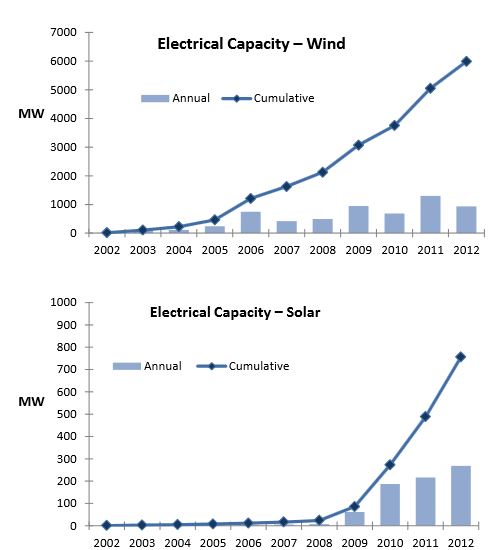 The next wave of Canada’s electricity infrastructure will need to focus on the replacement of the remaining emitting and less efficient generation with distributed generation primarily wind and solar PV.
Cumulative wind generation reached 6.2 GW in 2012. Beginning with Ontario’s Green Energy Act in 2009 solar photovoltaic (PV) has grown rapidly
- 2009 62 MW
- 2010 186 MW
- 2011 216 MW
- 2012 268 MW
to reach a cumulative total capacity of 765 MW in 2012. The majority of these installations occurred in Ontario through Ontario’s feed-in-tariff program..
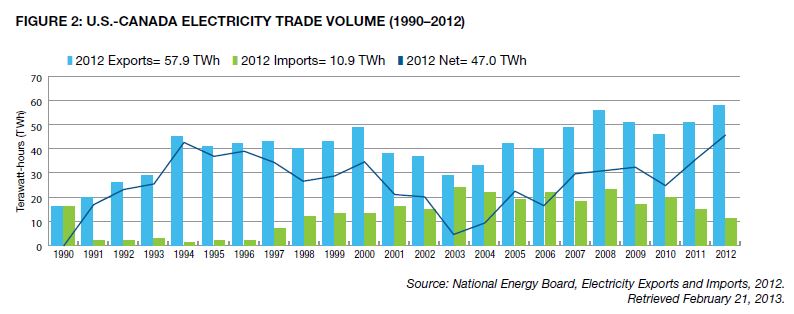 Canada is the largest supplier of electricity to the U.S. In 2012 Canada supplied 47,000 GWh net of electricity to the U.S. Historically, electricity exports to the U.S. have represented
5 to 10 % of Canada’s total generation. The majority of electricity moving from Canada to
the U.S. is coming from clean, non-emitting sources. Most of the states in the U.S. have renewable portfolio standards (RPS) setting clean energy objectives which creates increasing future opportunities for clean (relative to the U.S. generation mix) Canadian energy.
The Conference Board of Canada estimates that more than $350 billion will be need to be invested in Canada’s electricity grid over the next two decades. This will be required to exand transmission networks to provide new generation, including renewables, access to the grid. It will also enable energy conservation, smart grid and distributed generation technologies, increase system effi ciency and empower customers to make more informed decisions about their power usage. For example, 50 % of Ontario consumers have access through the province’s Green Button program to the power usage data collected by their smart meters (everyone in Ontario has a smart meter and is on time-of-use tariffs). British Columbia has completed installing 1.8 million smart meters across the province.

Be the first to comment