
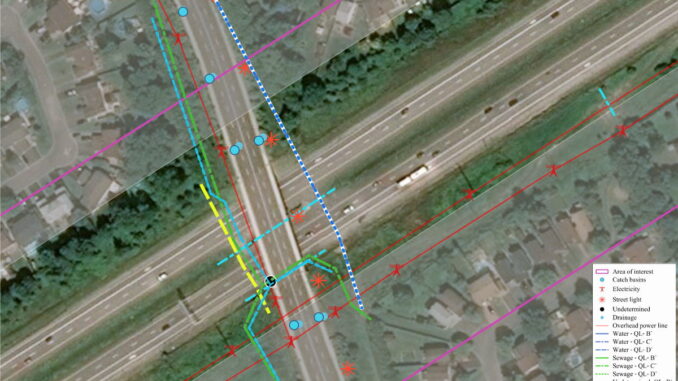
Return on investment (ROI) studies of subsurface engineering utility engineering (SUE) surveys applied to highway construction projects conducted since the late 1990s have consistently revealed a large return-on-investment from conducting SUE surveys as part of highway construction projects. Studies have found that the major benefits of SUE surveys are improved construction efficiency, greater probability of on-time and on-budget project completions, fewer and shorter utility service outages and less traffic disruption and delays for the motoring public. Recently jurisdictions such as Colorado have mandated SUE surveys on all public civil engineering projects.
The objective of a SUE survey is to identify and locate all underground infrastructure in the area of the proposed project to ASCE 38-02 Quality Level B or better. Currently SUE surveys rely on on-site detection technologies such as electromagnetic (EM), ground penetrating radar (GPR), and other methods to remotely detect underground utilities. Potholing is also routinely conducted as part of a SUE survey to confirm the identification and location of utilities that have been detected by remote sensing technologies.
Using remote detection methods and potholing requires “boots on the pavement” which raises safety as a major concern when conducting a SUE survey. EM devices are typically handheld wands and GPR is usually mounted on pushcarts. Data acquisition occurs at a walking pace. Furthermore the reliable interpretation of GPR scans requires an experienced geotechnical practitioner. Together these factors make SUE surveys slow, laborious processes with serious safety issues.
I have recently come across a technology innovation developed by 4M-Analytics that could provide SUE practitioners with a source of data without the major disadvantages of traditional remote detection methods; it is safer because it does not require boots on the pavement, can reliably provide accurate locations, can be conducted without disrupting traffic, and can be generated much more rapidly than the traditional on-site remote detection methods. Intended for linear civil engineering projects such as pipelines and transportation routes 4M-Analytics’ technology utilizes high-resolution satellite and aerial imagery, computer vision algorithms, and training sets for machine learning developed for different biomes, including forests, grasslands, and deserts. The deliverable to the SUE practitioner is a complete, accurate and up-to-date utility conflict map showing the location of all underground utilities and pipelines intersecting a proposed civil engineering project.
SUE is rapidly growing in importance for civil engineering projects. This revolutionary approach to locating underground infrastructure, which utilizes the huge volume of aerial and satellite earth observation imagery that has been built up over the past decades together with machine learning, could provide an important source of rapidly produced, safely acquired, and reliable underground location data for SUE practitioners.

Be the first to comment