
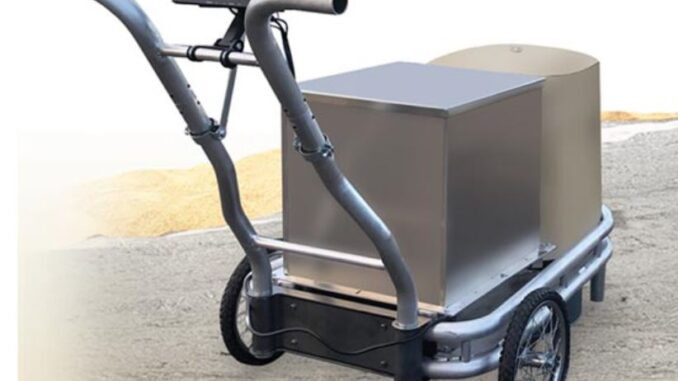
There have been significant advances in technologies for detecting underground infrastructure including inertial locating, novel radar technologies applied to ground penetrating radar (GPR), and software for post processing GPR signals to produce tomographic images. Each has its limitations. Inertial locating is restricted to known pipelines. Electromagnetic detection (EM) is restricted to conducting cables and pipes and low conductivity soil conditions. GPR can’t distinguish between different types of utilities and its effectiveness is also limited under high conductivity soil conditions. Recently there is evidence that acoustic surveying may provide a technology that complements existing techniques; unlike EM and GPR methods it can detect non-metallic objects and is not affected by type of surface, soil type or moisture content.
Cartacoustics, LLC, has developed an acoustic surveying technique that uses specially crafted audible sound wave packets to locate and trace buried utilities. Sound waves are crafted into recognizable patterns and sent into the ground using special speakers. Ultra sensitive geophones then listen for reflected sound waves with the crafted patterns. Post-processing determines the time of the flight of the waves to estimate the depth of the objects that reflected the sound waves. Because of the frequencies used, the ability to detect underground objects is not affected by the type of surface (asphalt, concrete, dirt, or sod), the type of soil such as clay and the moisture content of the soils, all of which reduce the effectiveness of GPR. Acoustic locating has been successfully used in saturated soils, rocky and sandy soils, and in high-clay content soils. It has also been applied successfully with four inches of snow on the ground and immediately after a hard rain. In many soils GPR may be only able to detect objects a few meters down. Acoustic location is effective 30 feet or 10 meters down. The survey is non-invasive and non-destructive.
Acoustic surveying involves sampling at a number of points in the field area and then interpolating between the survey points to detect man-made structures such as cables or pipelines and their approximate locations. In addition to manufacturing the acoustic field collection hardware, Cartacoustics has also created several deliverable map products to present placement of the detected underground structures. ASTmap!™ contains a series of products that summarize the data collected in an acoustic underground survey at various levels of fidelity. A 2D map product called a DIGsafe! map highlights areas where underground structures have been located and areas that are free from acoustic returns. These areas show where it is safe to dig and where caution is required. Two additional ASTmap! products provide more detailed information on depth of cover to detected structures and can be provided in various CAD formats. For a typical day-long collection, the processing and analysis takes a day or two. This means that results are generally available within a week of the survey for review.
To validate the technology Cartacoustics has surveyed a number of sites across the country. In the first such surveys they chose sites with manholes, fire hydrants, water valves and gas metering stations that are obvious indicators of subsurface structures. Acoustic surveys were conducted along the streets and right-of-ways containing these features. The acoustic returns revealed the features in the correct locations and depths as expected from nearby manholes.
Brown and Caldwell (BC) recently employed Cartacoustics’ technology to survey a half-acre portion of Metro Vancouver’s Annacis island Wastewater Treatment Plant (AIWWTP) in Vancouver, British Columbia. In the past, mapping underground infrastructure would have employed traditional techniques such as EMI, GPR and excavation. At this site, the soil conditions render GPR and EMI techniques ineffective, and excavation would have been required.
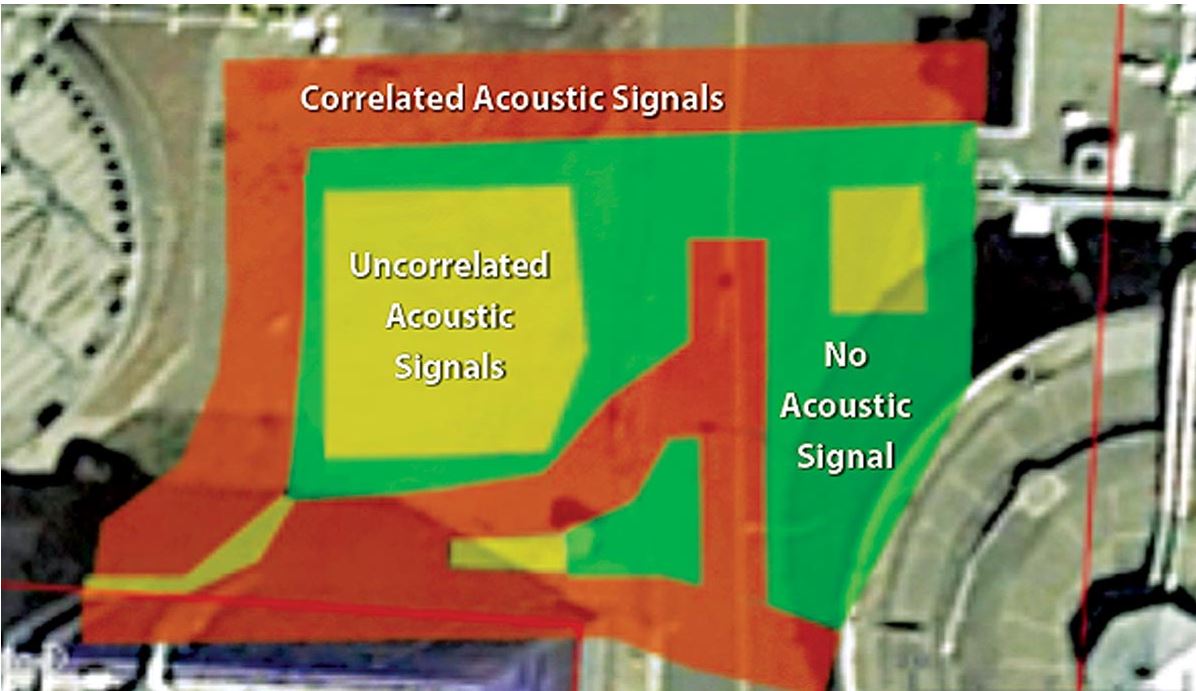 To acquire the needed subsurface data, an acoustic survey was conducted on a rectangular grid with 3-meter spacing between points. At each point the time of flight and horizontal location was recorded. Collected data are post-processed and detected objects were correlated from the recorded information of all surveyed points to reveal objects extending across multiple adjacent survey points and objects that were uncorrelated across adjacent points. The result of the post-processing is a 3D model of underground objects. Comparing the 3D model against the plant’s engineering drawings and Building Information Model (BIM) showed very strong correlation between expected infrastructure and the acoustic results. While the correlation was strong, the results also offered a couple of surprises – one pipe that did not follow the expected track according to the engineering drawings and several areas of uncorrelated data. This latter is suspected to represent “debris fields”; the area surveyed is in the oldest part of the plant and the “debris fields” are likely construction waste that was buried during early construction of the facility.
Many in the subsurface utilities location industry rely on a multi-sensor approach including electromagnetic detection, ground penetrating radar and other technologies. The acoustic survey results acquired to date suggest that this acoustic-based technology has the potential to add an important complementary technique to the typical underground locating quiver of EM and GPR.

Be the first to comment