
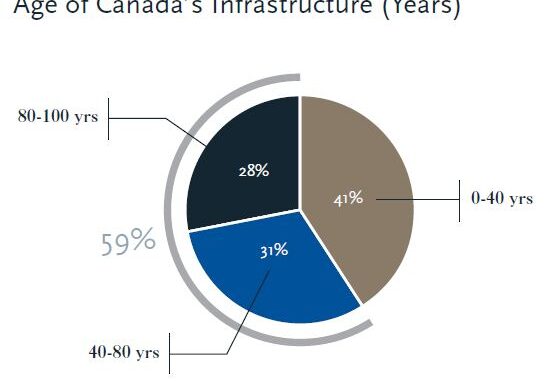
In 2007 I blogged about a report by the Ontario Sewer and Watermain Construction Association that found that crumbling underground pipes in some areas of Ontario were causing leakage rates as high as 30 per cent. It also estimated that leakage is costing ratepayers more than $160 million a year across the province.
Last year I blogged about a wastewater example here in Ottawa, the nation’s capital, where the Chairman of the City Council’s Planning and Environment Committee was quoted as saying “We can’t continue to pump sewage into the Ottawa River, that’s not acceptable to residents.” In spite of that the City continues to this day to dump untreated sewage and storm water into the Ottawa River.
Canada’s Infrastructure Deficit
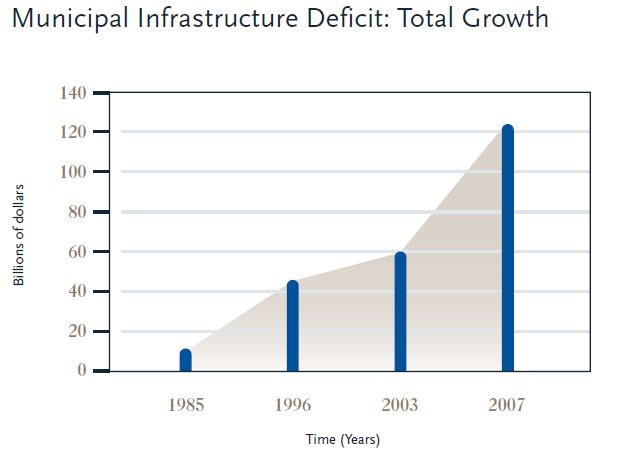 In 2007 the Federation of Canadian Municipalities (FCM) commissioned McGill University to survey Canadian municipal governments to determine their infrastructure needs. The study distinquishes between maintaining and upgrading existing infrastructure and new infrastructure require to meet the changing demographics of communities. Works undertaken to replace existing assets or restore/repair existing infrastructure capacity is considered to be an existing infrastructure need.
 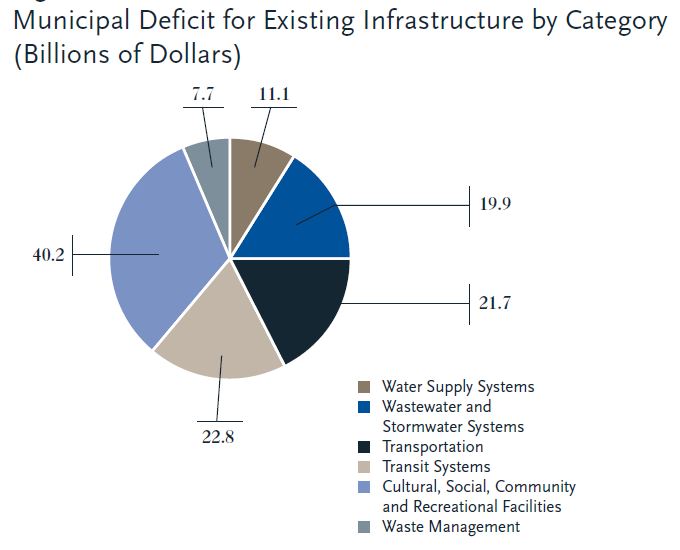 Based on the responses to the survey, FCM estimated that the municipal infrastructure deficit in Canada in 2007 was C$123 billion. The FCM broke this down by key infrastructure categories,
- water and waste water systems – $31 billion
- transportation – $21.7 billion
- transit – $22.8 billion
- waste management – $7.7 billion
- community, recreational, cultural and social infrastructure – $40.2 billion
New Infrastructure Needs
The FCM McGill University survey also attempted to estimate new infrastructure needs, defined as all infrastructure that needs to be expanded or built to meet the changing needs of a community for demographic, socio-economic, environmental and other related reasons. Capital investments required to provide an enhanced level of service or meet new regulations would also be included. The FCM estimated the cost of new infrastructure to be C$115 billion.
Wastewater in Ottawa
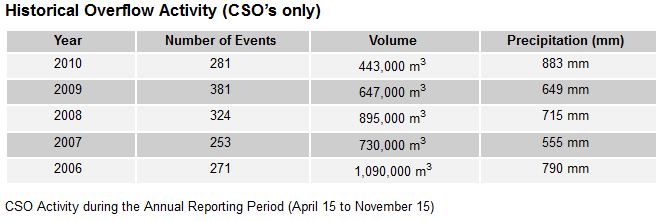 The primary wastewater problem in older cities such as Ottawa is combined sewer overflows (CSOs). Ottawa has about 120 km of combined sewers. It is reported that in 2010, 443,000 m3 of combined sewage and rainwater overflowed into river, compared to almost 1.1 million m3 in 2006. In 2011 to date, it is estimated that 215,000 m3 of combined sewage and rainwater has been released into the Ottawa River – it has been a wet spring.
Since 2006 $100 million has been invested in the wastewater system through the Ottawa River Action Plan. The next major step is the construction of underground holding tanks (three-metre-wide tunnels six kilometres in length and running from LeBreton Flats to New Edinburgh) at a cost of $140 million to contain the combined sewage and storm water until treatment capacity is available. But this project won’t start until funding is agreed to by federal, provincial and municipal governments. The latest federal budget which proposes to legislate a permanent annual investment of $2 billion in municipal infrastructure through the Gas Tax Fund should help fund this type of project.
Be the first to comment