
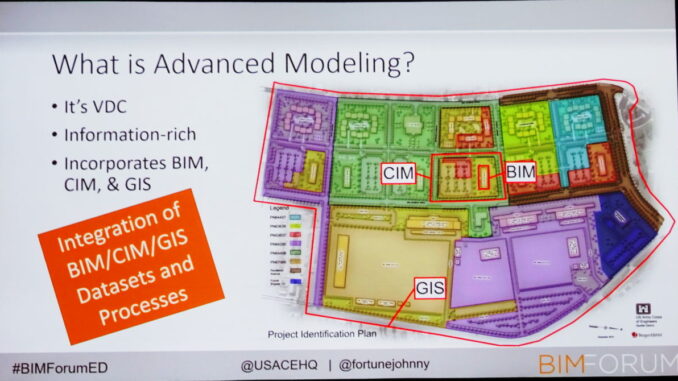
The mission of BIMForum, part of the Associated General Contractors of America (AGC), is to further the adoption of BIM in the construction industry in the U.S. At this year’s annual BIMForum conference Johnny Fortune and Steve Hutsell of the U.S. Army Corps of Engineers (USACE) gave a presentation about advanced BIM modeling and how it ensures that the requirements of advanced modeling are met not only on its design/build projects but also in managing the 500,000 sites that the USACE operates and maintains. As a result of the full-lifecycle perspective at USACE advanced modeling includes not only BIM and BIM for infrastructure (called civil information modeling or CIM at USACE), but also GIS.
Since 2006 USACE has been required to use BIM for all projects over $3 million. Its goals in developing advanced modeling include improved collaboration among stakeholders, improved design and construction processes, reduced risk, fewer errors and omissions, and higher quality design and construction quality.
But USACE not only designs and builds facilities. It is also responsible for operating and maintaining some 500,000 sites around the world. Therefore one of the key goals of the advanced modeling initiative is enabling more complete information-loaded deliverables so that data and information is not lost through the planning, design, build and operate and maintain life-cycle (See USACE Roadmap for Life-cycle BIM with supplements for Autodesk and Bentley). USACE has found that integrating GIS along with BIM into the life-cycle is a key enabler for full-lifecycle BIM.
 USACE has been been working with industry through consortia to define clear advanced modeling requirements for their projects. The have developed a toolbox of documents, templates, tools, checklist and guides to enable the advanced modeling goals of USACE which are also used by other Department of Defense (DoD) agencies. As an example, one of tools is the minimum model matrix, which defines a minimum level of development (LoD) for each element which must be modeled. This includes not only the standard LoD categories 100, 200, 300 but also whether the element must be modeled in 3D, 2.5D, or 3D.
USACE is also part of the FedBIM Working Group which includes many federal agencies outside of DoD which means that USACE’s toolkit is a model for other federal agencies.
Be the first to comment