
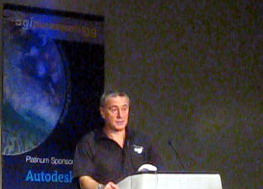
I’ve just spent the last two days at the annual AGI conference
in Stratford-upon-Avon. The last time I attended AGI was 2004 in London. The conference chair this year is Steven Feldman, who has made this conference one of the most interesting I have been to in the last year. I often miss many excellent presentations at the conferences I attend because I spend a lot of time chatting with folks about business opportunities. However, at this conference, I was fortunate enough to hear most of the keynotes as well as an overview of the National Underground Assets Group (NUAG) presented by Mark Hobell of the Ordnance Survey.
People agreed that the most memorable phrase of the conference was from Sean Phelan, the founder of Multimap, who opined that this may be the last generation who knows what it’s like to be lost.

Summer 2007 Floods
But the presentation that I found had the most impact was given by Charlie Pattinson, Head of Resources and Information Management, at the Environment Agency. In Summer 2007 the UK experienced torrential rains that overwhelmed the storm sewer systems in many localities and led to widespread flooding. The statistics indicate how serious the flooding was:  48,461 homes and 6,896 businesses affected, GBP2.5B in losses, and 13 fatalities. The most interesting personal reminiscence
of the conference was Charlie’s story about being caught in a coach 9 hours during the worst
of the flooding, and only admitting at 4am to the other travellers in the coach the organization he worked for.
He showed a memorable picture of a power sub station that was somehow kept operational during the 2007 flood even though inundated by flood waters.
The Environment Agency has assessed the susceptibility
of critical infrastructure in the UK to flooding, literally thousands of essential facilities are at risk.
The point that Charlie made that probably had the most significant impact on the audience was his estimation of flood risk for the future. the best case scenario is bad, the worst case scenario is really bad.
Importance of Visualization
One of the important points that Charlie made that really resonated for me is that the visualization of information about flood risk must be effective and targetted. To reinforce
this point he used a 3D model of a city to show a time series simulation of the progress of a flood.
Importance of Visualization in Support of Combat Operations
Another speaker, Stuart Haynes, Director of the Defence Geographic Centre, made same point about the important of visualization, but in his case in support of military operations in Afghanistan, where it assisted in a difficult combat situation in Helmand Province. Mr. Haynes showed a series of images including a 3D visualization of the combat location showing topography, buildings and other built structures, and trees.
Be the first to comment