
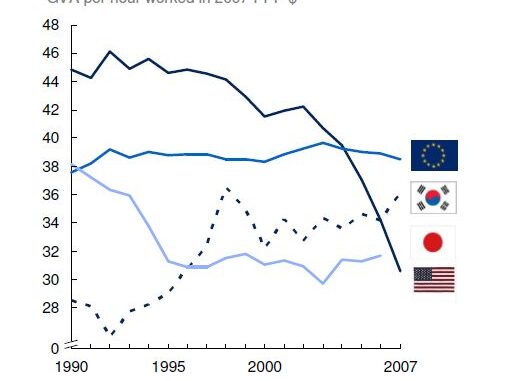
Productivity has become a major challenge in the $7 trillion construction industry. Recently McKinsey reported that construction productivity has stagnated in the EU, Japan, and Korea, and declined in the U.S.
In the utility and telecom industries productivity has become a critical issue partly as a result of the aging workforce. Organizations are losing experienced workers to retirement faster than they can replace them with younger, less experienced workers. This means that they are not only facing reduced headcount, but also less experienced workers. In 2007 a Booz Allen Hamilton study predicted a 20% decline in productivity in the US electric power industry.
The share of workers 55-and-o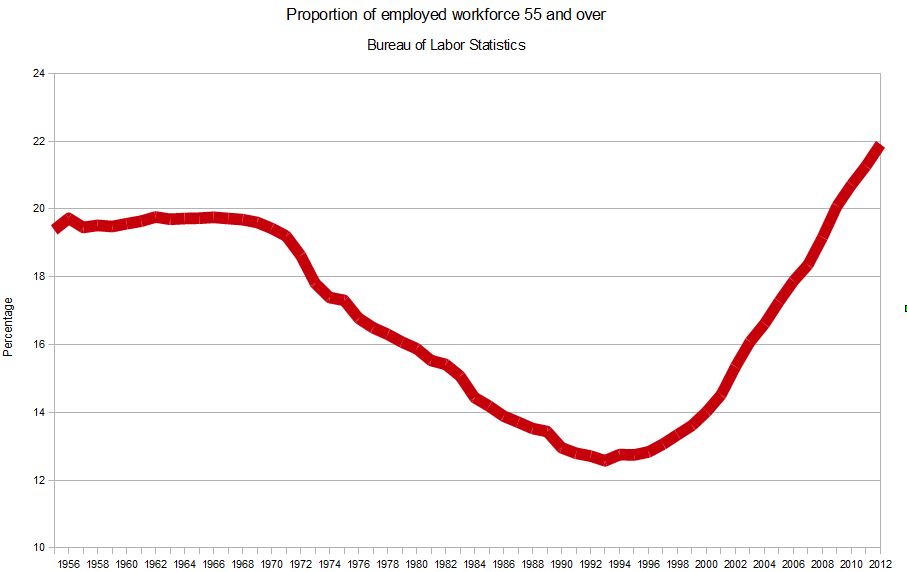 ver in the workforce has reached an all time high of over 21 % (BLS Labor Force Statistics from Current Population Survey). The labor force growth has been affected by the aging of the baby-boom generation, people born between 1946 and 1964. In 2012, the baby-boom cohort is between 48 to 66 years old. This age group has grown by over 4 times the rate of growth of the overall labor force. Over the past decade the share of the 55-and-older age
group has increased from 14.3 % in 2002 to over 21 % in 2012.
There are two important trends affecting the electric power industry. One is what is referred to as the aging workforce, which is affecting many of the world’s advanced economies. In countries like Germany and Japan, the population is aging and shrinking. In others such as the US, in the 90’s the participation rate declined as life expectancy increased. The problem is exacerbated in the utility industry, where the age of many utility workers in the world’s advanced economies is over 55. The second challenge is that as we expand and replace our existing electric and other utility networks with renewable energy and intelligent networks (smart grids), new skills, especially digital technology skills, are required.
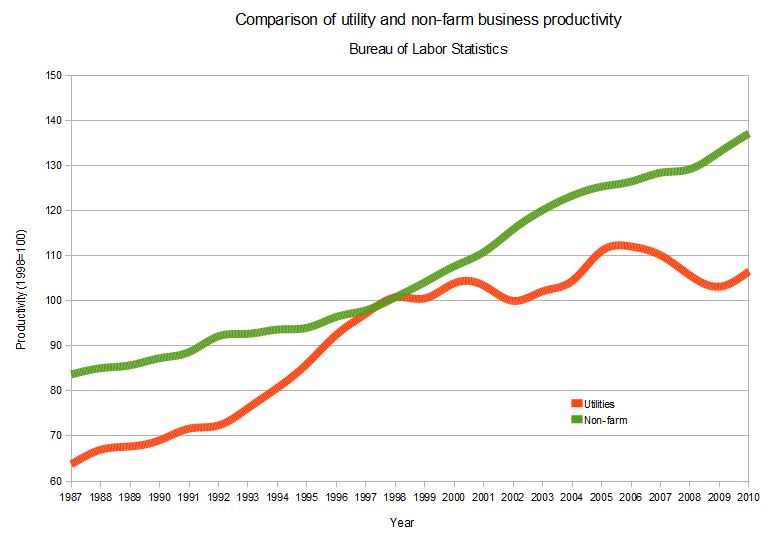 In 2009 I graphed some statistics from the US Bureau of Labor Statistics (BLS) to compare productivity in the electric power industry to non-farm industrial productivity through 2007. I’ve updated the results with the latest data from the BLS comparing productivity in the non-farm and electric power utilities sectors through 2010. The resuls, which are shown in the attached graph, show that productivity in the electric power industry increased more rapidly than non farm industrial productivity through 1998, but that since 1998 productivity in the electric power industry has ben fairly flat.
I suspect that productivity might even have declined as projected by the Booz Allen study of the electric power industry in 2007 if the participation rate of workers 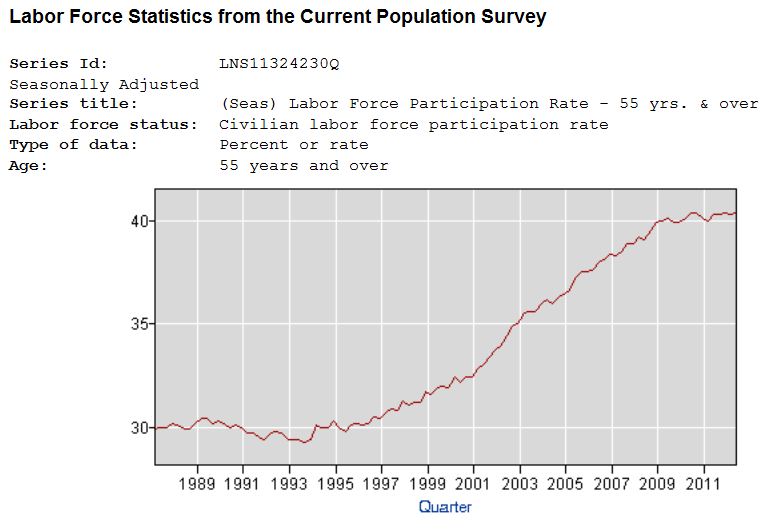 55-and-over had not increased significantly from 30% in the 90’s to 40% in 2011 for the general labor force. Even the participation rate of workers 65-and-over has increased significantly, from about 12% to over 18%, in the same time period.
The challenges that utilities are facing is how to increase productivity while capturing the knowledge and experience of experienced workers and transferring it to the next generation of engineers and designers.
In the sphere of design utilities are finding that 3D model-based design technology can help. The next generation is conversant with communications, media, and digital technologies, having been brought up with the internet and gaming technology, PSPs, XBoxes, and Wiis. Modern 3D model-based design applications, which use 3D visualization tools that were developed for the gaming industry, provide an environment that is much more familiar and stimulating for the millennial generation, who may perceive traditional 2D design and paper construction drawings as something left over from the dark ages. 
For example, a large U.S. utility, which is developing 3D models for all of its 3000 substations as part of a program to increase the productivity of their substation designers, has found that 3D model-based design faciliates knowledge transfer between experienced designers and recently hired, young designers. They have found that by forming substation modeling teams of young designers who are comfortable with 3D model-based design but have limited experience in electric power design together with an experienced electric power designer as a mentor, they can optimize the transfer of knowledge and experience in the process of developing 3D models of their substations assets. The good news is that because there is a trend for experienced workers to remain in the workforce longer, there is still time for utilities to implement programs like this one.

Be the first to comment