
At the American Public Power Association (APPA) Annual Conference in Denver one of the recurrent major issues is distributed power generation. It is the elephant that shows up in every room. The last general session of the conference was devoted to a panel discussion of this issue. It was moderated by Sue Kelly, the new CEO and President of APPA, and included Doyle Beneby from CPS Energy, Mark Bonsall from the Salt River Project, Julia Hamm from the Solar Electric Power Association, and Phillip Solomon from the City of St. George Utilties.
Solar power
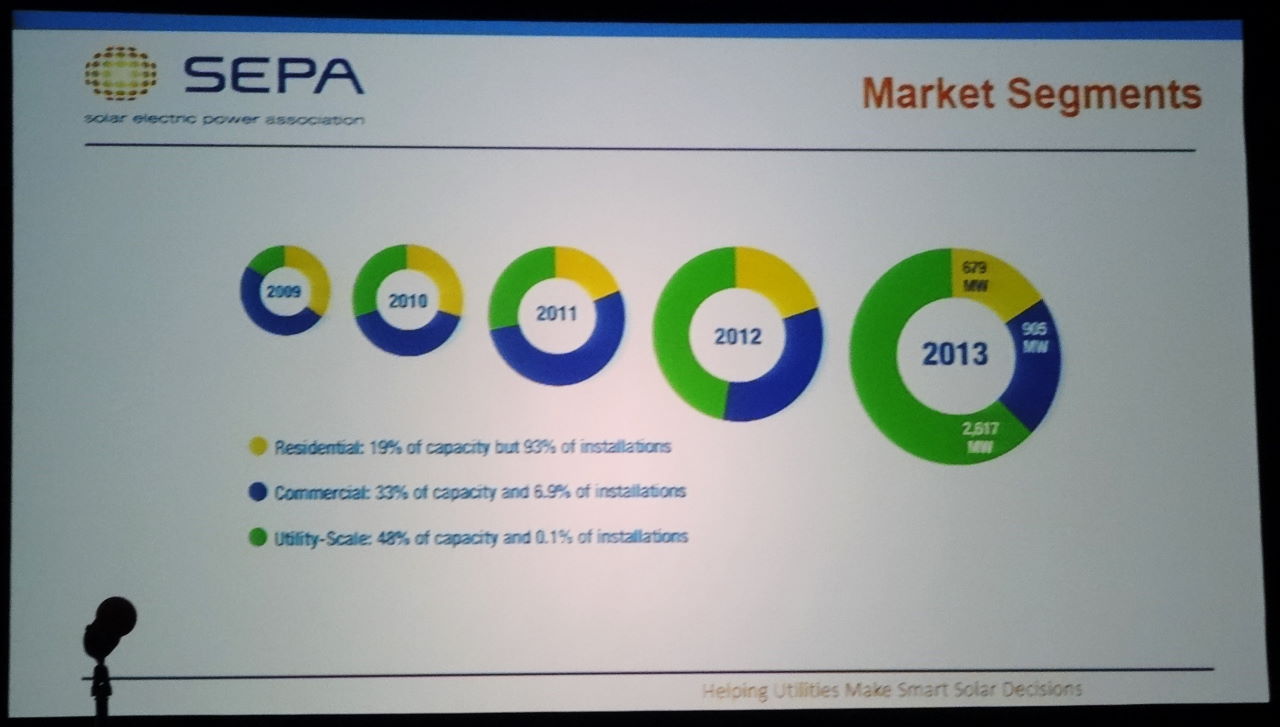 Julia set the context for the discussion. Solar power is growing rapidly. 4.2 GW of solar power was added in 2013. She is expecting 20GW of solar and a million installations in the near future. This is driven primarily by customers wanting choice and by solar PV becoming very economical. She sees significant growth in the medium scale 5-20 MW plants on the distribution side. But even with this significant growth at most utilities customers with solar installations still only represent 1% or less than the total base at utilities. An exception to this rule is Hawaii, where solar customers represent 10% of the customer base.
Low-carbon generation fleet
A number of years ago CPS Energy set a goal of a low-carbon generation fleet. For example. they intend retire coal generation by 2018, they have invested in wind, they have developed energy conservation programs such as replacing city street lights with LED, and they have 150 MW of demand response including 3000 smart thermostats. They have a program to encourage the installation of rooftop solar PV which has been very successful. Total solar PV installation has reached 17 MW and is growing rapidly.
 New utility business model
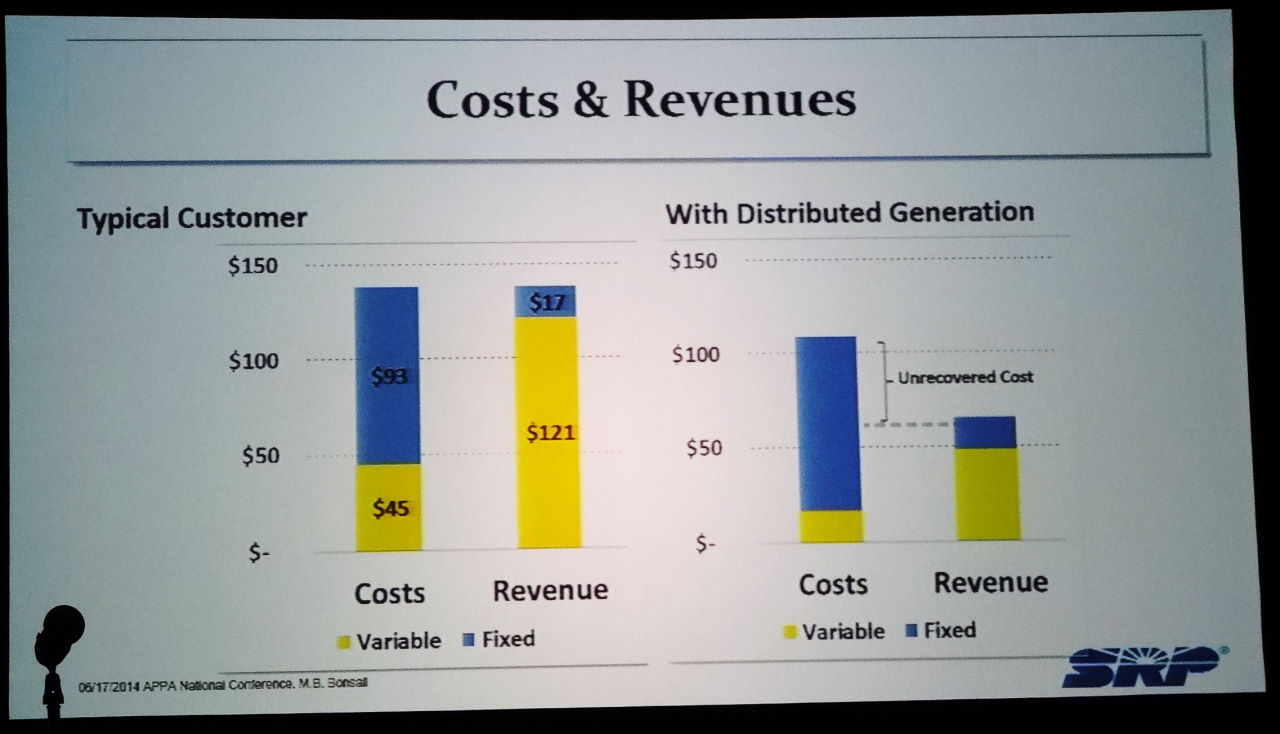
Mark Bonsall went right to the heart of the issue. The Salt River Project (SRP) has about about 9000 solar customers representing about 800 MW of rooftop solar PV capacity. In the traditional utility model, if you compare variable and fixed costs with fixed and variable revenue, there is a mismatch. This translates into a revenue shortfall or unrecovered cost when you look compare a non-solar customer’s with a solar customer’s annual bill. Mark made it very clear that the problem is not technology, it is the price structure and that it has to change.
 He showed a graph of the output from 800 of SRP’s solar customers. What is interesting is that the peak output varied from 11 am for some customers to 4 pm for others. SRP’s demand peak is around 6 pm, when everyone goes home from work and turns on their air conditioners. He suggested that SRP’s price structure should encourage solar customers whose PV output peaks closer to SRP’s demand peak. This means a price structure based on demand (kW) not just energy (kWh), which is a different business model from that used by utilities today.
Julia Hamm made a very interesting suggestion, that the utility owns the inverters, but not the PV panels. This reduces the cost of PV to customers, but also makes the utility responsible for a critical piece of equipment that fails most frequently and therefore requires an asset maintenance program, something that utilities are good at. Furthermore inverter technology is a key technology in enabling greater PV capacity on a feeder and for this reason the choice of a inverter should be a utility responsibility.
Community solar
Phillip Solomon described an approach to solar that the City Of St George Utilties has used. St. George has a sizable number of customers that want choice about their energy sources. They also have a sizable number of retirees living in residential units that do not permit rooftop installations. St George Utilities have implemented a community solar project called SunSmart that residents can participate in. A resident purchases a one kW share for $5000. In return they get a credit for for the power generated by one kW of solar panels every month on their bill. It provides customers with a solar option and enables low income earners who may not be able to afford a rooftop array to participate. Phillip related a story about a grandmother on a fixed income who wanted to contribute to cleaner air. The SunSmart program enabled her to contribute to cleaner air through solar generation.
This is similar to the community program that the Wright-Hennepin Cooperative Electric Assn in Minnesota described at an NRECA TechAdvantage conference.

Be the first to comment