
Many of the technologies for detecting underground utilities and other infrastructure involve shooting some type of signal, electromagnetic or acousic, into the ground and measuring the reflection off underground objects. A major challenge for these techniques is attenuation. Ground conditions limit the depth of penetration of the signal. For example, wet soils can such as clays can render ground penetrating radar ineffective. A remote detecting technology that is not susceptible to problems of attenuation is gravimetry, measuring small variations in the acceleration due to gravity. Gravimetry is not a new technology, but its effectiveness has been limited by the capabilities of the conventional measuring devices. Now a new generation of gravimetric devices that rely on quantum technology are being developed and applied to detecting underground utilities with promising results.
Recently Professor Nicole Metje of the University of Birmingham Civil Engineering, gave a presentation (Revealing the Unseen – Potential of Quantum Technology Gravity Sensors – A Civil Engineer’s Perspective) that elucidated the progress that has been made as the result of a collaboration between physicists and civil engineers in developing a new generation of gravity instruments based on quantum technology (QT) that promises to overcome the limitations of conventional gravimetry. Academics in civil engineering and physics at the University of Birmingham together with end-users are exploring the potential of QT gravity gradiometers and applying these novel sensors in engineering driven applications.
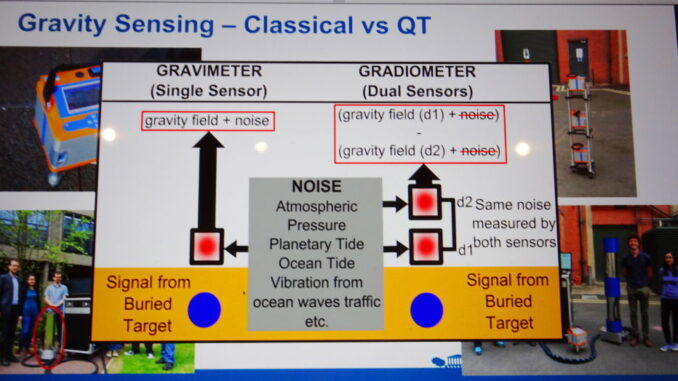
Conventional gravimetric instruments suffer from several severe limitations. They generally have low resolution which means that small objects at depth cannot be detected and resolved. They require corrections for various types of noise such as variations in atmospheric pressure, vibration from traffic, ocean tide, planetary tide, and others. In addition the process of surveying a site with conventional gravimeters is slow and expensive.
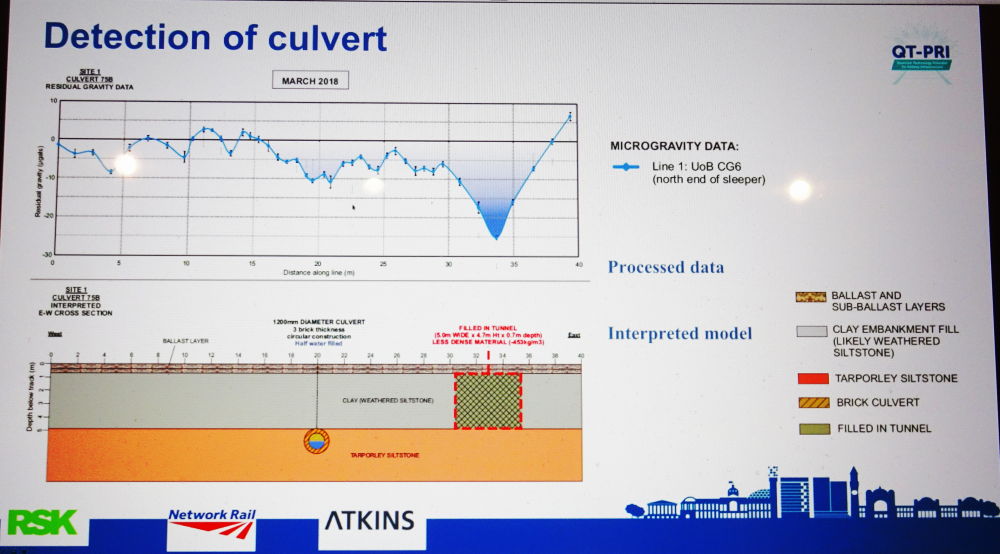 Quantum technology gravimetry relies on atomic interferometry to measure gravity gradients with significantly higher resolution than conventional devices. Furthermore the QT devices rely on dual sensors using two clouds of cold rubidium atoms which cancel out the effects of noise. Initial experiments have shown promising results. Experiments in the field in engineering applications have show that the QT devices are able to resolve smaller objects and voids at deeper depths. Furthermore conducting a survey with the QT devices are much faster than with conventional gravimetric devices. Gravimetric measurements can also be successfully used in a multi-sensor approach to augment GPR, resistivity and other detection techniques to resolve underground objects and voids (for example, badger setts).

Be the first to comment