
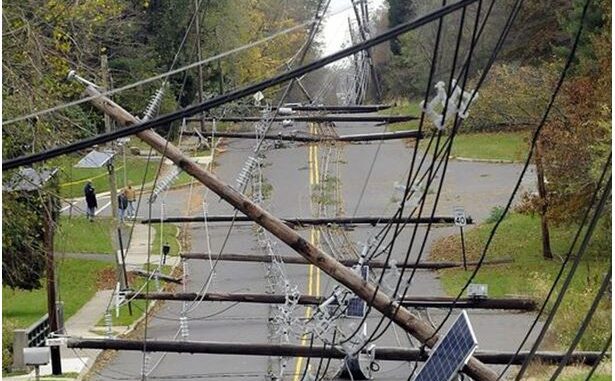
Maintaining accurate, up-to-date GIS data has been a challenge for utility and communications firms for decades. Inefficient CAD/GIS workflows result in utility GIS quality degrading with time. Now with business drivers such as implementing a smart grid, determining service availability and other applications making GIS quality a top priority at an increasing number of utilities and communications firms, new technical solutions are being applied to implement new business processes that raise the quality of utility GIS data over time. These include CAD/GIS integration; integrated engineering design, GIS and enterprise services; extensive geospatial open source libraries for viewing, editing and analyzing geospatial and other data; and reality capture often together with AI for inspections, distribution and transmission vegetation management, asset inventories and creating network data models. Another example of a technical advance that can contribute to improving GIS quality over time is a recent proof of concept by Duke Energy, Verizon and EPRI in which augmented reality (AR) was applied to improve the reliability of damage assessments after major events. While successful in making damage assessments more reliable, Duke found an unexpected result that AR also improved the locational accuracy and description of assets in the GIS.
Broken business processes degrades GIS data quality
Over the years the lack of CAD/GIS interoperability has cost communications and utility companies hundreds of millions of dollars trying to cleanup their GIS data and streamline their CAD+GIS workflows. For many utilities and communications firms traditional GIS/CAD business processes, which have been the standard approach for maintaining utility GIS for the past few decades, has simply not been able to maintain cost-effective, real-time, high quality asset location and associated data. Instead GIS data quality tends to degrade with time.
Challenge: improving the reliability of damage assessments
At Distributech 2019 Aleksandar Vukojevic of Duke Energy together with Paul Giers Duke Energy, Micah Tinklepaugh EPRI, Norm McCollough EPRI, and John Simmins (now Associate Provost for Research and Economic Development at Alfred University) reported on a proof of concept at Duke Energy the primary objective of which was to apply AR to improving the reliability and trust-worthiness of damage assessments after major disasters, but found an unexpected benefit in contributing to improving GIS data quality.
The objectives of the trial were to investigate the application of AR to reduce errors in identifying and characterizing missing and damaged equipment and as a result improve trust in the assessments by the work crews assigned to carry out the repairs required to restore power. It was envisaged that AR could improve damage assessments by visualizing before-storm images over post-storm damage thereby simplifying identifying missing or damaged assets. Currently field technicians visit the area of the outage and use paper and pencil to assess and record damage. Some of the challenges associated with this process is that field technicians, especially less younger, less experienced ones or office staff seconded to the field, may not be knowledgeable about the secondary power grid and in assessing damage to it. The result is missed and incorrect identification of missing or damages equipment. In addition paper processes are slow and error prone making ordering the required replacement equipment a major source of delay in restorating power. The result is a lack of trust in damage assessments by field crews.
Proof of concept: Applying AR to improve reliability of damage assessments
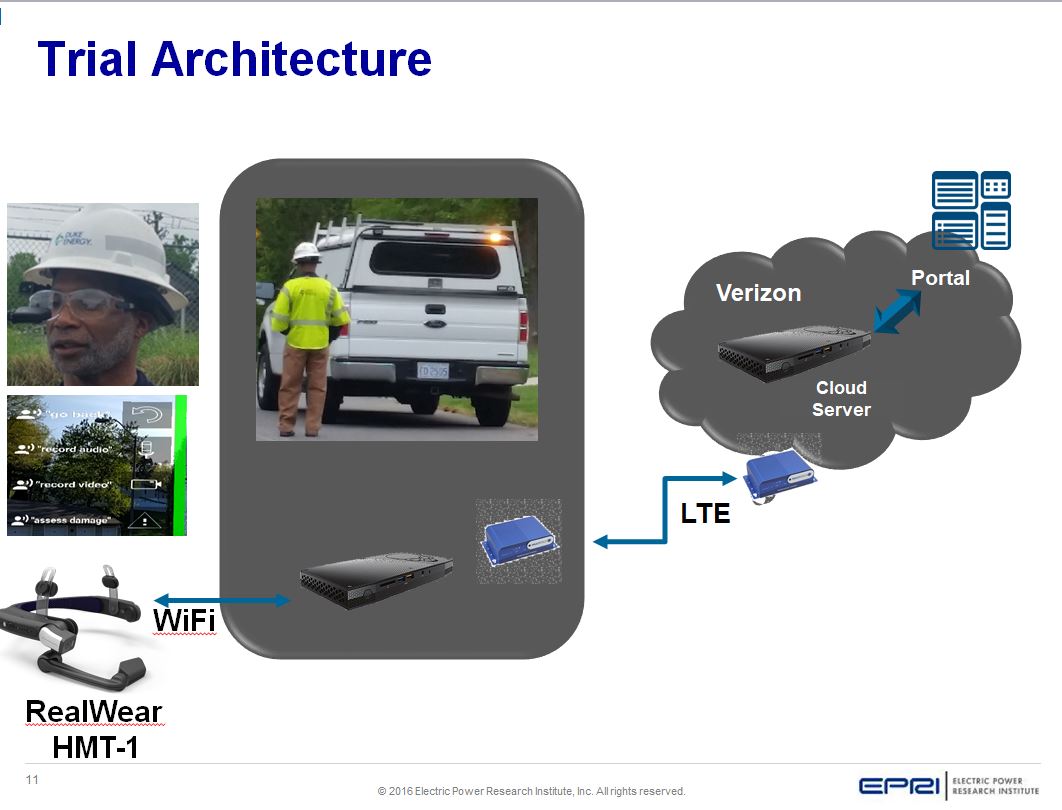 The trial involved a safety helmet mounted RealWear HMT-1 Android computer with an eye-level display and microphone. It incorporated a GPS so that location was recorded automatically. The HMT-1 was connected via WiFi to router in a truck that connected via a Verizon wide area network to a cloud server. The field engineer views the “before picture” based on the location data and is guided to align the high resolution, stabilized HMT-1 camera to match the same view to capture a corresponding “after picture”. Voice commands and voice responses to damage assessment questions presented in the application are utilized for a fully hands-free user interface. As the engineer performs the work, data is immediately sent to the back office for evaluation and action. The images and data are used to create a list of equipment and inventory required to restore missing and damaged equipment. The trial did not involve an actual outage but simulated a major outage. 17 different sites were involved in the exercise.
Results of the proof of concept
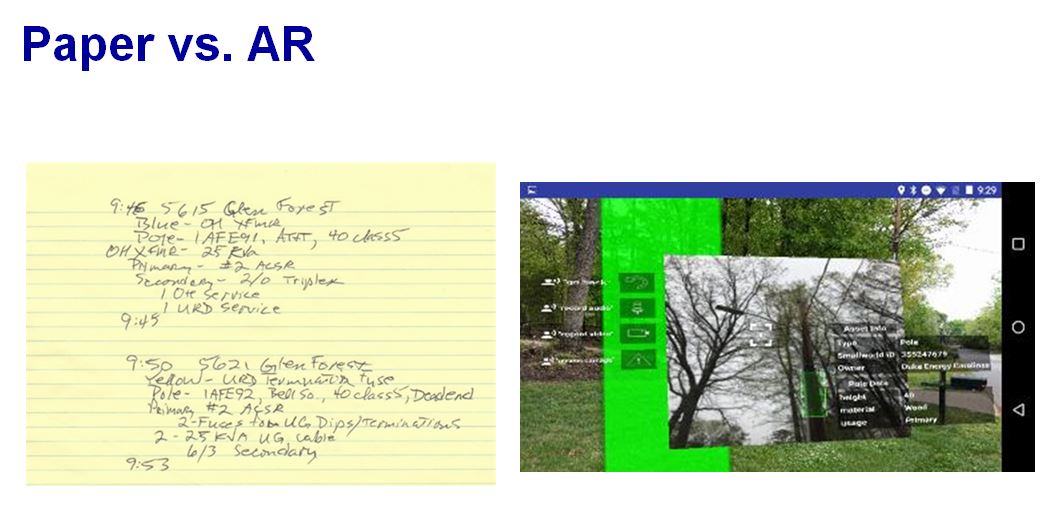 Early results indicated that nearly 100% accuracy rate was achieved in damage assessments using AR. This represents a 50 % improvement over the existing, paper-based process. This resulted in much greater trust by work crews in the damage assessments. In addition financial benefits were estimated to be significant. The first 12 hours response spent manually recording and transferring assessment reports was sped up dramatically. It was estimated that for an outage affecting 250,000 customers over a four day period, the time to assess and restore power could be reduced by 12 hours with a cost savings of over $ 8 million. One of the big advantages is that training only took 10 minutes even for a worker with no damage assessment experience. Assessments were delivered to the back office in near real-time, much faster than for paper reports and eliminating the “middle man” who transcribed paper reports into a computer based system reduced the number of errors.
Side benefit of using AR: Improved GIS data quality
While Duke assessed the proof-of-concept to be successful for damage assessment, they also reported an unexpected but important result of the proof of concept. The process using AR for identifying assets helped improve the quality of utility GIS data compared to the existing paper-based process that could actually result in degrading the quality of the GIS.
In conclusion Duke was extremely happy with the proof of concept. Achieving 100% accuracy even for inexperienced assessors impressed the Duke Energy team and created much greater trust by the work crews in the assessment reports. But AR had an important side benefit – Duke found that using AR to accurately locate and identify assets had the potential to contribute to improving the reliability of asset data stored in the GIS. This is another example of the application of technology which change business processes and result in improving the quality of GIS data over time.

Be the first to comment