
At the Second Annual Summit on Data Analytics for Utilities in Toronto, Brad Williams, Vice President of Utilities Industry Strategy at Oracle, presented recent results from a survey of of 151 North American senior-level utilities executives with smart meter programs. The report Utilities and Big Data: Accelerating the Drive to Value is the result of the second annual study conducted by Oracle Utilities in their Big Data series. They survey showed that the industry as a whole still hasn’t really taken advantage of the data that is available, but there is a small group of early adopters who are pushing the envelope.
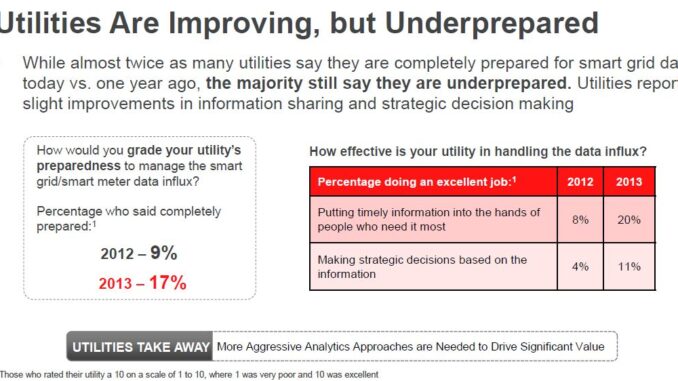
* Big data preparedness: Utilities are more prepared to manage the huge volumes of data that smart grids are capable of generating in 2013 than they were one year ago, but the majority still say they are unprepared. This year 17 % of respondents said they are completely prepared compared to 9 % in 2012.
* Mutiple data sources: In addition to smart meters 95% of utilities gather useful data from other sources such as outage management systems (68 %), SCADA (58 %), customer data and feedback (54%), alternative energy sources (12 %), social media (11 %), weather-monitoring systems (11 %), wholesale market data (11 %), and other grid equipment (11 %).
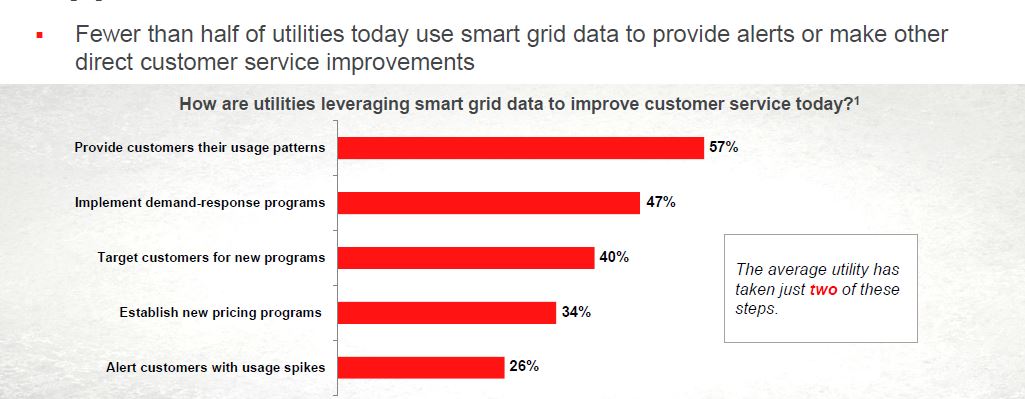 * Using smart grid data to improve customer service: How are utilities leveraging smart grid data to improve customer service today?
- Provide customers their usage patterns (57%)
- Implement demand-response programs (47%)
- Establish new pricing programs (43%)
- Target customers for new programs (40%)
- Alert customers with usage spikes (26%)
The average utility has implemented just two of these measures.
 * Strategic decision making: More respondents report using information for strategic decision making. In 2013 11 % said they were using smart meter and other data for strategic decision making. This is an increase from 4 % in 2012.
 * Skills gap: 62 % of survey respondents said they have a “big data” skills gap. This is a very serious problem. The preferred solution according to respondents is retraining existing employees.
In addition to Brad many of the other speakers at the Data Analytics Summit mentioned this problem.
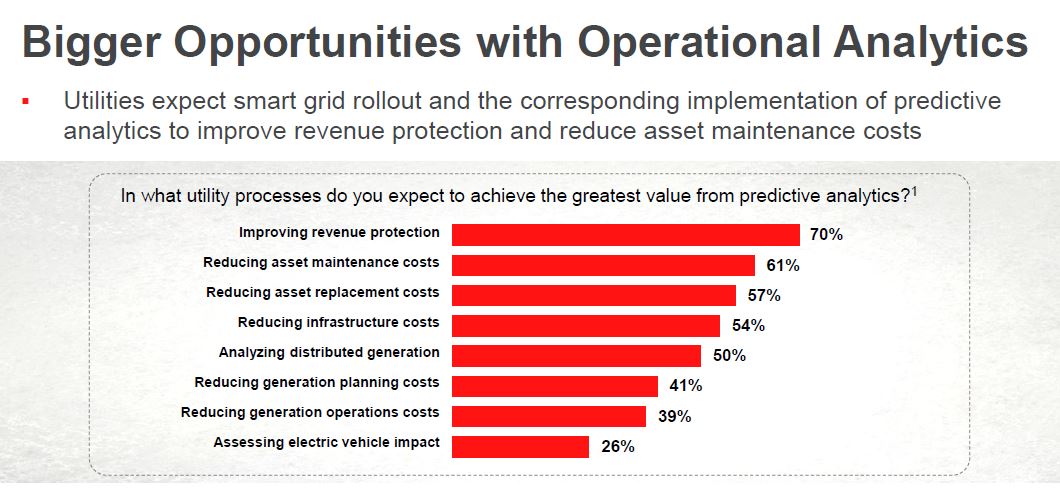
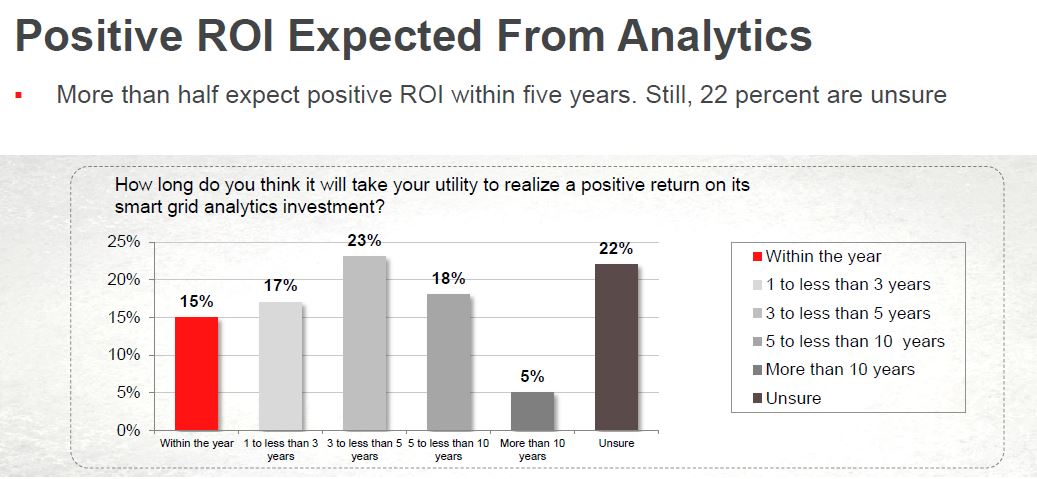
* Confidence in analytics: 70 % of utilities said they expect predictive analytics to improve revenue protection. 61 % saw analytics reducing asset maintenance costs. 55% expect an ROI on implementing analytics of less than 5 years.
* Benefits from analytics: What utility processes are expect to benefit the most from predictive analytics?
- Improving revenue protection (70%)
- Reducing asset maintenance costs (61%)
- Reducing asset replacement costs (57%)
- Reducing infrastructure costs (54%)
- Analyzing distributed generation (50%)
- Reducing generation planning costs (41%)
- Reducing generation operations costs (39%)
- Assessing electric vehicle impact (26%)
Applying analytics to smart grid data
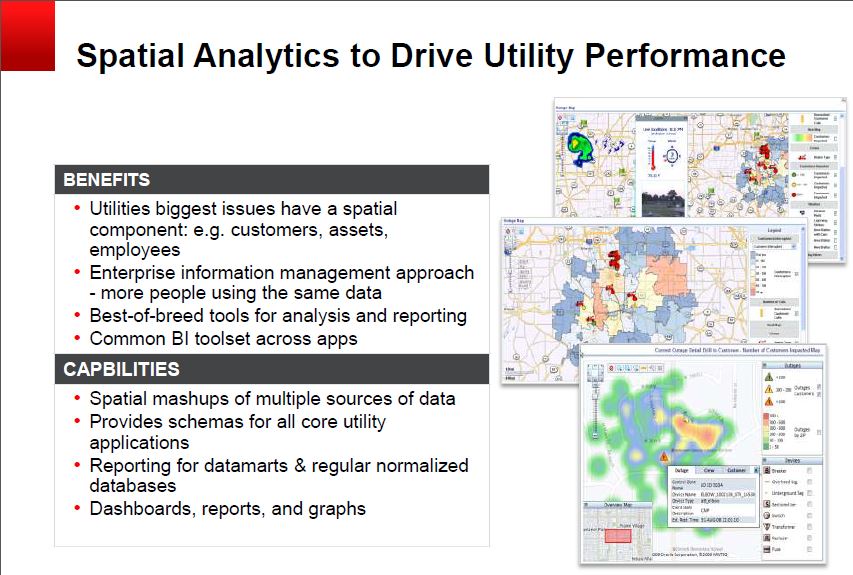 Brad outlined a number of areas which represent relatively low hanging fruit where significant benefits from applying analytics to smart grid data can be expected. Brad emphasized the importance of spatial analytics because many if not all of these of these have a geospatial dimension.
- Reducing non-technical losses – this has been one of the first areas where analytics has been applied by many utilities. The payback is typically significant and immediate.
- Targeting demand response – prioritizing customers for energy conservation and demand response programs using geospatial techniques such as energy density mapping
- Distribution operations planning – target customers with high peak load to help them reduce peaks by staggering powering on ventilation, heating/cooling and lighting
- Transformer load management – identify transformers that are overloaded or underutilized
- QA/QC data quality – improve the quality of connectivity information including phase
- Voltage correlation – use analytics to link meters to transformers including phase
- Energy modeling – analyzing usage patterns including including unmetered usage from street lights and other devices
- Voltage deviation – identifying transformers with voltage deviating from the rated voltage by 2-3% or more
- Geospatial outage frequency analysis – analyzing outage patterns geographically
- Predictive analytics for electric vehicle adoption – identifying PEV owners and predicting demand pattterns to ensure adequate transformer capacity is in place
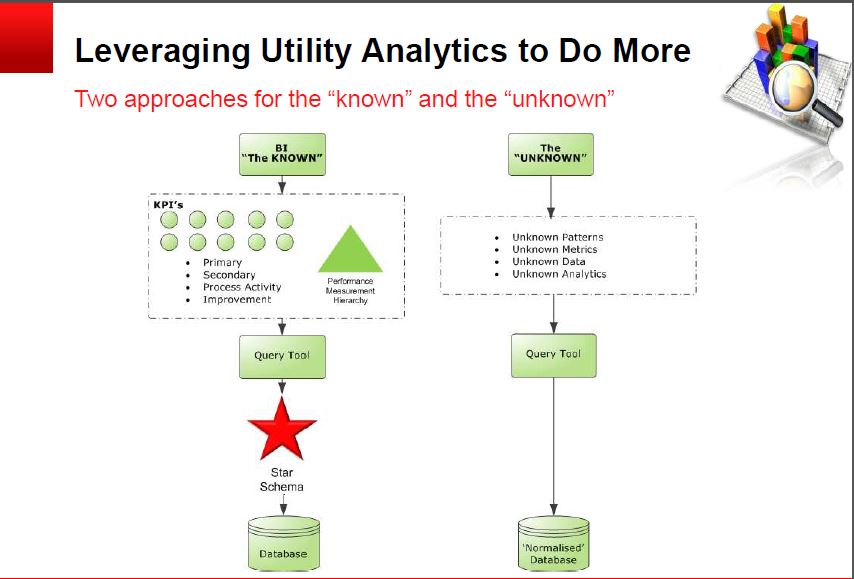 A very interesting point that Brad made is that there are really two types of analytics. Measuring and analyzing things we know – for example, the key performance indicators that are already on many dashboards – and the things we don’t know. The latter is where we can find significant opportunities for improving performance or reducing the frequency and duration of outages where we really don’t have any preconceived notion of what to expect. This is an area where different and more sophisticated analytical and visualization tools for analyzing relationships and looking for patterns can be very valuable.

Be the first to comment