
The dramatic reduction in the price of solar panels has made solar PV competitive with the central power grid in some parts of the country. For the first time in 100 years there is a competitive alternative to the local power company’s grid. Consumers are installing their own solar panels or buying energy services from companies like Solar City. But this is disruptive for the traditional utility business model, because distributed generation results in reduced demand for power from the grid and reduced revenue to the utility.
Regulators are concerned about this. At the recent SGIP meeting FERC Commissioner Norris mentioned that the National Association of Regulatory Utility Commissioners (NARUC) and FERC periodically meet for what they call a Sunday Morning Collaborative to discuss common burning issues. As a measure of the level of concern, Commissioner Norris said that the burning issue currently being discussed at these meetings is new utility business models.
Consumer empowerment
It is important to recognize that the regulators’ customer is the public not the utility. Competition tends to reduced prices to the consumer. In addition many consumers are interested in helping to reduce emissions. But most of all consumers like the idea that solar PV (and storage) puts them in control even to the point of creating their own microgrid. FERC Chairman Jon Wellinghoff in a recent GreenTech Media Energy Team podcast on distributed generation pointed out that consumers are strongly driving the solar PV industry. “I think the most exciting thing I see in the solar industry is the enthusiasm of the consumers and really wanting to embrace this technology and that is driving the growth of the industry.” He mentioned a recent solar industry trade event that attracted 600 exhibitors and 12 000 attendees. On the other hand if the organization responsible for ensuring the availability and reliability of the power infrastructure is not able to cover its costs, the consumer may experience more and longer duration grid outages.
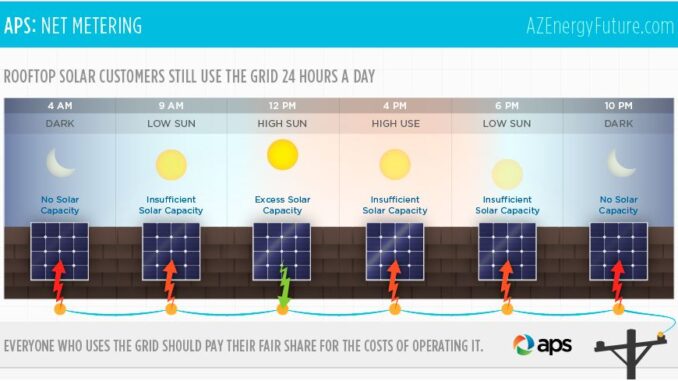
Last week the Arizona Corporation Commission (ACC), the power regulator in Arizona, took the middle road and instituted a fixed charge of $0.70 per kilowatt effective January 1, 2014 on future customers who install rooftop solar panels. It is estimated that this will collect $4.90 per month from a typical (future) rooftop solar customer. The ACC said that the current net metering program creates a cost shift, causing non-solar utility customers to pay higher rates to cover the costs of maintaining the electrical grid that all customers use.
APS, the Arizona power utility which brought the net metering issue to the ACC, in a press release highlighted that the ACC agreed that the current net metering program creates a cost shift, causing non-solar utility customers to pay higher rates to cover the costs of maintaining the electrical grid.
But according to APS the fixed charge “does not increase APS revenue, but instead will modestly reduce the impact of the cost shift on non-solar customers.” APS said that the new charge addresses only a portion of the cost shift. The charge wiill be reviewed in 2015 as part of the APS rate case review.
In a state that is second in the U.S. in grid connected solar PV capacity, that the ACC decision was a split decision (3-2) and that the decision does not cover the total cost shift and does not provide new revenue to the utility suggests that the regulator is listening very closely to the consumer and recognizing that the traditional utility business model is being challenged.

Be the first to comment