
Last week at GITA Ontario’a Spring Educational Session, one of the presentations was given by Kevin Miller, who has had over 24 years in the electric utility industry, most of that time with First Energy where he worked on design, GIS, and work management solutions for distribution and transmission. Kevin talked about geospatially-enabled asset management, what the business drivers are and guidelines for designing and implementing asset management solutions at power utilities
Business Drivers
The electrical equipment you find running down the street, either underground or aerial includes poles, transformers, conductors, and other outside electrical equipment, all of which have geographical locations. There are several important business drivers that motivate the development of geospatially-enabled asset management systems for outside equipment. A location aware asset management system allows you to frame a geospatial query, for example, find which assets are contained in a specific area, which may be defined by city limits, county or state/provincial boundaries, or a tax district, and compute financial information (dollars) about these assets. Some examples where this information is important, even critical, are
- Rate case – Utilities have to prepare and submit rate cases to the regulator (public utility commission) to justify rate increases. Showing a sustained pattern of investment in electrical infrastructure maintenance, replacement or expansion in a jurisdiction can help support a rate case.
- Taxation – Utilities are typically taxed based on the total value of their assets in a given tax district.
- Reducing costs – Utilities are increasingly looking to condition-based maintenance to reduce their maintenance costs. Knowing where assets are and their value helps prioritize inspections and maintenance.
- Smart grid – Smart grid initiatives are driving a trend toward more reliable and comprehensive information about assets to improve reliability and service levels, drive down costs, and empower the customer.
Business Challenges
There are several business challenges that make it difficult to develop, and even more critically, maintain a location-aware asset management system. First of all, business processes in utilities are complex making tracking how information flows through the organization a challenge. Secondly, business processes are often not designed to optimize data quality and, more often than not, actually inhibit data quality.
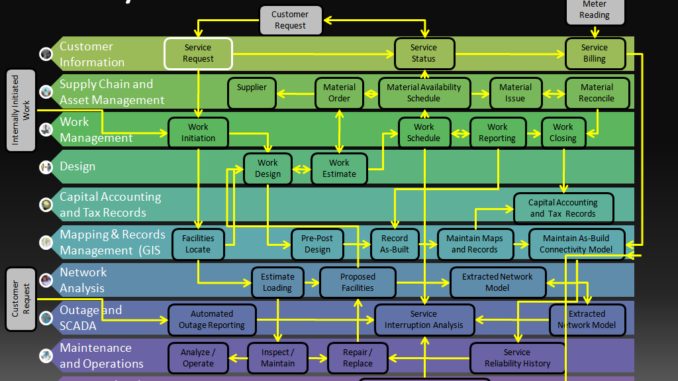
In the top diagram, each bar represents a group or division within a typical utility,
engineering, records, operations, and so on. The interesting part is
to trace how information flows through these groups, for example,
engineering designs start in the Engineering group then go to
Construction, come back to Records as as-builts. Records maintains the
as-builts which are used to prepare maps for operations and planning.
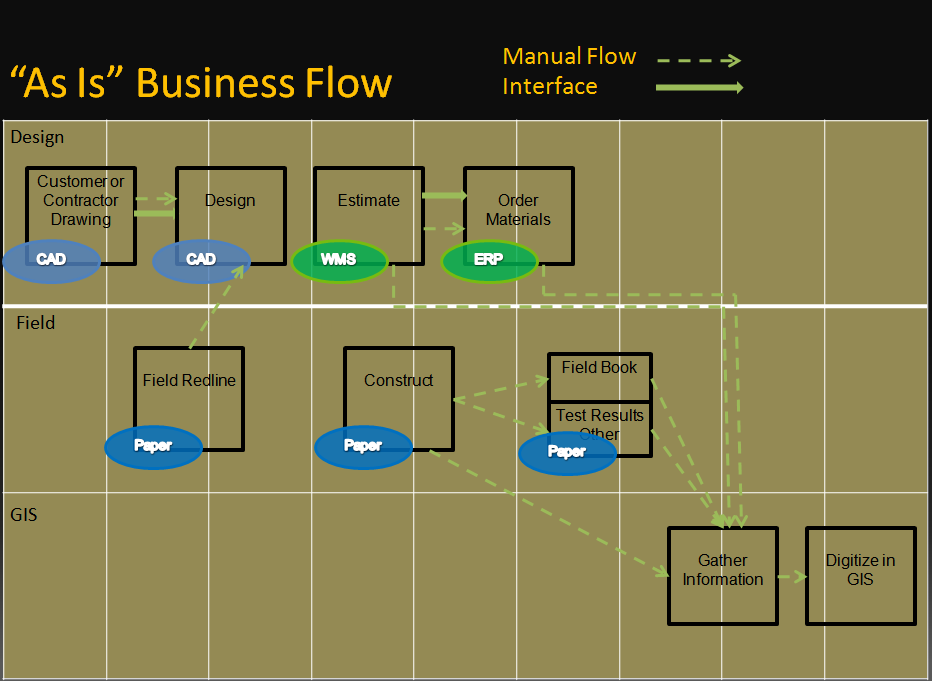 Typically, business processes are characterized by paper and many manual data hand-offs that degrade the quality and currency of data. In addition, often it is not clear who the data owner or custodian is, which can mean no accountability. The net result is that unreliable, out of date data makes it difficult to translate data into actionable information. If nine different groups are maintaining data about poles, for example, there is the potential for nine different assessments on the state of the company’s pole assets. To quote Dave Sonnen, “That is a solid illustration of the data integrity challenges that organizational structure necessarily causes. Data gets tweaked every time it crosses one of the bars.”
Guidelines for Designing an Asset Management System
The most important first step is to understand your business processes and to be able to map how information flows through your organization. Identifying the data requirements of each group and then working backwards to identify the sources of the data used by each group allows you to define a single source of truth.
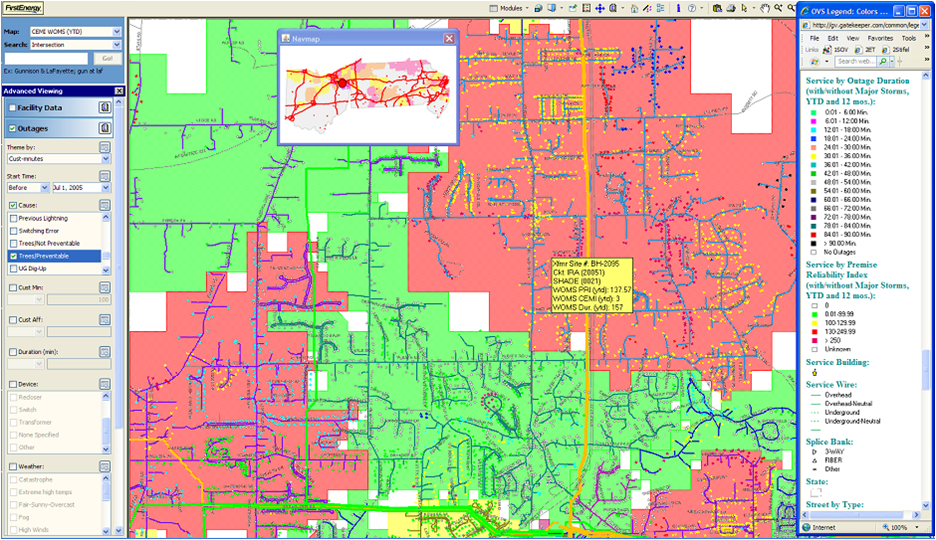 A single source of truth doesn’t necessarily mean a single, centralized database, but rather identifying or defining a data owner or custodian, which may be an operational system, for each data element. Virtual data stores based on separate, operational databases can then provide actionable information to internal and external users, such as mapping asset performance metrics identifying poorly performing assets.

Be the first to comment