
One of the challenges of disaster response for utilities is situation assessment which involves sending utility personnel to the areas affected by a storm to assess the state of utility infrastructure. Skilled staff are often in short supply at such times and office and other staff without field experience are often assigned to perform damage assessment. These staff find it difficult to perform a reliable situation assessment because of unfamiliarity with the equipment they are looking for. At Distributech 2019 in New Orleans Rodney James of Duke Energy and John Simmins of EPRI described research they have been doing to use augmented reality (AR) to help with damage assessment by using specially equipped glasses to superimpose a map of the utility’s infrastructure on the real world making it easy for an inexperienced staff member to see where equipment has been destroyed or otherwise affected by a storm.
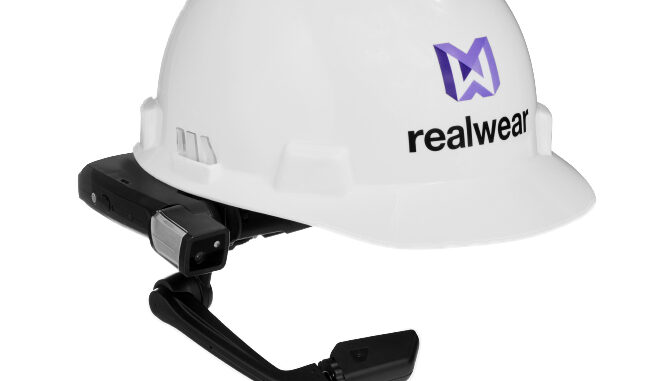
Augmented reality used to require large heavy headsets or helmets but now there are a number of manufacturers of specially equipped light-weight glasses that can be used for AR. Duke Energy uses Realwear HMT-1 glasses that can be attached to the helmet that utility field workers are required to wear and that are safety rated. The glasses are smart running the Android operating system and are able to connect via a wide area network for real-time video and audio making it possible for someone back in the office to view what the staff member in the field is seeing. However, this can be a drain on the battery, so the setup can work with just audio communications as well.
I have blogged previously about Duke Energy’s MapView mobile GIS application which enables anyone with a web browser to see a queryable map of all of the utility’s infrastructure. A worker equipped with glasses sees MapView superimposed on the real world showing the location of all utility infrastructure with appropriate labelling. This enables an untrained staff member to determine very easily, quickly and reliably which equipment has been carried away by a flood, for example. Of course this assumes that the utility’s GIS data is accurate and uptodate. I have blogged about this problem many times and about the recent research at EPRI to apply deep learning to improve the quality of utility GIS data.
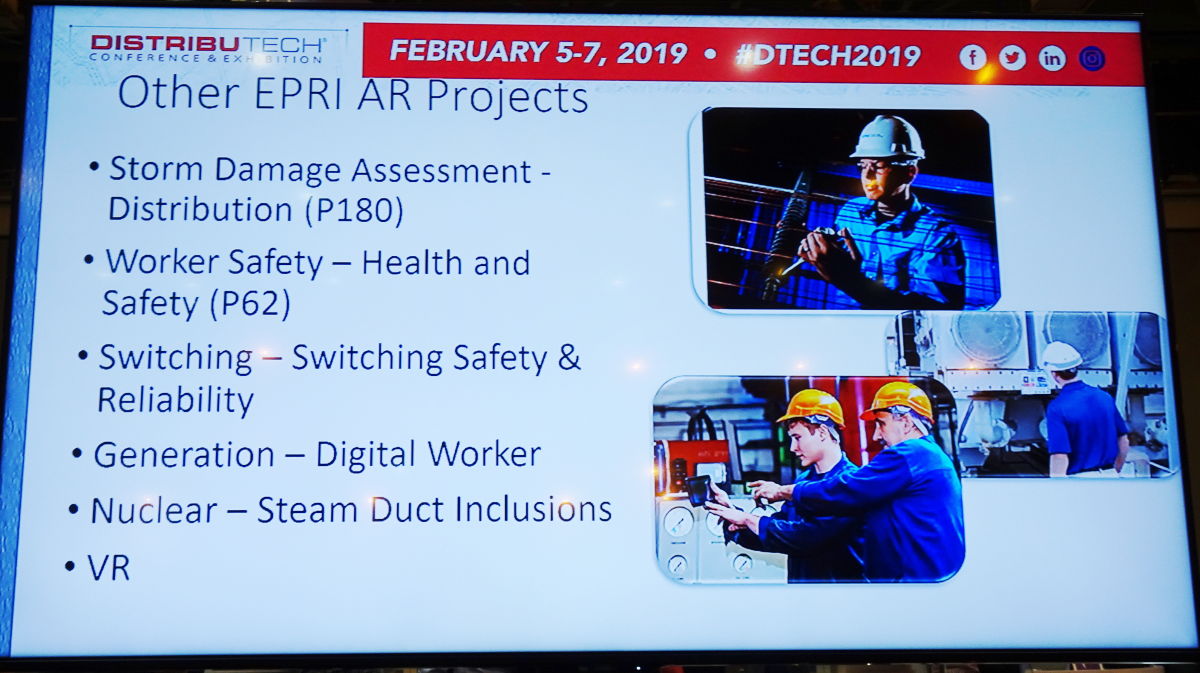 Rodney James described other AR applications of the technology as well such as supervised routine field maintenance enabling new field workers to be mentored from the office by an experienced engineer. It appears that we may soon see some practical applications of AR in the utility space deployed in the field. A question then will be will all field staff including linesmen be equipped with glasses or just some. In Duke’s experience field staff have been enthusiastic about the glasses.

Be the first to comment