
Engineering design is typically done on a desktop computer, using CAD or BIM software. Models are viewed in 3D or 2D on a monitor. Increasingly they can be viewed in mixed reality. At a SPAR3D conference three companies in the construction sector, Gensler (a collaborative design firm), McCarthy (a commercial construction firm), and Martin Brothers Construction (a heavy civil construction firm), demonstrated how they were using mixed reality on real-world projects. For example, Martin Brothers demonstrated building a bathroom pod with Hololens. The bathroom pod was designed using a standard design application such as Revit or Sketchup, then projected onto the reality of a shop floor were it was constructed using the full-scale virtual reality projection of the design into the shop. The next step is bidirectional between the mixed reality environment and the authoring design tool. This makes it possible for changes made in the mixed reality environment to be visible in Revit or Sketchup where they can be incorporated into the design. It is also possible to reverse this process where design changes made in Revit or Sketchup are simultaneously visible in the mixed reality environment.
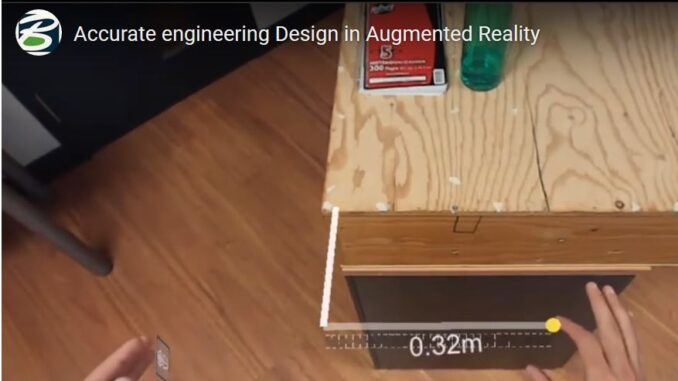
Stéphane Côté of Bentley has taken this one step further and suggested that the design and visualization process should really be a continuum involving design, markup, and visualization. To enable this to happen Stéphane’s team developed a simple set of drawing tools along with features that enhance drafting accuracy, such as angle, length and element snapping. But most innovative was the ability to snap to real world objects in augmented reality. This is illustrated in a video by designing an extension to a table. To do this the designer simply snaps to the table in augmented reality and then designs the extension seeing exactly what it looks like including accurate measurements such as lengths and angles.
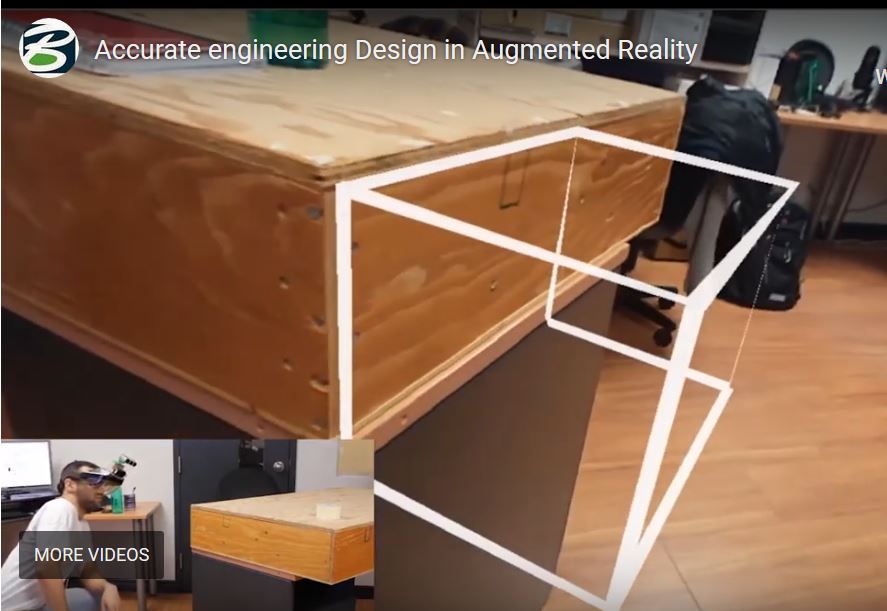 As a real world example, when an engineer needs to design a bypass system between two existing pipes, normally he/she would have to take measurements of the pipes or scan them using a laser scanner. These measurements would then be imported into a CAD application where they would be used as the basis for the design. It might even be necessary to iterate this process once or twice to ensure the accuracy of the design. With an augmented reality design tool such as that created by Stéphane’s team the design could be done on-site, avoiding the initial measurement step and being able to see immediately if the design fits accurately between the existing pipes.
Be the first to comment