

On Earth Day 2010, Autodesk has announced the new online Autodesk Sustainable Design Center. It provides a one-stop shop to find the most current and up-to-date news about Autodesk’s sustainability performance and accomplishments. The new Autodesk Sustainable Design Center will focus on the most pressing sustainability issues;
- Clean tech development
- High performance buildings
- Teaching sustainable design
- Green manufacturing
- Greening government
- Sustainable urban development and design
- Green consumer products
- Smart utilities
- Better roads and transportation
- Green vehicles
The Autodesk Sustainable Design Center will provide global facts, figures, and trends about these issues and most importantly, it will report how technology and people around the world are solving these issues. Sustainability is happening so rapidly that an online sustainability center seemed the best way to help people stay current with what is happening in this area.
As an example of things you can find on this site, Autodesk has reported on its own efforts to reduce its carbon footprint.
Autodesk’s Carbon Footprint
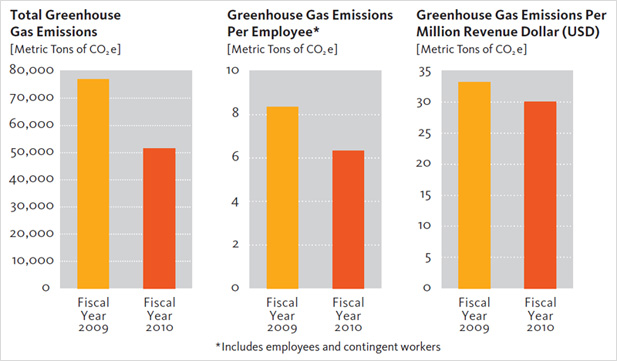 Over the past 3 years, Autodesk has made a serious effort to do business more sustainably. Two important objectives were to measure carbon footprint consistently and to become a more carbon-efficient company by reducing greenhouse gas (GHG) emissions per revenue dollar.
Last year (February 2009-January 2010), Autodesk reduced its carbon footprint over the prior year by 33% to 51,540 metric tons of carbon dioxide equivalent (CO2e). On a per employee basis, Autodesk decreased carbon emissions by 24%. On a per revenue dollar basis, GHG emissions decreased by 10% over the prior year.
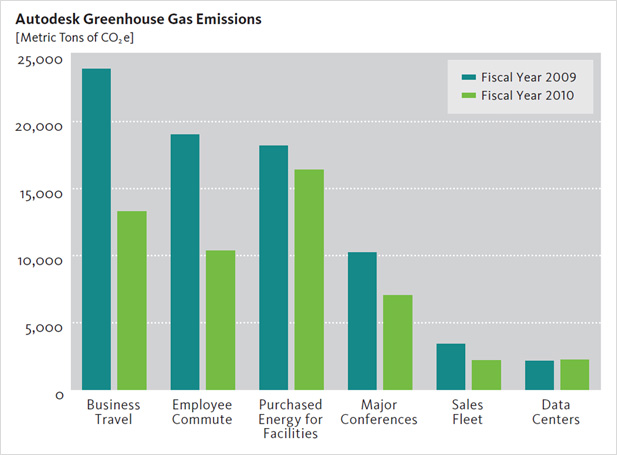 Autodesk reduced emissions from travel by 44%, primarily through using virtual meeting technology, from facilities by 10% through energy efficiency retrofits, operational changes in facilities, better space utilization at major offices, and divestiture from smaller sites, from employee commuting by 46%, and from major events by 31%. For example, for Autodesk University (AU), AU Virtual was a virtual program that enabled over 20,000 participants to be at AU without having to travel.
Autodesk’s carbon footprint process has been recognized by the Carbon Disclosure Project.
Be the first to comment