
Renewable energy sources like solar and wind power are being used more and more worldwide, while the market share of conventional power stations is decreasing. Wind and solar are intermittent sources of power and balancing these power sources and consumer demand becomes a serious challenge when intermittent reperesent more than about 20% of total demand. For example, distributed generation with many small sources of power feeding energy at medium and low voltage levels can reverse the load flows from lower to higher voltage levels. In addition the greater distances between where power is generated and consumed require increased transmission capacities.
All of these changes affect the provision of system services which balance supply and demand. For example, conventional power stations not only provide most of the balancing energy required in the system, but the inertia of their generators also guarantees the provision of instantaneous reserves for immediate frequency support. Other important system services include voltage maintenance, operation management and re-establishment of power supply.
The decision to shutdown its nuclear power plants in favour of renewable
energy (and increased use of coal) is fundamentally changing the supply
of energy in Germany. In the first six
months of 2012 according to BDEW,
Germany produced 67.9 billion kWh of renewable energy, about 25 % of Germany’s total power production. And this trend is accelerating. This represents an
increase of 19.5 % over the same period last year. (Wind energy
accounted for 9.2 %, biomass 5.7 % and solar 5.3 % of total energy
output.)
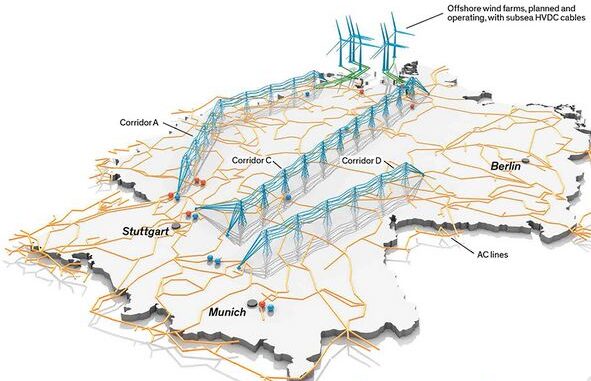
Transmission line buildout
Germany’s transmission-system operators have proposed four high voltage direct current (HVDC) transmission lines that would ship power from northern wind turbines to the south, which is more reliant on nuclear energy. In 2011. The estimated €10 billion project is already underway. The project would start with the southern half of a 1000-megawatt, 660-kilometer line called Corridor A from the North Sea port of Emden where there are offshore wind farms under construction around Borkum Island to an AC grid hub about 70 km northwest of Stuttgart. Image IEEE Spectrum
Balancing distributed intermittent generation and demand
 To address the challenge of balancing generation and demand with increasing intermittent energy sources distributed over larger areas, the Deutsche Energie-Agentur GmbH (dena) – the German Energy Agency – has commissioned a study to be led by Prof. Dr.-Ing. Christian Rehtanz, Technical University Dortmund/ef.Ruhr to determine the scope of grid system services in the context of an increasing supply of intermittent energy. In particular, the study will look into the extent to which distribution grids can contribute to grid stability for the transmission grid, and the role renewable energy systems, storage facilities and demand-side management need to play to esnure grid stability and resilience. The results of the study are expected by the end of 2013.

Be the first to comment