
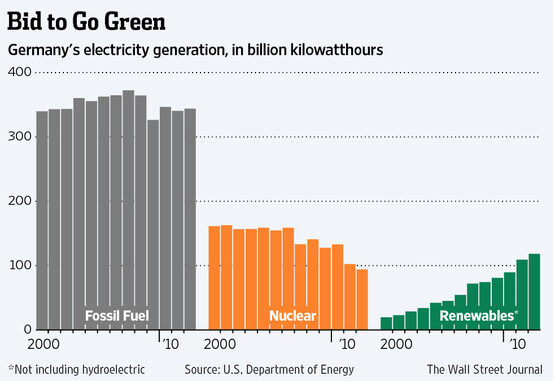
Over the past decade,distributed generation, especially solar photovoltaic (PV), consumer demand response programs, and other flexible distributed resources of electric power has grown dramatically. Until now, with a few exceptions such as Germany and Hawaii, distributed intermittent resources have represented a relatively small proportion of total power generation. However, as we face the prospect of scaling the use of flexible distributed energy resources including affordable energy storage batteries, attention is focussing in many jurisdictions not only on the economics of distributed energy, but also on the control system that will balance intermittent micro-generation resources and consumer demand and the rapid evolution of new consumer devices, aka the Internet of Things.
Renewable energy sources like solar and wind power are being used more and more worldwide, while the market share of conventional power stations is decreasing. Wind and solar are intermittent sources of power and balancing these power sources and consumer demand becomes a serious challenge when intermittent represent more than about 20% of total demand. For example, distributed generation with many small sources of power feeding energy at medium and low voltage levels can reverse the load flows from lower to higher voltage levels.
All of these changes affect the provision of system services which balance supply and demand. For example, conventional power stations not only provide most of the balancing energy required in the system, but the inertia of their generators also guarantees the provision of instantaneous reserves for immediate frequency support. Other important system services include voltage maintenance, operation management and re-establishment of power supply.
Germany’s Energiewende
The decision to shutdown its nuclear power plants in favour of renewable energy (and increased use of coal) is fundamentally changing the supply of energy in Germany. According to Fraunhofer ISE in the first half of 2014 solar and wind power plants together produced more than 45 TWh or approximately 17% of Germany’s net electricity generation. All renewable energy sources including hydro and biomass produced a total of about 81 TWh and accounted for approximately 31% of German net electricity production.
For example, the Unterfränkische Überlandzentrale eG (ÜZ) in Lülsfeld is a medium sized utility company in Northern Bavaria. It operates a typical regional distribution network in Germany – a large area with many small towns and villages and plenty of space for renewable plants. In 2013 its total electricity demand was 497 million kWh of which renewables had a share of more than 285 million kWh which is more than 50% of electricity demand.
 To address the challenge of balancing generation and demand with increasing intermittent energy sources distributed over larger areas, the Deutsche Energie-Agentur GmbH (dena) – the German Energy Agency – commissioned a study to determine the scope of grid system services in the context of an increasing supply of intermittent energy. The dena Distribution Grid Study is a detailed examination of the need for expansion and conversion in the German electricity distribution grids based on two alternative expansion scenarios for renewable energy sources. The results document a significant need for expansion by 2030. It also analyses technical options for reducing grid expansion requirements. It found that the use of innovative grid operational resources, the adaptation of technical guidelines and down-regulation of generation peaks of decentralised generation systems could reduce the need for grid expansion.
Sacramento Municipal Utility District
In Sacramento, California, some neighborhoods already generate much more power than they use and send power back onto the grid. Sacramento Municipal Utility District (SMUD) engineers had thought this would cause problems in balancing load with generation and raise the risk of damaging equipment. But so far that hasn’t happened. SMUD has a working group on solar issues that is looking at system enhancements that might be necessary to handle more local solar on the system in the future. Estimates of SMUD’s solar potential are that it could potentially produce around 1,400 MW. SMUD experiences a minimum load of 800 to 900 MW and a peak load around 3,300 MW. SMUD engineers expect that there is an “optimal” amount of solar power to have on the system that is probably less than the maximum that is technically feasible. In addition utilities have to make provision for what happens when the sun doesn’t shine during peak load periods. To provide backup power, building so-called gas-fired peaking plants are expensive because they typically are idle most of the time.
Changing the utility price structure for rooftop solar PV power
One way of addressing the balancing issue is to change the price structure that a utility uses to pay for solar power generated by its customers. The Salt River Project (SRP) has about about 9000 solar customers representing about 800 MW of rooftop solar PV capacity. Mark Bonsall has pointed out that in the traditional utility model, comparing variable and fixed costs with fixed and variable revenue shows there is a mismatch, which translates into a revenue shortfall or unrecovered cost when comparing a non-solar customer’s with a solar customer’s annual bill. From Mark Bonsall’s perspective, the problem is not technology, it is the price structure, which he feels has to change.
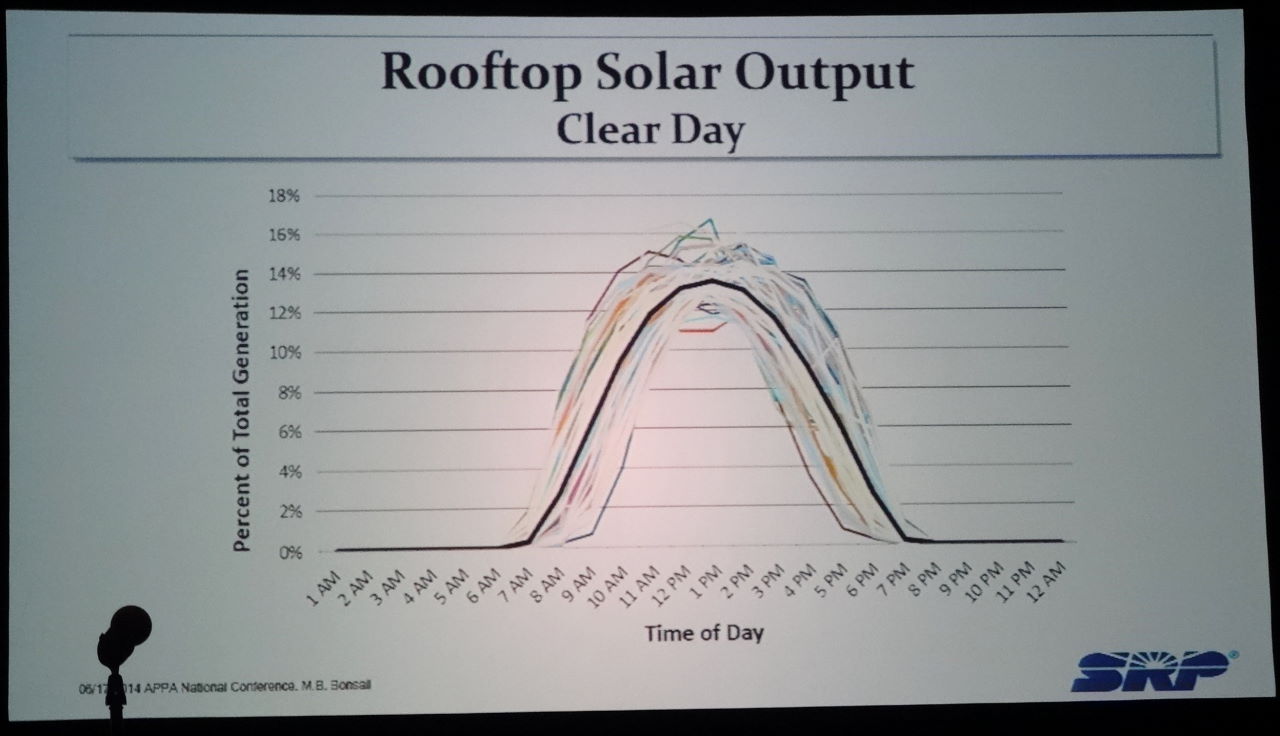 A graph of the PV power output from 800 of SRP’s solar customers shows that the peak output varied from 11 am for some customers to 4 pm for others. SRP’s demand peak is around 6 pm, when everyone goes home from work and turns on their air conditioners. Mark Bonsall suggested that SRP’s price structure should encourage solar customers whose PV output peaks closer to SRP’s demand peak. This means a price structure based on demand (kW) not just energy (kWh), which is a different business model from that used by utilities today.
Energy storage
The renewable + energy storage market is getting interesting and has been forecasted to grow to $2.8 billion in 2018. Solar City offers a small scale residential and commercial solar+battery system which uses Tesla batteries and Tesla has just announced a $5 billion battery factory to be completed by 2017.
The development of combined solar PV and batteries from Tesla and others promises to make solar + storage accessible for increasing numbers of consumers. With storage solar consumers could form their own microgrid, either by themselves or with their neighbours and disconnect from the grid. Alternatively they could become a source of dispatchable power and become an energy provider. Increasingly they could find that either of these options is economically advantageous. This has serious implications for local utilities because if this trend develops it could seriously erode the traditional utility revenue base. It could also lead to a completely decentralized grid comprised of many microgrids. From an operations perspective it increases the complexity of managing the grid compared to the centralized model in use today.
Be the first to comment