
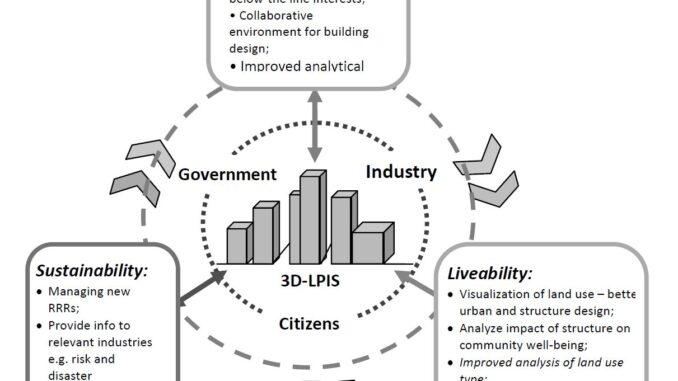
At the GSDI 13 conference in Quebec City, Serene Ho and Abbas Rajabifard from Australia delivered a paper on the benefits of a 3D land and property information system (3D-LPIS) to an increasingly urbanized society. 70% of the population of Australia lives in urban centres and this proportion is increasing.
The land administration system in Australia is widely regarded to be of high quality and integrity, but as in Canada, the lack of a single federal authority with responsibility for land administration makes it difficult to aggregate information collected at local and state levels up to the national level. This represents an inhibitor to understanding increasingly complex urban challenges from a national perspective.
In 2011 the federal government in consultation with the state governments published the National Urban Policy (NUP) that attempted to delineate the broad urban challenges Australia is facing and the implications for land and property management. The NUP defines the primary goals of government policy as
- improving productivity
- improving sustainability and resilience of built and natural environment
- improving the liveability in terms of housing, transport and community services
- improving governance through integration of processes, engagement and evaluation.
In this paper the authors argue that implementing the NUP should be a key driver for the development of a 3D‐LPIS in Australia.
Improving productivity
Efficiencies in productivity would be gained from more holistic planning, incorporating social and economic aspects as well as improving transportation modes and improving land use and development. A 3D‐LPIS provides a platform to catalogue and connect ‘above the line’ with ‘below the line’ interests of a given property, resulting in improved analytical capabilities and potentially dramatically improving current regulatory processes.
Improving sustainability
Improving the sustainability of the built and natural environments involves protection of the environment, improvements in air and water quality, sustainable management and increasing the ability of cities to adapt and respond to natural disasters. Recent Australian legislation on greenhouse gas emissions means that carbon emissions and energy information are becoming mandatory elements of modern land administration system in Australia. A 3D-LPIS would provide the appropriate infrastructure for collecting, managing and visualizing this information, because land and property information is used as the common denominator. This information could then be accessed and used by relevant industries such as risk and disaster management, for example, as a 3D model is already being used for emergency planning and management in Sydney Down Under.
 Improving liveability
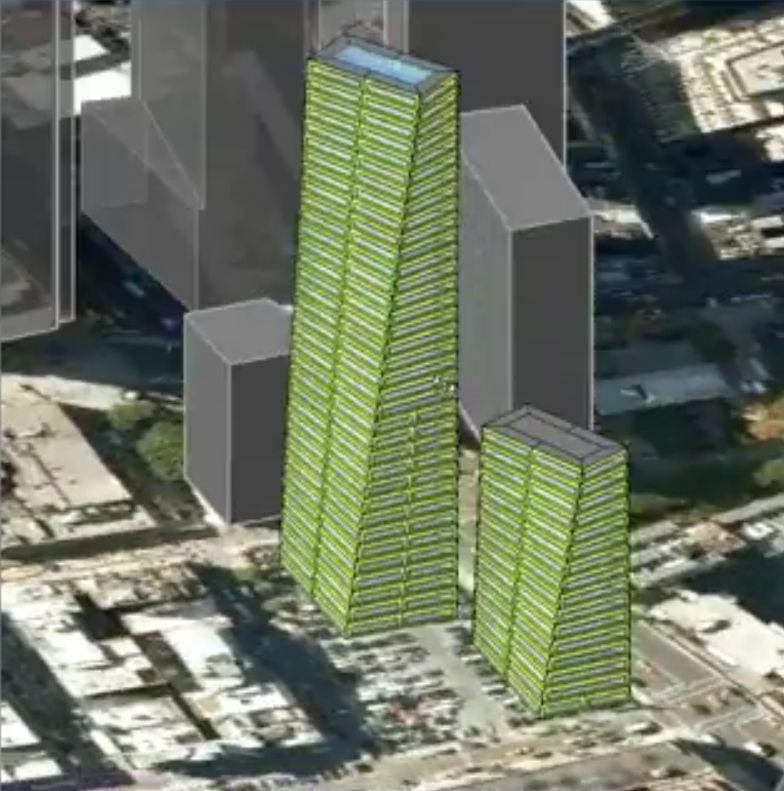
A 3D‐LPIS would help planners achieve better urban design by providing a visual representation to planners and the public of the types of land use currently in place, as well as the types of structures and how these may impact upon the well‐being of residents in adjacent properties. It would help analyze land use by spatial clustering of land use type to ensure an appropriate mixture of land use. And It would provide an intuitive spatial representation of land use policies to foster a better understanding of these policies among the public and evaluate their relevance to the communities they serve.
Improving governance
A 3D‐LPIS could facilitate open access of information and communication between stakeholders by presenting land and property data in an intuitive 3D visualization. This would support federal initiatives supporting open, transparent government in Australia. This system would not only link citizens with governments and industry with each other, it could link the various levels and branches of governments dealing with land and property matters.

Be the first to comment