
To encourage Californians to invest in renewable energy such as solar PV, California implemented a policy of net metering. Basically what this means is that customers who install solar PV panels on their roofs and sell excess power to the local power utility are reimbursed at the prevailing retail power rate.
This is set to change. Bill AB 327 requires the California Public Utility Commission(CPUC) to implement a new policy that continues to encourage customer-sited renewable distributed generation, but that strives to equitably distribute the costs of renewable generation.
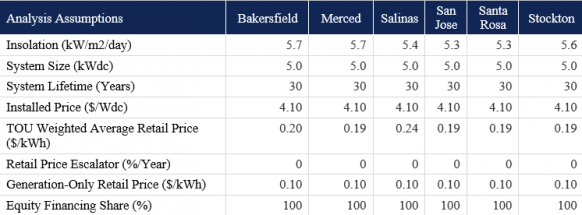
GTM Research has analyzed the impact of net energy metering on the annual electricity bill of PG&E customers with 5-kilowatt (kW) solar PV systems in Bakersfield, Merced, Salinas, San Jose, Santa Rosa and Stockton. They used real hourly energy consumption data from OpenEI and energy production data from PVWatts, as well as the actual PG&E tariff schedule for residential customers with retail time-of-use rates. They assumed that the cost of installation was $20,500 and that each installation had a lifetime of 30 years.
Their analysis found that with net energy metering using the retail power rate, installing solar PV saves the customers they analyzed $700 to $1,000 (54 % to 85 %) on their annual electricity bill compared to no net metering. It is interesting to compare this to Arizona Public Service’s recent proposal to rent customer rooftops for $30/month, or $360/year.
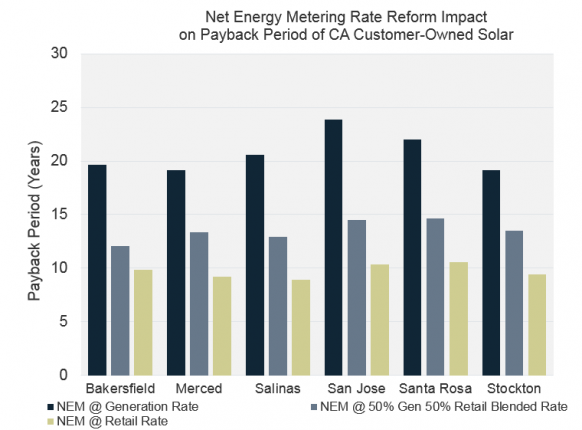 The reformed policy that will replace current net metering is not yet well-defined, so GTM Research looked at some alternatives that satisfy AB 327 guidelines. GTM concluded that net energy metering reform would have an enormous impact on the economics of residential solar. They found that reimbursing solar customers for excess electricity in the worst case, in other words the lowest rate, would increase the payback period for installing solar PV from the current ten to eleven years to nineteen to twenty-four years. While GTM believes that the worst case scenario is unlikely, the analysis demonstrates how sensitive the economics of customer-installed solar is to the price paid for excess power by the utility.

Be the first to comment