
Beginning in 2006/2007 a number of national governments including Finland, Norway, U.S., U.K., France, Singapore, Russia and others began mandating building information modeling (BIM) for public construction projects. Although the private sector in Canada has been quite active in adopting BIM, at the government and institutional level BIM penetration has been limited. The two provinces where there has been significant progress in developing BIM awareness at the government level are Québec and Alberta. A recent report based on a survey of public owners in the province of Québec aims at capturing a picture of the deployment of BIM in Québec from the perspective of public owners in order to identify gaps in BIM adoption and provide a basis for the development of a comprehensive strategy for BIM deployment in Quebec.
Background
There is a general consensus that the development of BIM in Canada lags many other developed countries around the globe. This can be ascribed partly to little encouragement from government procurement at the federal and provincial levels.
The Canadian architecture, engineering, construction and owners (AECO) industry represent about $300 billion in capital expenditure, approximately 20% of the Canadian GDP. The construction industry employs over 1.3 million people or 7.5% of total workforce distributed across more than 120 000 enterprises.
Although a number of private AEC firms in Canada have adopted BIM and are using it on major projects, government procurement with some exceptions does not require or incentivize BIM on public projects. An exception is the the Department of National Defence (DND) which began adopting BIM in a significant way a number of years ago. BIM requirements have appeared for years in RFPs from Alberta Infrastructure and Infrastructure Ontario, but there has not been a concerted effort to advance BIM as there has been in other countries.
On the provincial government procurement policy front Quebec and Alberta represent the leading edge of planned BIM advancement by top levels of provincial government in Canada. In Quebec the Société québécoise des infrastructures (SQI) developed an action plan for the progressive and gradual adoption of BIM and related technology. Since 2016, the SQI has had a rolling deployment plan for BIM that is based on the evolution of the maturity of Québec industry. The University of Alberta completed a review in 2016 of international BIM standards and released Digital Project Delivery and Handover Standards last year.
State of BIM adoption by public owners in Quebec
The Initiative Québécoise pour la Construction 4.0 (Groupe BIM du Québec) has just released a report Macro Building Information Modeling (BIM) adoption in the province of Quebec Canada based on a survey of eleven public owners at the federal, provincial and municipal levels as well as representing public institutions (eg. Universities) and provincial associations. The objectives of the study are to capture a picture of the deployment of BIM in Québec from the perspective of public owners and associations and identify gaps in BIM adoption to provide a basis for the development of a comprehensive strategy for BIM deployment in Quebec. Eleven organization responded to the survey including three at the federal level, five at the provincial level, and three at the municipal and institutional level.
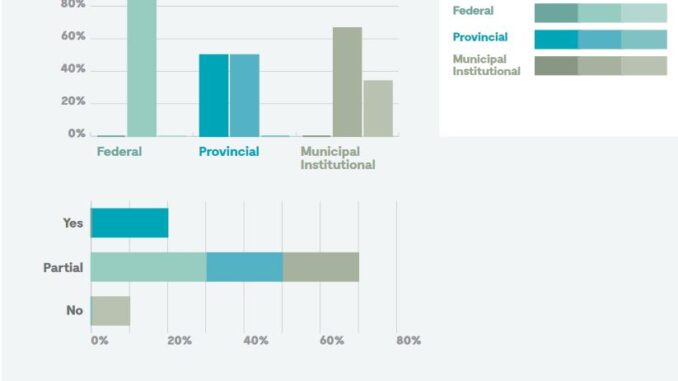
A key question asked of the respondents was about the overall understanding of the benefits of BIM by policy makers in their respective organizations. A majority of respondents at the federal and municipal levels indicated that policy makers were only partially aware of the benefits of BIM. Provincial respondents reported a higher awareness of the benefits of BIM. It was concluded that there is a need for greater awareness about the BIM value proposition as part of the digitalization of the construction industry.
The survey found that indicated there were no local, provincial, or national standards or regulatory directives that were obligatory (such as the Canadian National Building Code or Canadian National Energy Code). Furthermore the survey indicated that current insurance policies don’t reflect the realities of BIM-enabled project delivery. BIM mandates are still sparse across Quebec and at the federal level. However, there is active engagement and widespread support by most respondents in the digital transformation agenda. Interestingly, only a small majority of respondents indicated that their organization had developed pilot projects.
The findings also suggest there is little in the way of development of formal process maps to guide digital workflows and deliverables for project participants. The survey found that BIM specific education and training is still very marginal within organizations. While specific programs in BIM education can be found in colleges and universities across Quebec and Canada, there does not seem to be a concerted or coherent BIM education plan across Quebec.
Affordability of technology was not a key issue in influencing large scale BIM adoption rates. However, there are technological issues including cloud-based computing and file exchange as well as data security concerns.
Key takeaways from the survey highlight the need to focus on municipal and institutional bodies being the procurers and managers of considerable (if not a majority) of Canada’s built environment.
The key recommendation from the study was the development of a national BIM strategy including a harmonized strategy for BIM deployment across Canada with action items with clear responsibilities attributed to the various stakeholders involved in this transformation effort and milestones.

Be the first to comment