
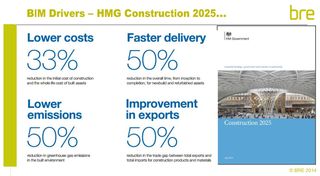
The UK Government’s goal for construction industry is to reduce the CAPEX for public construction projects. To reach its goal for the construction industry the UK Government has undertaken several initiatives, one of which is a commitment to embrace Building Information Modelling (BIM) in Government projects. The drivers for this incredible effort to transform the UK public construction industry over a 4-year time frame are to reduce costs, improve delivery times, lower emissions and create export opportunities for UK firms. The Government’s mandate for Level 2 BIM came into force in April of this year. Since then any public sector project that is funded by HM Government will need to be done through collaborative 3D BIM.
The NBS does a National BIM survey annually to determine what the increasing adoption of BIM in the construction industry means for construction product manufacturers. More than 1000 people responded to this year’s survey. It represents one of the most accurate depiction of BIM adoption and usage in the UK.
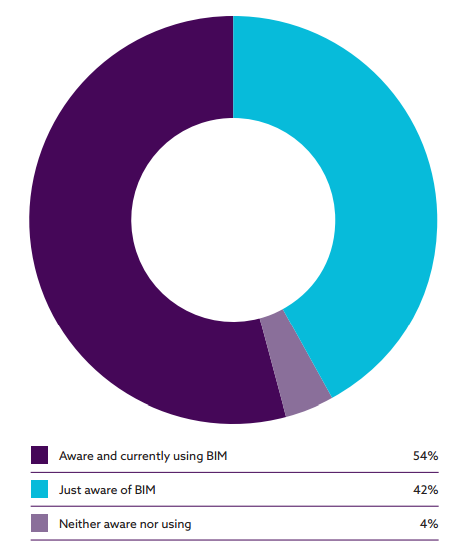 According to the survey 54 % of designers are currently using BIM. Another 42% are aware of BIM, but are not yet using it. Only 4% don’t know what BIM is. It is interesting to compare this to 2011, when only 13% of people were using BIM and 43% did not know what it was. Of designers who reponded that they are aware of BIM, 86% expect to be using BIM by next year, and 97% within five years. The Government is already reporting significant cost savings through BIM and is making further investment in it. It is concluded that BIM adoption will continue to rise in the UK.
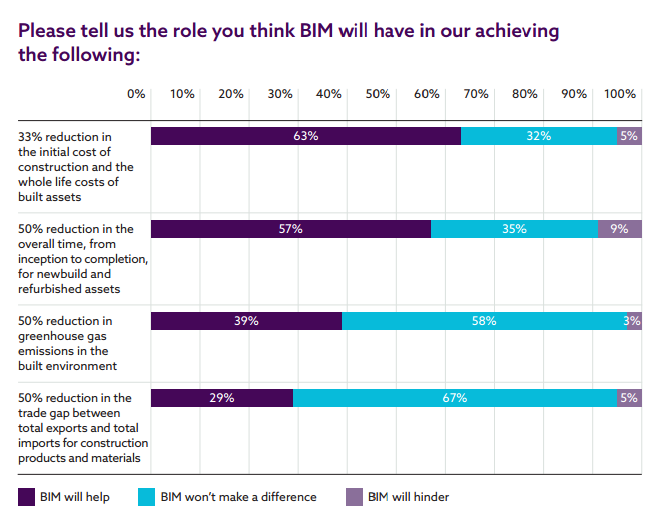 In the NBS National BIM survey, designers were asked whether they feel that BIM will help the UK construction industry reach the Government’s targets. 63% of the respondents felt that BIM will lower costs by about a third. 57% responded that BIM will bring about a 50% reduction in the overall time, from inception to completion, for new build and refurbished assets. 39% believe that BIM will reduce emissions in the built environment.
The maturity of BIM in the UK and the rise in BIM adoption globally is believed to represent an opportunity for UK manufacturers, but fewer than a third of the respondents believe that BIM will help reduce the trade gap between UK exports and imports of construction products and materials.

Be the first to comment