
Over the past five years the processes and technologies of building information modeling (BIM) have been transforming the construction industry. First architects and to a lesser extent engineers, and now increasingly contractors are adopting BIM to reduce risk and increase margins. There are signs that owners are also realizing benefits from BIM and that operations and maintenance which are responsible for about 80% of a building’s lifetime cost may be the part of the lifecycle of a building where BIM provides the largest benefits. Typical applications where BIM has been applied include automating clash detection, quantity takeoff. and change propagation; reducing data redundancy; improving collaboration among design teams; construction scheduling; automating bill of materials and job costing; and using 3D visualization to involve non-technical stakeholders in the design process.
BIM and Geospatial
Several years ago, in an award winning paper at a conference organised by Britain’s Association for Geographic Information (AGI), Ann Kemp, then head of GIS at Atkins Global, the design and engineering firm, asked the question ‘BIM isn’t geospatial — or is it?’ and then argued that integration of geospatial and BIM was essential to address the challenges of the 21st century. Kemp wasn’t the first one to speak on this. The need to integrate geospatial and BIM has been gaining traction for some time now and government mandated energy efficiency for buildings is a major driver of BIM/geospatial convergence.
BIM in the construction industry
McGraw-Hill Construction has conducted a survey of the use of BIM processes and technologies in the construction industry in 2007, 2009 and 2012. The most recent report called “The Business Value of BIM in North America: 2012” involved an online survey that was completed by 582 respondents from North America in August to September, 2012. The companies invited to participate came from McGraw-Hill Construction’s own databases as well as from industry associations including AGC, AIA, ASA, ASCE, CMAA, COAA, DBIA, NIBS, SMACNA & SMPS.
Workng Definition of BIM
In the survey the working defintion of “BIM” that was “broadly the creation and use of digital models and related collaborative processes between companies to leverage the value of the models.” The definition was intended to differentiate BIM from CAD. It also was intended to be inclusive, to include users not just model authors. Respondents were classified as BIM users or non-users. By non-users was meant “not engaging with BIM at all”. BIM users included a broad range of users including model authors and users who used models for analysis or simulation, but did not author them.
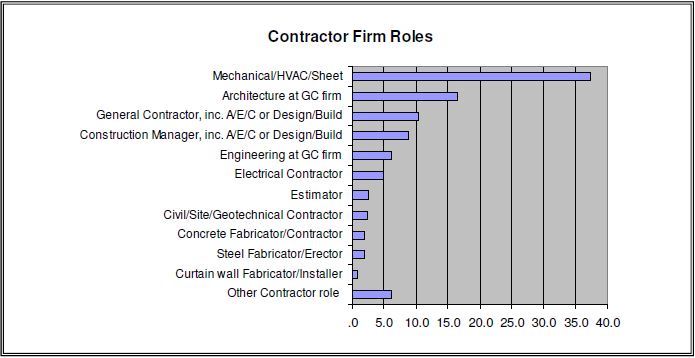 Repondents’ companies were classified into five categories, architects (building and interior), engineers (structural, mechanical, and others), contractors (general and trade), owners, and others. Of the 582 respondents, the company breakdown was
- 7 % owners
- 39% contractors – broad array of contractors
- 21% engineers – mostly structural and mechanical
- 33% architects – mostly building architects
 Key trends in BIM in the construction industry
Adoption
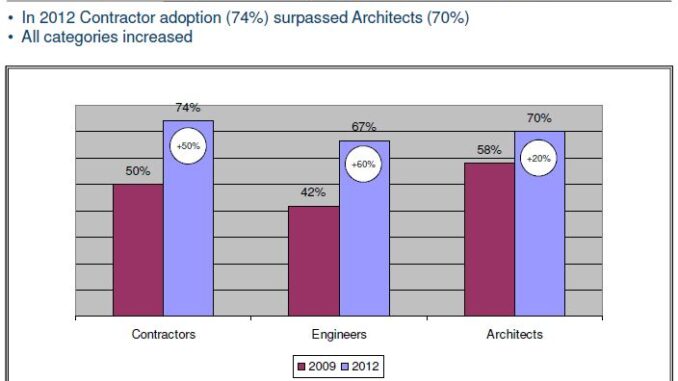
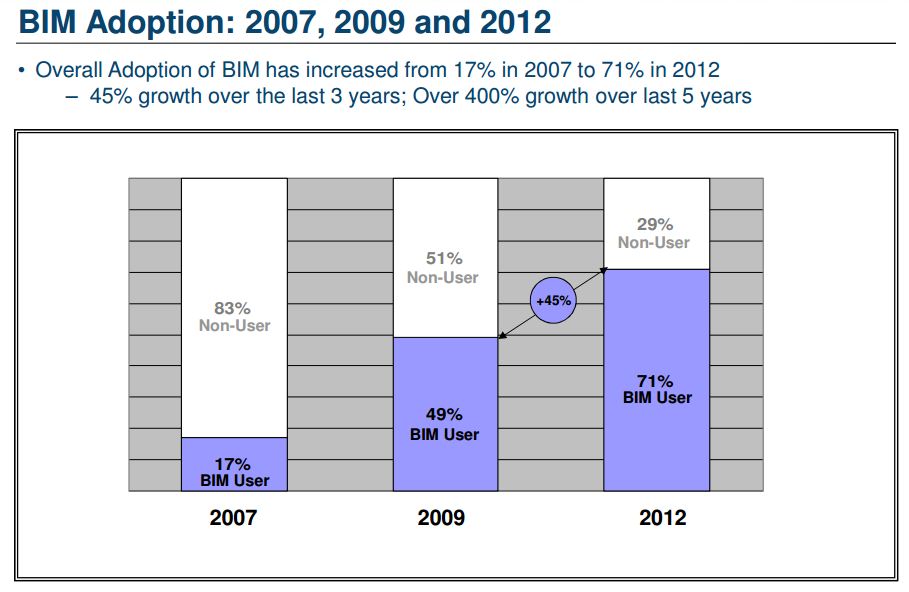
Overall Adoption of BIM has increased from 17% in 2007 to 71% in 2012, representing 45% growth over the last 3 years. In 2012 adoption by all categories of company increased, but contractors in particular saw increased adoption (74%) exceeding that of architects (70%).
 Expertise level and experience
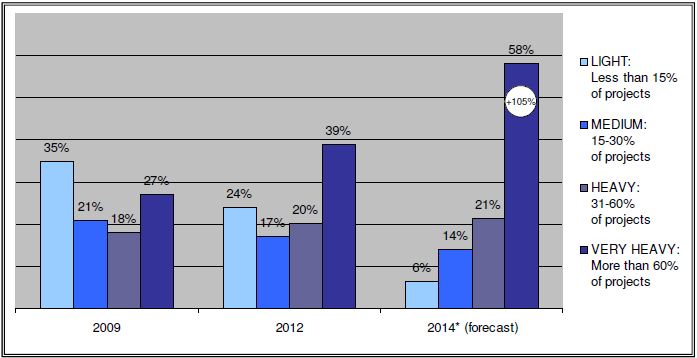
The percentage of very heavy users increased from 27% in 2009 to 39% in 2012, and is projected to increase to 58% by 2014. The percentage of very heavy users is forecasted to double over the next 5 years. The percentage of highly experienced users (5 or more years) more than doubled from 2009 to 2012.
 Perceived Return on investment (ROI)
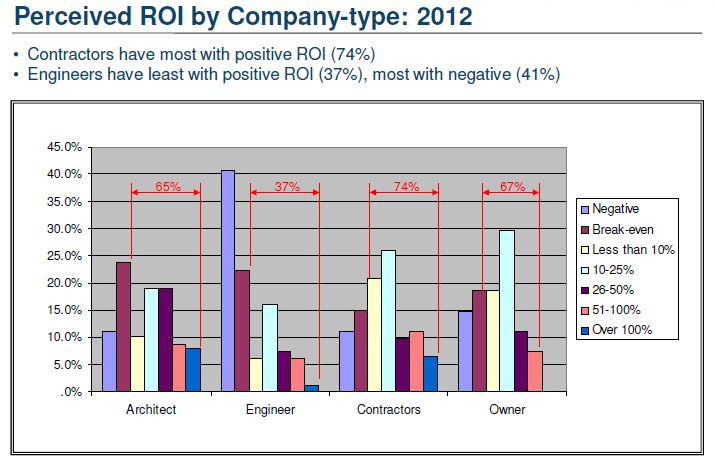
Most repondents reported a positive return on investment in BIM with owners, contractors and archtects reporting the highest proportion of positive ROI.
- Owners 67%
- Contractors 74%
- Engineers 37%
- Architects 65%
A significant proportion of contractors (7%) and architects (8%) report an ROI of over 100%.
Internal benefits of BIM
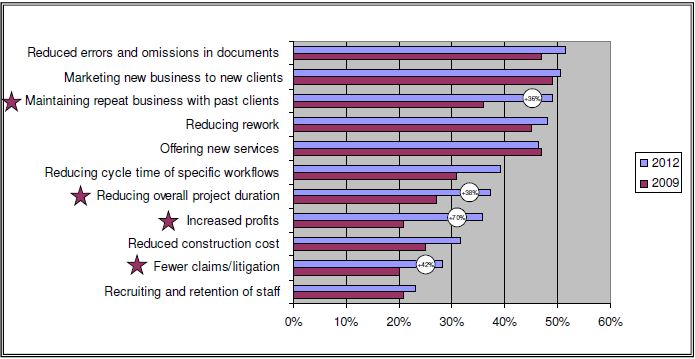 The most important internal benefits of adopting BIM reported by the respondents were
- Reduced errors and omissions in documents
- Marketing new business to new clients
- Maintaining repeat business with past clients
- Reducing rework
- Offering new services
- Reducing cycle time of specific workflows
- Reducing overall project duration
- Increased profits
- Reduced construction cost
- Fewer claims/litigation
- Recruting and retention of staff
In 2012 the largest increases over 2009 were Increased profits, maintaining clients, reducing project duration and fewer claims.
 BIM for operations and maintenance
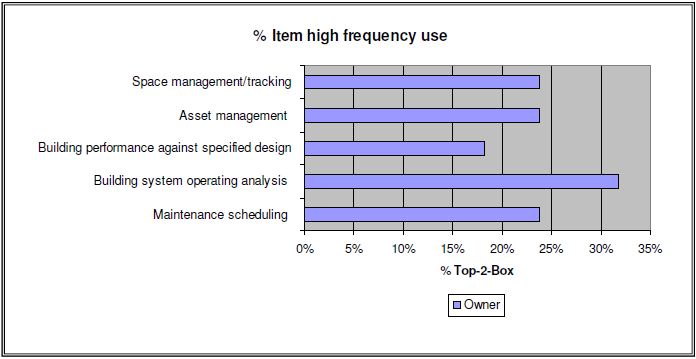
A small but significant percentage of owners are using models for building system operation analysis, maintenance scheduling, asset and space management.
Related to this, about 60% of contractors report medium to high demand from owners for as-built record models.

Be the first to comment