
The Task Force on Climate Remediation of the U.S. Bipartisan Policy Center (BPC) has released a report entitled Geoengineering: A National Strategic Plan for Research on the Potential Effectiveness, Feasibility, and Consequences of Climate Remediation Technologies recommending that the Federal Government initiate a research program into climate remediation technologies, also known as geoengineering, to understand the risks, costs, and feasibility of these technologies.
Two justifications for the recommendation are offered.
- the physical risks of climate change are real and growing
- national security, the risk of deployment of climate remediation technologies by other countries is real
The Task Force says that the Unites States must research climate remediation technologuies in order to assess the risks and benefits of different techniques, and secondly, to evaluate steps other nations may take.
A 2009 report Geoengineering the Climate by the Royal Society provides a detailed assessment options for mitigating the effects of global climate change. It divides geoengineering methods into two categories;
Carbon Dioxide Removal (CDR)
Removing CO2 from the atmosphere address the root cause of climate change, rising CO2 concentrations. These are beleived to be low risk, but work very slowly to reduce global temperatures.
Solar Radiation Management (SRM)
These methods are intended to reflect a small percentage of the sun’s light and heat away from the Earth. They do not address the root cause, rising CO2 levels, but act quickly, and so may be the only way to lower global temperatures quickly in the event of a climate crisis
The Royal Society report recommended:
- Increased efforts towards mitigating and adapting to climate change.
- Considering CDR and SRM geoengineering methods as part of a wider package of options for addressing climate change.
- CDR methods should be regarded as preferable to SRM methods.
- Funding a 10 year geoengineering research programme at a level of £10million per annum.
- That the Royal Society develop a code of practice for geoengineering research and recommendations for governance.
The UK has already initiated the Stratospheric Particle Injection for Climate Engineering (SPICE) project, which is supported by the Engineering and Physical Sciences Research Council (EPSRC), the Universities of Bristol, Cambridge, Edinburgh, and Oxford, the Met Office, and Marshall Aerospace. The project was created to investigate a solar radiation management (SRM) technology involving the injection of reflective aerosol particles into the Earth’s upper atmosphere.
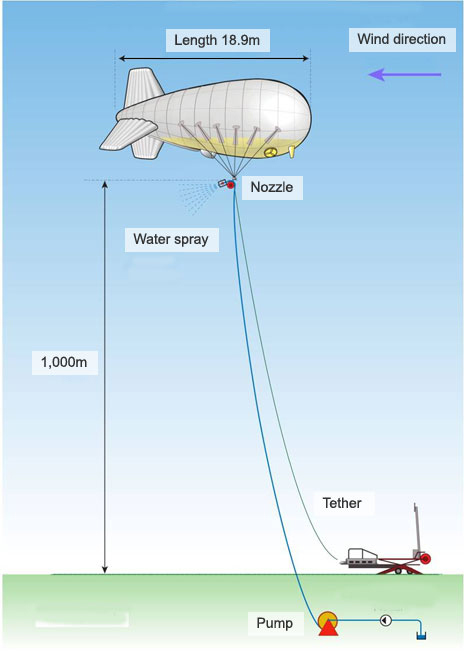 The first SPICE experiment, scheduled for this month, is led by the University of Bristol and involves hoisting one end of a one kilometer long hose using a balloon, then pumping a fluid up to it and spraying it into the atmosphere. The first test will use water, but the intended materials would be sulphate aerosols of the type injected into the atmosphere from volcanic eruptions. However, criticism has pushed the scheduled time for the experiment back by six months to allow for more public consultation.
Governance
The BPC Task Force recommends that the federal government begin a program of research on climate remediation coordinated by the White House Office of Science and Technology Policy (OSTP).
The Tsk Force recommends that OSTP should be guided by an advisory commission responsible for,
- advising the government on how to set up an effective and adequately funded scientific program commensurate with the scale of the problem
- identifying and recommending policies and practices that ensure effective scientific research is conducted in a manner consistent with the principles articulated in this report
- recommending criteria for federal agencies to use in deciding whether to approve field research based on the level of risk posed by the proposed activity
- conducting public communication and engagement activities
The Task Force also recommends international cooperation, specifically with nations that have the requisite scientific, technological, and financial qualifications to establish common norms and expectations for climate remediation research.

Be the first to comment