
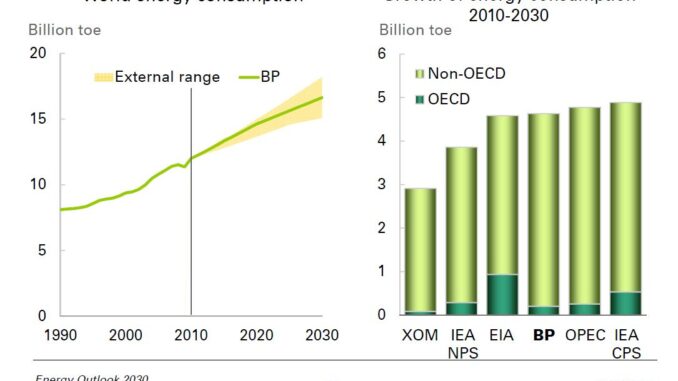
For the past two years BP has prepared an annual projection of energy trends through 2030. Their projection of energy consumptions differs somewhatt from others that are publicly available, but lie within the International Energy Agency’s (IEA) 2011 Current Policies and New Policies Scenarios.
Population, GDP, Energy intensity, Per capita energy consumption
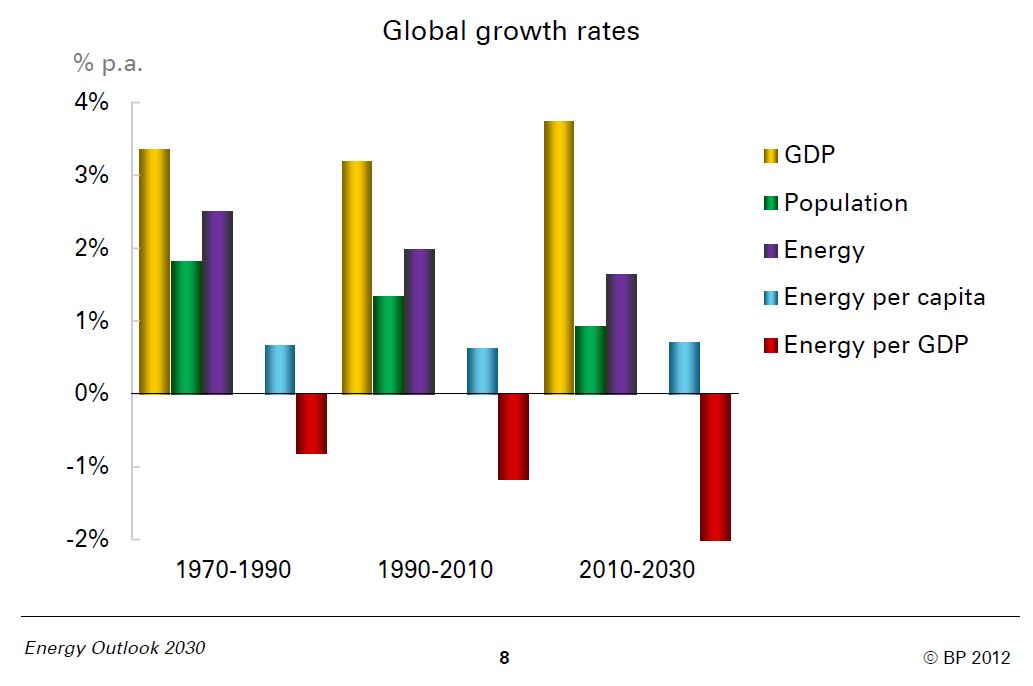 BP assumes that the rate of population growth is decreasing. In the last 20 years the world’s population increased by 1.6 billion people, but it is projected that the population increase will drop to 1.4 billion over the next 20 years. World GDP growth is expected to accelerate from 3.2% per year in the past 20 years to 3.7% 2010-2030. It is also expected that the rate of decrease in energy intensity (energy used per unit of GDP) will also accelerate to 2.0% per year compared to 1.2% per year over the past 20 years. This implies that energy consumption per capita will continue to grow at 0.7% per year, the same rate as it has since 1970.
 Electric power generation
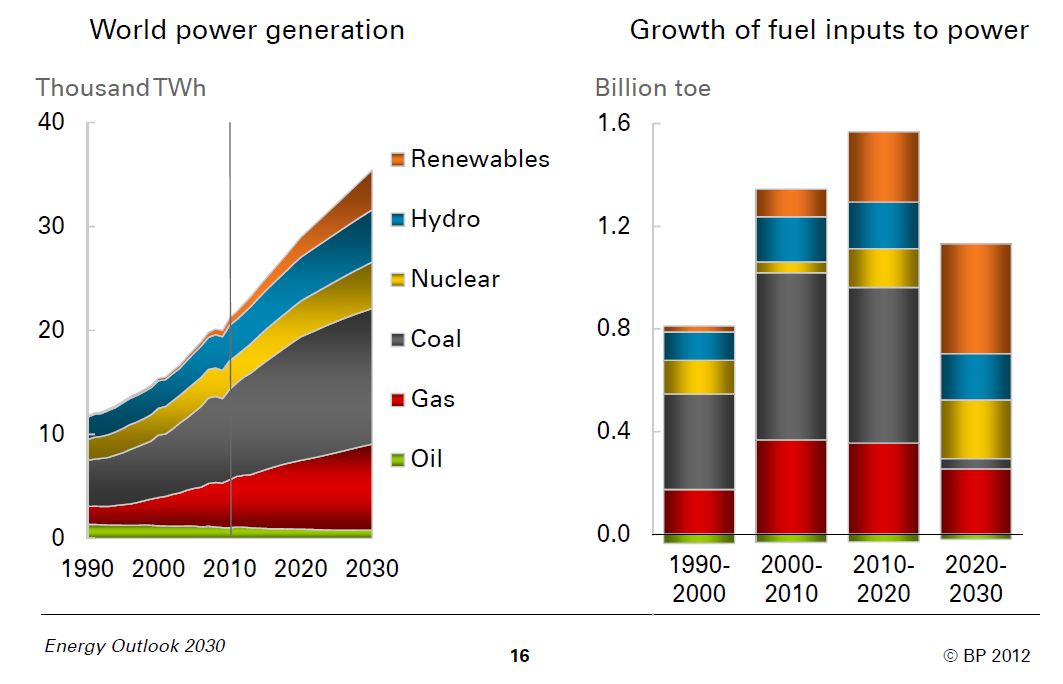
World electricity demand is projected to average 2.6% growth over the next 20 years. It is expected that improved efficiency will mean that fuel consumed will not grow as rapidly as generated power. Coal will continue to be the largest source of electric power at 39%. It is projected that together nuclear, hydro and other renewables will contribute about as much to power generation as coal. In the subsequent decade 2020-2030, 75% of the growth in electric power generation will come from nuclear, hydro and other renewables. The proportion of natural gas is projected to remain roughly constant at about 31% through the next 20 years.
 Energy intensity
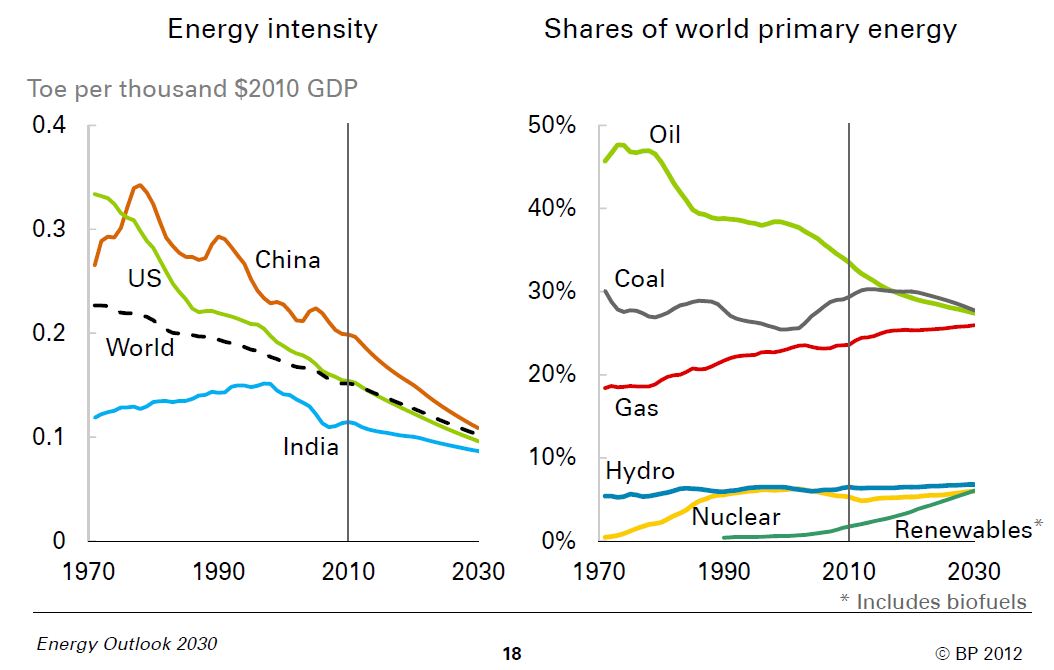
The long term worldwide trend in energy intensity is decreasing, which means we can produce more with the same amont of energy. As a proportion of the total energy market, oil continues to decline, natural gas and reneewables to increase. Coal is projected to increase until 2020, after which it is expected to decline. BP sees the rate at which renewables are penetrating the global energy markets as exhibiting remarkable similarities to the rapid adoption of nuclear power in the 1970s and 1980s.
 Emissions
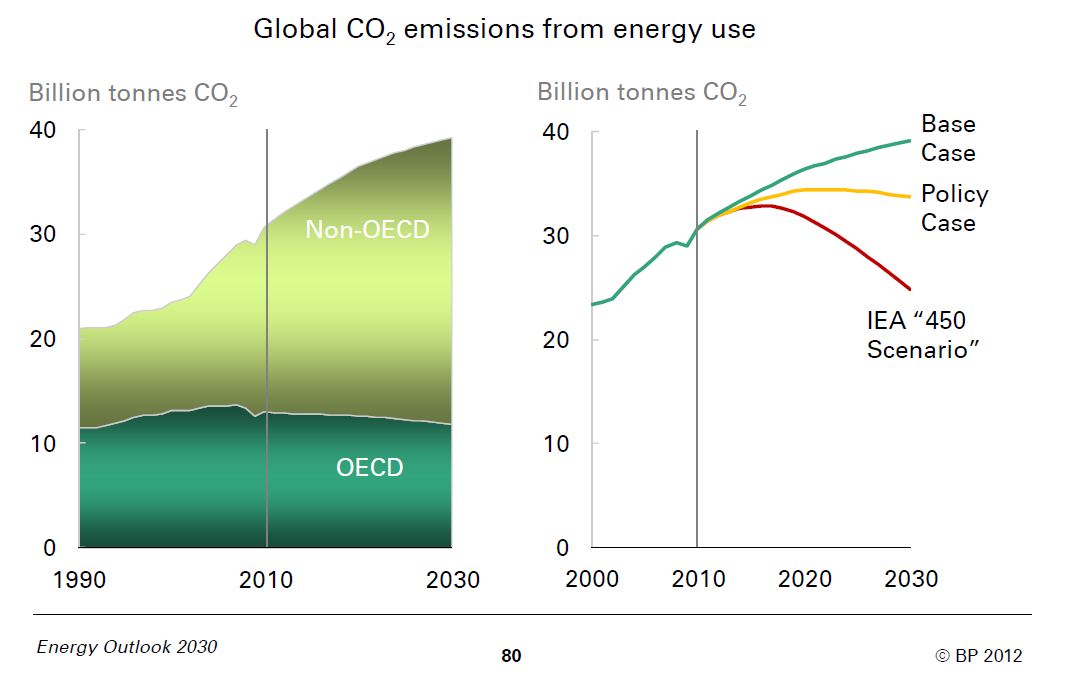
While decreasing energy intensity is good news from an environmental perspective, BP projects that CO2 emissions will continue to increase through 2030. Emissons from OECD countries are expected to decrease slowly, but by no means sufficiently quickly to make up for the rapid increase in emissions from non-OECD countries. The projected increase in global emissions is 28% by 2030 over 2010.
The IEA New Policies Scenario projects that energy-related CO2 emissions will increase more slowly, by 20% reaching 36.4 Gt in 2035. The IEA says this is consistent with a long-term global temperature increase of more than 3.5°C.

Be the first to comment