
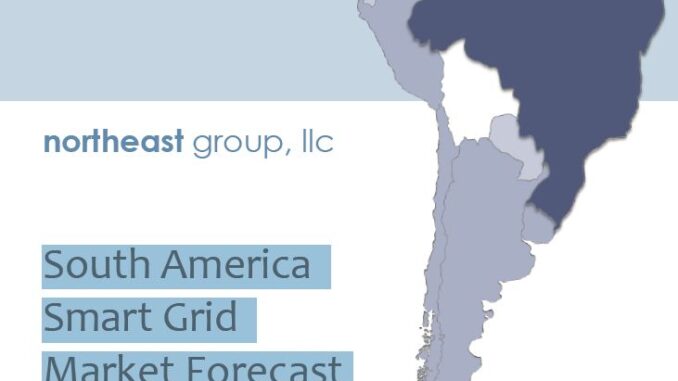
Brazil has become the economic powerhouse of South America. Over the next few years Brazil will be getting even more international attention because Brazil will be hosting the FIFA World Cup in 2014 and the summer Olympics in 2016.
One of the most important infrastructure sectors that has enabled Brazil’s very rapid economic development is electric power. Among major industrial powers, Brazil is unique in that most of its electric power generation is from clean energy sources. 72% of Brazil’s electric energy capacity (74GW) is hydroelectric generation. A by-product of the production process of the world’s most successful alternative fuel, sugar cane ethanol, contributes 3% of Brazil’s electric power generation. Over 25% of Brazil’s electric power comes from one hydroelectric plant, the Brazil Itaipu Dam, located between Brazil and Paraguay on the Paraná River. Additional very large hydroelectric power projects are underway for a total additional potential capacity of 31 GW. The largest is the 11 GW Belo Monte Dam in the state of Pará.
The national regulator is ANEEL, which is responsible for regulating generation, transmission and distribution of power. ONS is the national electric system operator and is responsible to ANEEL. Something like 98% of the Brazilian electric power system is part of a single grid, the National Interconnected System (SIN). There are 49 utilities with distribution networks, and about 64% of of the distribution network is controlled by private sector companies. About 10 % of generation is private including foreign owned capacity. For example, Duke Energy has about 1.5 GW of generation capacity in Brazil. Transmission is mostly public.
Challenges Facing the Electric Power Industry in Brazil
Last year I had the opportunity to spent some time at ANEEL to get a feel for some of the challenges facing the Brazilian power industry.
Rapidly Increasing demand
Electric power demand has been increasing in Brazil at a rate above the average world rate. Between 1980 and 2000, Brazil’s electricity demand increased on average by 5.4 % per year.
Nontechnical losses
It has been estimated that up to 30-40% of Brazil’s electric power consumption is non-revenue generating.
Manpower shortage
Similarly to North America and Western Europe, the Brazilian electric power industry is facing a manpower shortage, specifically electric power engineers. exacerbated by the rapid rate of economic expansion.
Data Quality
Data quality of asset records was identified several years ago as a major problem in Brazil.
South American Smart Grid Market Forecast
A recently released report South America Smart Grid Market Forecast (2011-2020) predicts that the smart grid market in South America will reach over $25 billion by 2020 led by Brazil and followed by Argentina and Chile and other countries. It is expected that distribution automation will be a key smart grid technology in the region. It also predicts that in the same period over 100 milllion smart meters will be deployed in South America. I have been to Brazil over the past years a number of times and the market drivers fro smart grid in Brazil are quite different from North America. Non-technical losses are a major source of lost revenue for electric power and water utilities in Brazil, and smart grid technologies especially distribution system automation will help in identifying where the losses are occuring and in finding a socially acceptable solution.
Brazil is also dependent on one dam for over 25% of its power generation and is trying to diversify its energy sources, to which distributed generation could contribute significantly.
As I have blogged previously data quality is a key prerequisite for an efficient smart grid, and Brazil’s electric power regulator ANEL began a program several years ago on improving the reliability of electric power utilities’ facilities databases including geospatial information.

Be the first to comment