
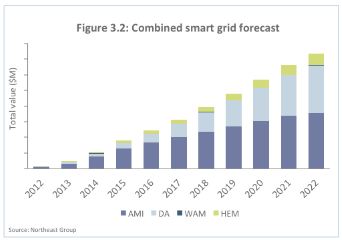
Total smart grid investments in Brazil will increase to $36.6 billion by 2022 according to a study by the Northeast Group. The business drivers for smart grid in Brazil are reducing non-technical losses, improving reliability (reducing frequency and duration of outages), and new pricing plans to ncrease flexibility for customers, all of which are expected to encourage economic growth.
In 2009 the electric power regulator ANEEL set a non
binding target of replacing all 63 million existing electromechanical
meters with smart meters by 2021. In August 2012, the
government announced an “opt in” smart meter regulation for existing
customers, paired with a mandate requiring smart meters for all new
customers. As a result, Northeast Group says that it does not expect that Brazil will not reach the 63 million smart meter
target.
ANEEL
defined a set of guidelines to achieve three major objectives for which smart meters will be necessary: One of them targets accurate geolocation as essential for the Brazilian smart grid.
- Requires utilities to
supply precise geographic information about the location of cables,
transformers and customer metering points. This will improve asset management in a number of ways, one of which is to reduce the duration of outages by being able to locate and repair or replace failed equipment faster.
This effort to improve the quality of geolocation information about electric power facilities is not new. It has been underway in Brazil for some time. I blogged about it in 2009. At that time ANEEL had
promulgated guidelines that required power utility facilities database to
achieve 95% (at least that is what I heard) accuracy by 2010. In Brazil this has been a compelling event that motivated power utilities to invest in technology to optimize business
processes for data quality in order to achieve the goal of 95% reliability of
their digital network data. This
regulation put Brazil in a position to have one of the most
reliable digital models of its network infrastructure in the world and
provide the basis for a reliable digital model which is perceived to be a prerequisite
for the Brazilian smart grid. At that time I had heard that the Brazilian water
regulator ANA had undertaken a similar initiative with respect to the quality of digital models of water utilities.
The other two guidelines target increasing distributed micro photovoltaic, wind, biomass, hydro generation and cogeneration, and implement time-of-use rates to give consumers the option
to shift energy use to off-peak periods.
The Northeast Group study looked at several segments of the smart grid market in Brazil including AMI; distribution automation; volt/VAR optimization, grid monitoring and control; wide area measurement (synchrophasors), and home energy management including home area networks, electric vehicle supply equipment and smart solar inverters.

Be the first to comment