
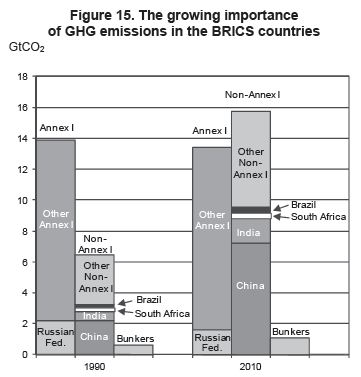
According to the International Energy Agency (IEA) in 2010, the BRICS countries Brazil, the Russian Federation, India, China and South Africa contributed about one-quarter of world GDP, compared to 16% in 1990. Also in 2010, BRICS countries represented 33% of global energy use and 37% of CO2 emissions from fuel combustion. (See Note beow for Annex ! countries.)
Brazil’s unique energy usage profile
Brazil is the third-largest emitter of total greenhouse gases (GHG) in the world, but energy-related emissions are a relatively small part (only 27%) of total emissions compared to other countries. Brazilian emissions are only 1.3% of global CO2 emissions from fuel combustion. Most of Brazilian GHG emissions comes from expanding agriculture, land-use and forestry activities, mainly in the Amazon region.
Brazil’s energy usage profile is one of the cleanest in the world with
renewables accounting for 44% of total primary energy supply (TPES).
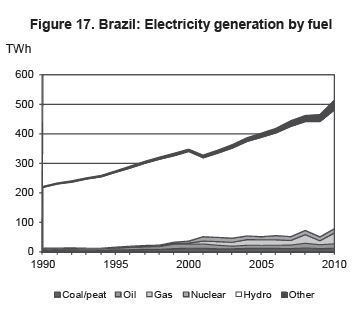 Electric power generation
78% of total electricity generation in 2010 came from hydropower. However, many of Brazil’s hydropower generating facilities are located far away from the main demand centres, resulting in high transmission and distribution losses. Recent droughts have ed to diversification of the electricity production mix including increased use of natural gas. And there are currently 22 GW of hydropower capacity already contracted and under construction (including the 11.2 GW of the Belo Monte) plus 3.9 GW of small hydro plants.
Sugar cane biofuel
Electricity produced from cogeneration plants (mainly from sugarcane
bagasse) is planned to reach 11.4% of the country’s electricity
supply by 2030.
Biofuels provide a large share of the energy consumed for road transport in Brazil. As a result Brazilian transport has a relatively low CO2 emissions intensity. CO2 emissions per unit of fuel consumed in road traffic are 20% lower than the world average (2.3 versus 2.8 tCO2 per toe). Currently, cars that can run on either 100% ethanol or a gasoline-ethanol blend represent 84% of the new cars purchased in Brazil and cost the same as cars that can only run on conventional fuel.
Note
Annex I of the 1992 UN Framework Convention on Climate Change (UNFCCC) includes Australia, Austria, Belarus, Belgium, Bulgaria, Canada, Croatia, the Czech Republic, Denmark, Estonia, Finland, France, Germany, Greece, Hungary, Iceland, Ireland, Italy, Japan, Latvia, Liechtenstein, Lithuania, Luxembourg, Malta, Monaco, the Netherlands, New Zealand, Norway, Poland, Portugal, Romania, Russian Federation, the Slovak Republic, Slovenia, Spain, Sweden, Switzerland, Turkey, Ukraine, the United Kingdom and the United States.

Be the first to comment