
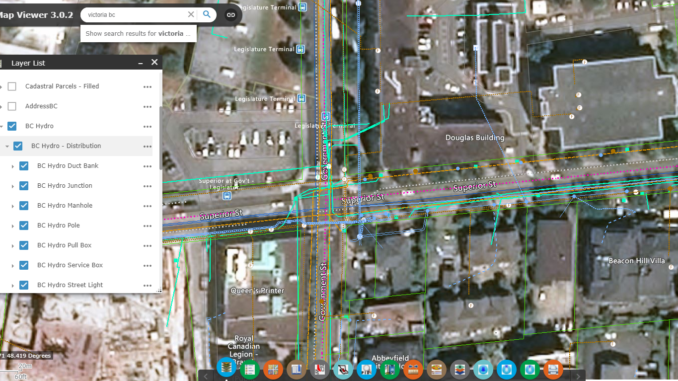
The only instance I know of in North America of a province or state wide database that includes maps of utility infrastructure is the Integrated Cadastral Information Society (ICI Society) in British Columbia. The ICI Society maintains a database of geospatial data, referred to colloquially as BC’s “Costco for geospatial data”, including utility infrastructure data (telecom, gas, electric power, water, and storm and sanitary sewers) updated weekly from the utility owners and other sources. Recently I had a chance to speak with Steve Mark, Director of Operations, about the data contained in the ICI Society’s database and how it is used.
The database includes 30 million records of which 45% are utility records, 35 % parcel data, and the remainder address and assessment data. ICI Society relies on collaborative processes among members with each member remaining a custodian of their contributed data and is similar to the Scottish Vault system in this regard. Access to ICI Society data is restricted to members and their contractors.
The ICI Society is a non-governmental and non-profit organization that is supported entirely by its members including telecommunications and utility companies (Telus, Shaw, FortisBC, BC Hydro, Enbridge, and others), local governments, First Nations, the Provincial Government, Federal Government departments, Land Title Survey Authority, and BC Assessment. The data in the ICI SOCIETY database is comprised of
-
utility infrastructure data contributed and maintained by major utility organizations operating in BC
-
sewer, storm and water data contributed and maintained by local government and First Nations
-
cadastral and parcel maps
-
a Province wide Civic Address feature class known as AddressBC, provided by local governments and First Nations
-
assessment data
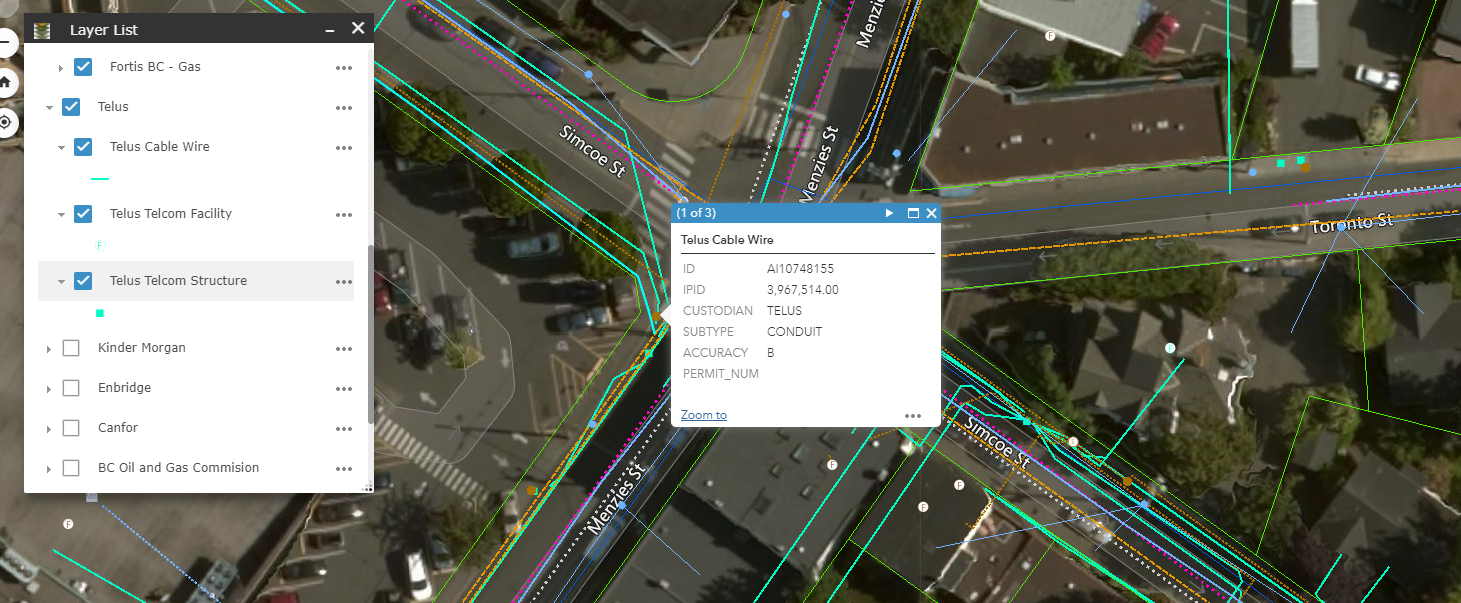 ICI Society data is used primarily for the following use cases; efficient communication between telecoms, utilities,and local government, safe operations and emergency response, optimized infrastructure planning and operational service delivery, and shared spatial reference data for engineering and survey work. There are legal agreements covering sharing of the data contained in the ICI Society database. Data is refreshed weekly as part of a shared process called Geoshare that even involves scripts being installed on members records system to extract data efficiently. There is a feedback process that allows corrections from the data consumers. Members are assiduous in making any corrections reported by their fellow Society members. All utility data can be viewed in a single map view using the Society’s Web Map Viewer. A harmonized data model, common symbology and layout were determined by working in collaboration with all the data providers. All of the data contained in the database is searchable and available for download as vector files.
A use case that is not directly supported by ICI Society is preventing damage to underground infrastructure during construction. However, utility and telecom operators routinely consult the ICI Society data when planning, designing, constructing and maintaining underground infrastructure. But the ICI Society utility maps are not a substitute for BC One Call.
The ICI Society is a unique and remarkable non-governmental example of how in a collaborative environment infrastructure and other data can be shared voluntarily among utilities, government, survey companies and others.

Be the first to comment